Problem-solving therapy linked to reduced brain activity and improved depression symptoms in patients with obesity
Early changes in neural circuit function engaged by negative emotion and modified by behavioural intervention are associated with depression and problem-solving outcomes: A report from the ENGAGE randomized controlled trial
Randomized controlled trialBenefit found
Does behavioral intervention change negative affect circuits and improve depression and problem-solving?
Who
108
Depressed patients with co-occurring obesity
Compared
Integrated collaborative care intervention
Usual care
Main outcome
Depression symptom severity and problem-solving ability
Bottom line: Problem-solving therapy reduced amygdala activation, mediating improvements in depression severity in patients with comorbid obesity.
Funded by: National Institutes of Health/National Heart Lung and Blood Institute
eBioMedicine · 2021-05-17Download image
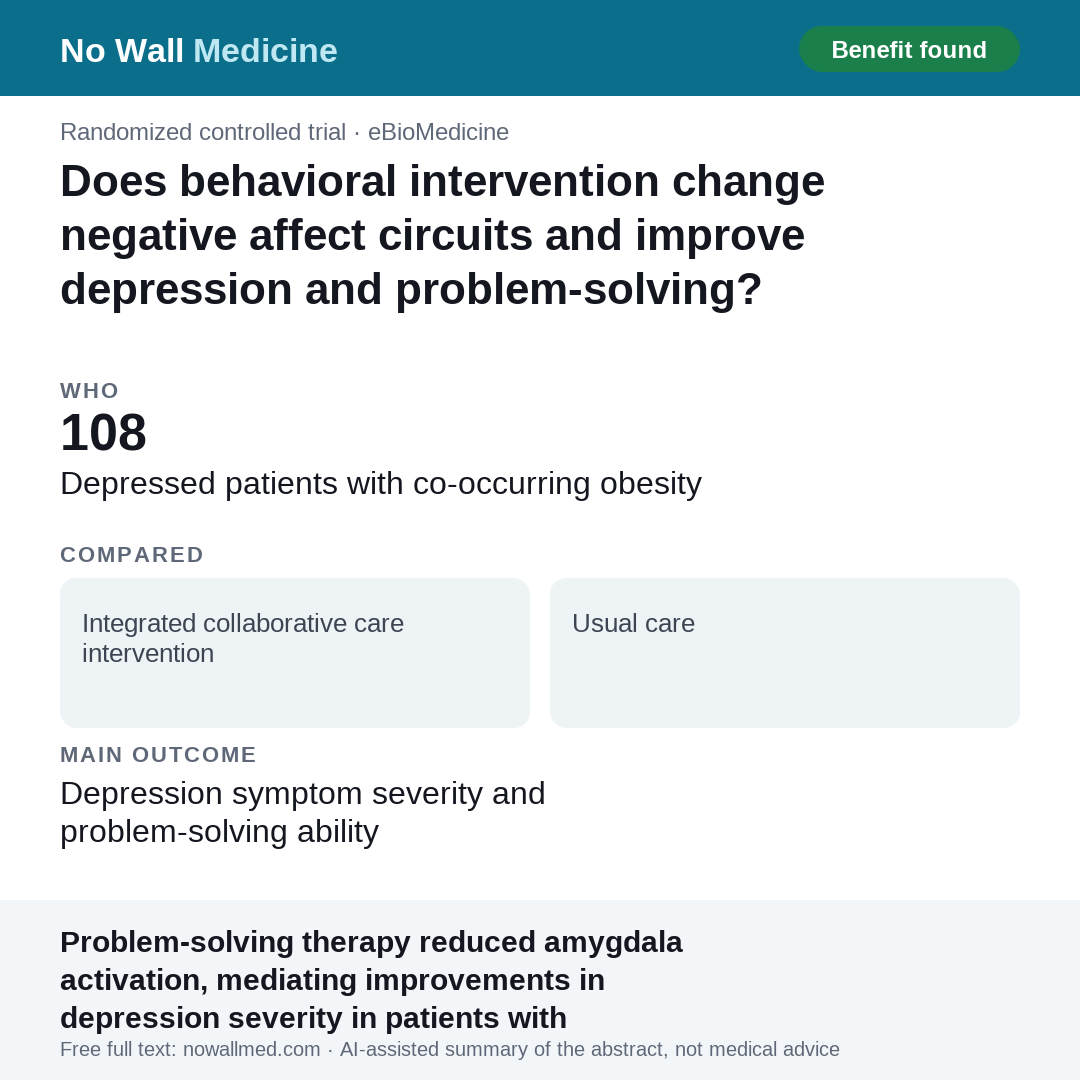
Clinical question: Does behavioral intervention change negative affect circuits and improve depression and problem-solving?
Why it matters: It is unknown if behavioral interventions change the brain circuits involved in negative emotions and if these neural changes relate to improvements in depression and problem-solving.
Key points
- The study randomized 108 depressed patients with obesity to receive either integrated collaborative care or usual care.
- Problem-solving therapy was associated with reduced amygdala activation—a brain region involved in processing threats—at two months compared to usual care.
- This reduction in amygdala activity was linked to subsequent improvements in depression severity and influenced the relationship between insula activation and problem-solving ability.
Headline and key points written with AI from the paper’s abstract, with every number checked against it. Read the paper before relying on them.
Was this summary helpful?
Subject terms
Cite this article
Goldstein-Piekarski AN, Wielgosz J, Xiao L, Stetz P, Correa CG, Chang SE. Early changes in neural circuit function engaged by negative emotion and modified by behavioural intervention are associated with depression and problem-solving outcomes: A report from the ENGAGE randomized controlled trial. eBioMedicine. 2021. doi:10.1016/j.ebiom.2021.103387
Spotted a mistake? Suggest a correction
Top studies every Monday
The week’s key trials and guidelines in your specialties, plus any topics you follow. By email, free.
Get the weekly digest