Telephone-based care coordination increased referrals and enrollment in developmental services for young children
Early Childhood Care Coordination Through 211: A Randomized Clinical Trial
Randomized trialBenefit found
Does care coordination improve services for children?
Who
565
children with upcoming well-child visits · Los Angeles County
Compared
25%intervention
16%control
Main outcome
referral to services
Result: adjusted odds ratio 2.25
Bottom line: Care coordination increases service referrals
Pediatrics · 2024-07-26Download image
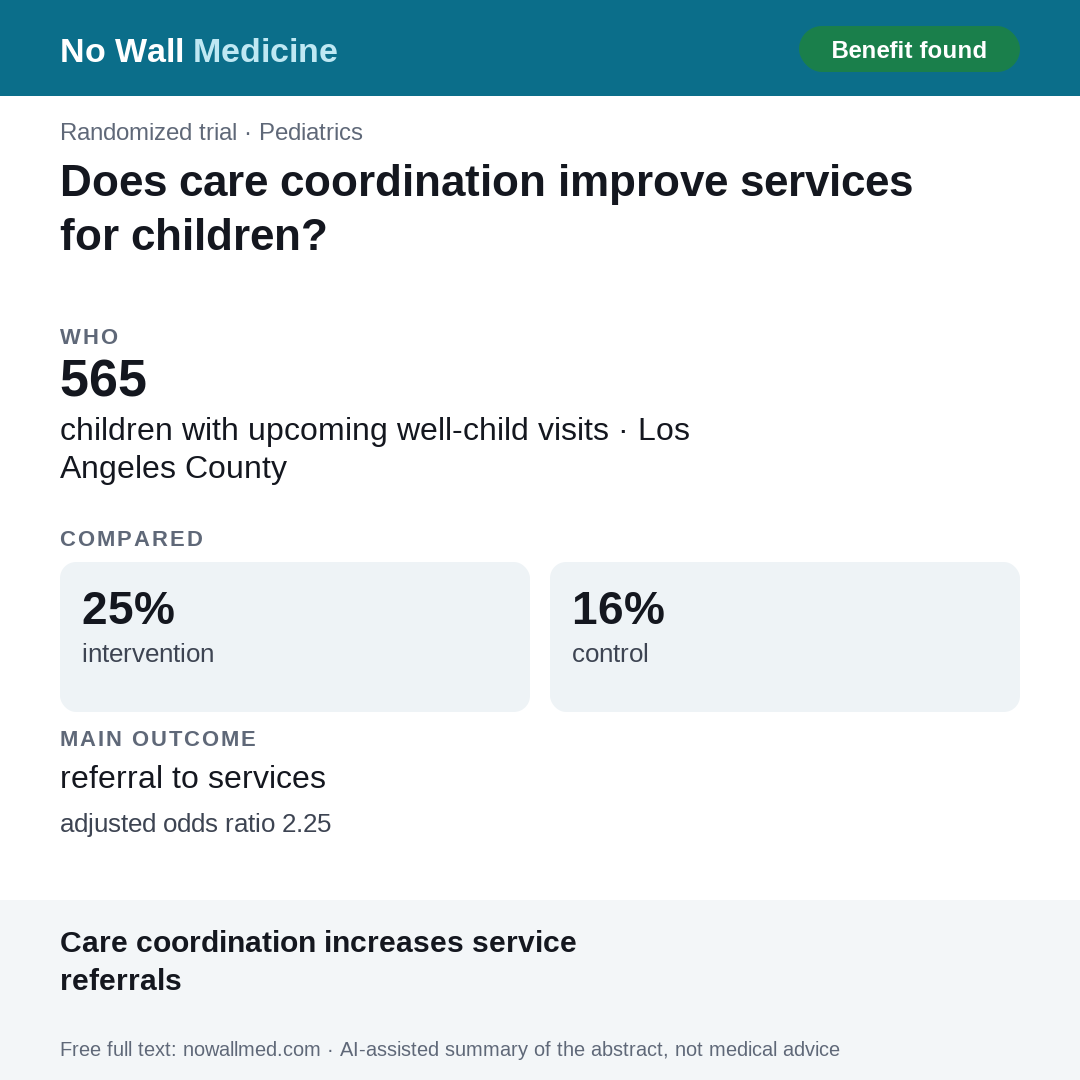
Clinical question: Does care coordination improve services for children?
Why it matters: Health care providers often struggle to ensure that children with developmental delays receive timely referrals and enrollment in necessary services.
In absolute numbers
intervention: 25% · control: 16% → a difference of 9 percentage points, so about 12 people would need the treatment for 1 more to benefit (number needed to treat) over the trial’s follow-up.
Worked out by us from the two group results above, not reported by the authors. Check the paper for the exact outcome and timing.
Key points
- Researchers randomly assigned 565 families of children aged 12 to 42 months to receive either telephone-based care coordination through a call center or usual clinic care.
- Children in the intervention group had higher rates of referral to developmental services (25% vs 16%) and enrollment in at least one service (15% vs 9%).
- The intervention group also showed higher rates of referral to early care and education (58% vs 15%) and enrollment in those programs (26% vs 10%).
Headline and key points written with AI from the paper’s abstract, with every number checked against it. Read the paper before relying on them.
Was this summary helpful?
Subject terms
Cite this article
Nelson BB, Dudovitz RN, Thompson LR, Vangala S, Zevallos-Roberts E, Gulsrud A. Early Childhood Care Coordination Through 211: A Randomized Clinical Trial. Pediatrics. 2024. doi:10.1542/peds.2023-065232
Spotted a mistake? Suggest a correction
Top studies every Monday
The week’s key trials and guidelines in your specialties, plus any topics you follow. By email, free.
Get the weekly digest