Early Complications in Implant-based Prepectoral Breast Reconstruction: Acellular Dermal Matrix Versus Synthetic Mesh
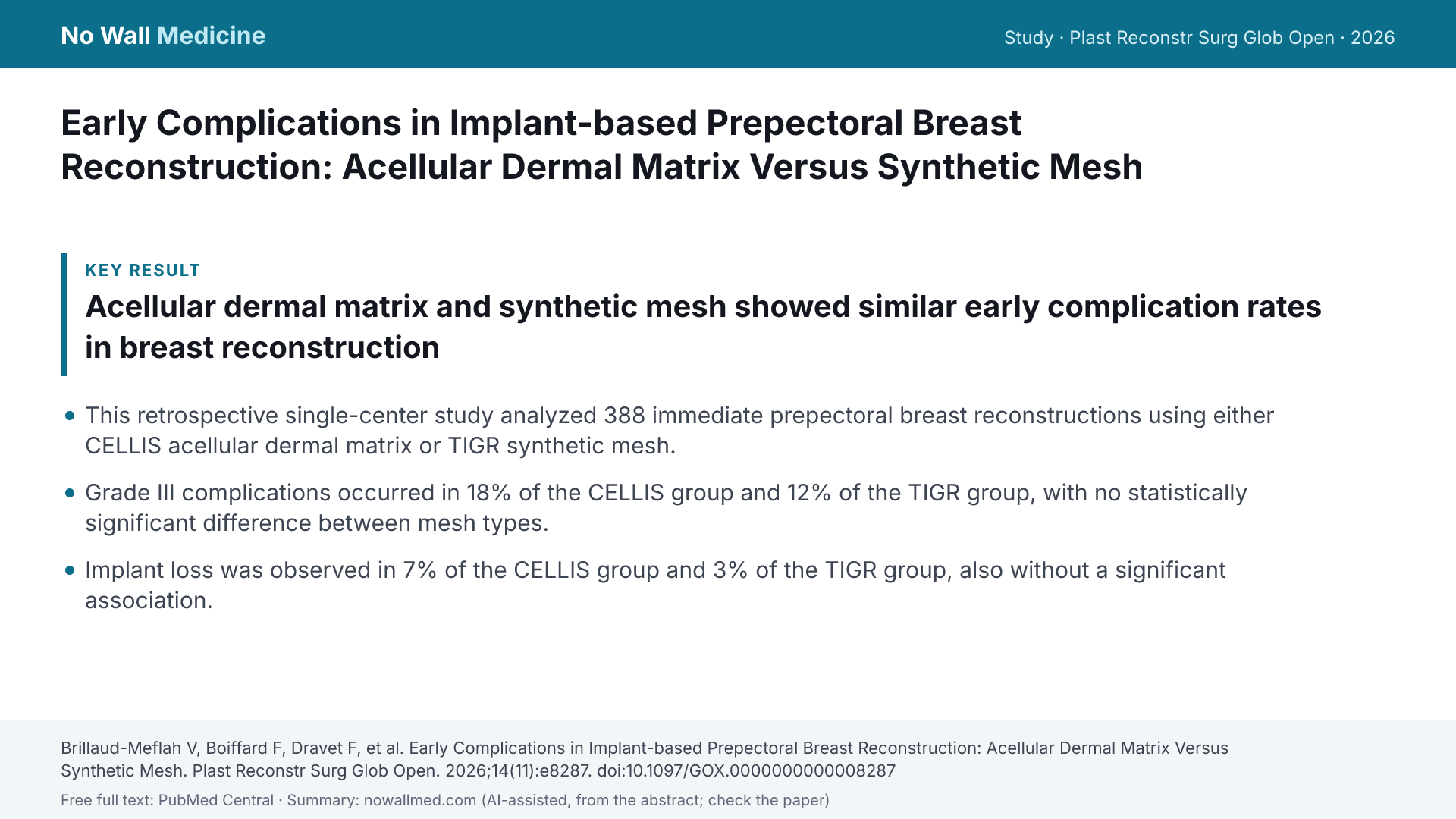
Key result: Acellular dermal matrix and synthetic mesh showed similar early complication rates in breast reconstruction
Key points
- This retrospective single-center study analyzed 388 immediate prepectoral breast reconstructions using either CELLIS acellular dermal matrix or TIGR synthetic mesh.
- Grade III complications occurred in 18% of the CELLIS group and 12% of the TIGR group, with no statistically significant difference between mesh types.
- Implant loss was observed in 7% of the CELLIS group and 3% of the TIGR group, also without a significant association.
Why it matters: Applies to patients undergoing immediate prepectoral breast reconstruction; suggests mesh type choice may not significantly impact early complication risk.
Limitation the authors note: The study was a retrospective single-center analysis with a follow-up period limited to 3 months postoperatively.
Discussion prompts
- Would these patients look like yours? Who was left out?
- Is the main outcome one that matters to patients?
- Is the difference large enough to change what you do?
Cite: Brillaud-Meflah V, Boiffard F, Dravet F, et al. Early Complications in Implant-based Prepectoral Breast Reconstruction: Acellular Dermal Matrix Versus Synthetic Mesh. Plast Reconstr Surg Glob Open. 2026;14(11):e8287. doi:10.1097/GOX.0000000000008287
Free full text: PubMed Central · Summary and visual abstract: nowallmed.com/a/early-complications-in-implant-based-prepectoral-breast-1ognczn/ (AI-assisted from the abstract; check the paper before relying on it).