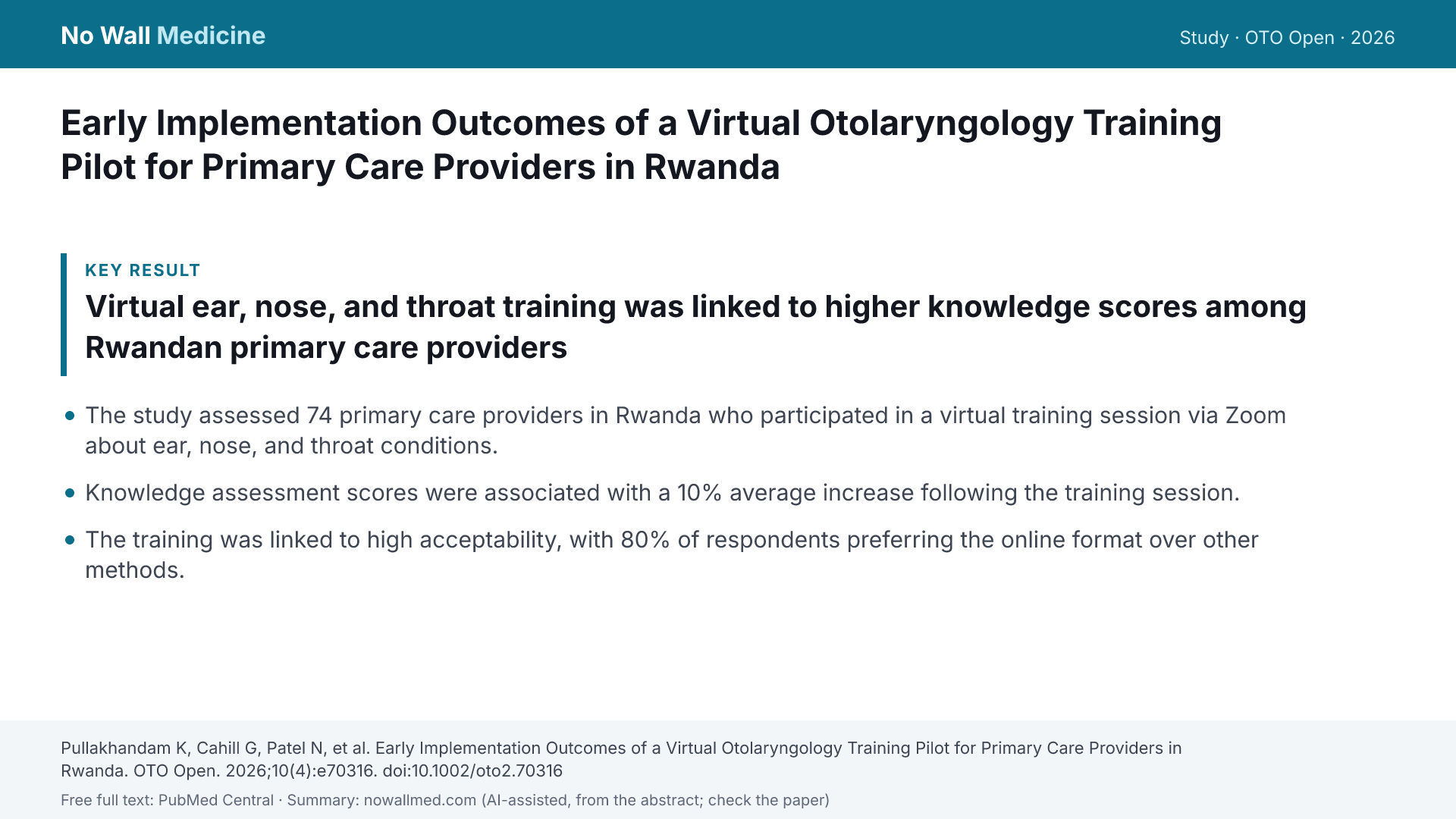
Early Implementation Outcomes of a Virtual Otolaryngology Training Pilot for Primary Care Providers in Rwanda
Key result: Virtual ear, nose, and throat training was linked to higher knowledge scores among Rwandan primary care providers
Key points
- The study assessed 74 primary care providers in Rwanda who participated in a virtual training session via Zoom about ear, nose, and throat conditions.
- Knowledge assessment scores were associated with a 10% average increase following the training session.
- The training was linked to high acceptability, with 80% of respondents preferring the online format over other methods.
Why it matters: Rwanda has significant gaps in ear, nose, and throat care due to having less than 30 specialists for a population of 13.2 million.
Discussion prompts
- Would these patients look like yours? Who was left out?
- Is the main outcome one that matters to patients?
- Is the difference large enough to change what you do?
Cite: Pullakhandam K, Cahill G, Patel N, et al. Early Implementation Outcomes of a Virtual Otolaryngology Training Pilot for Primary Care Providers in Rwanda. OTO Open. 2026;10(4):e70316. doi:10.1002/oto2.70316
Free full text: PubMed Central · Summary and visual abstract: nowallmed.com/a/early-implementation-outcomes-of-a-virtual-otolaryngology-training-1fkg1ux/ (AI-assisted from the abstract; check the paper before relying on it).