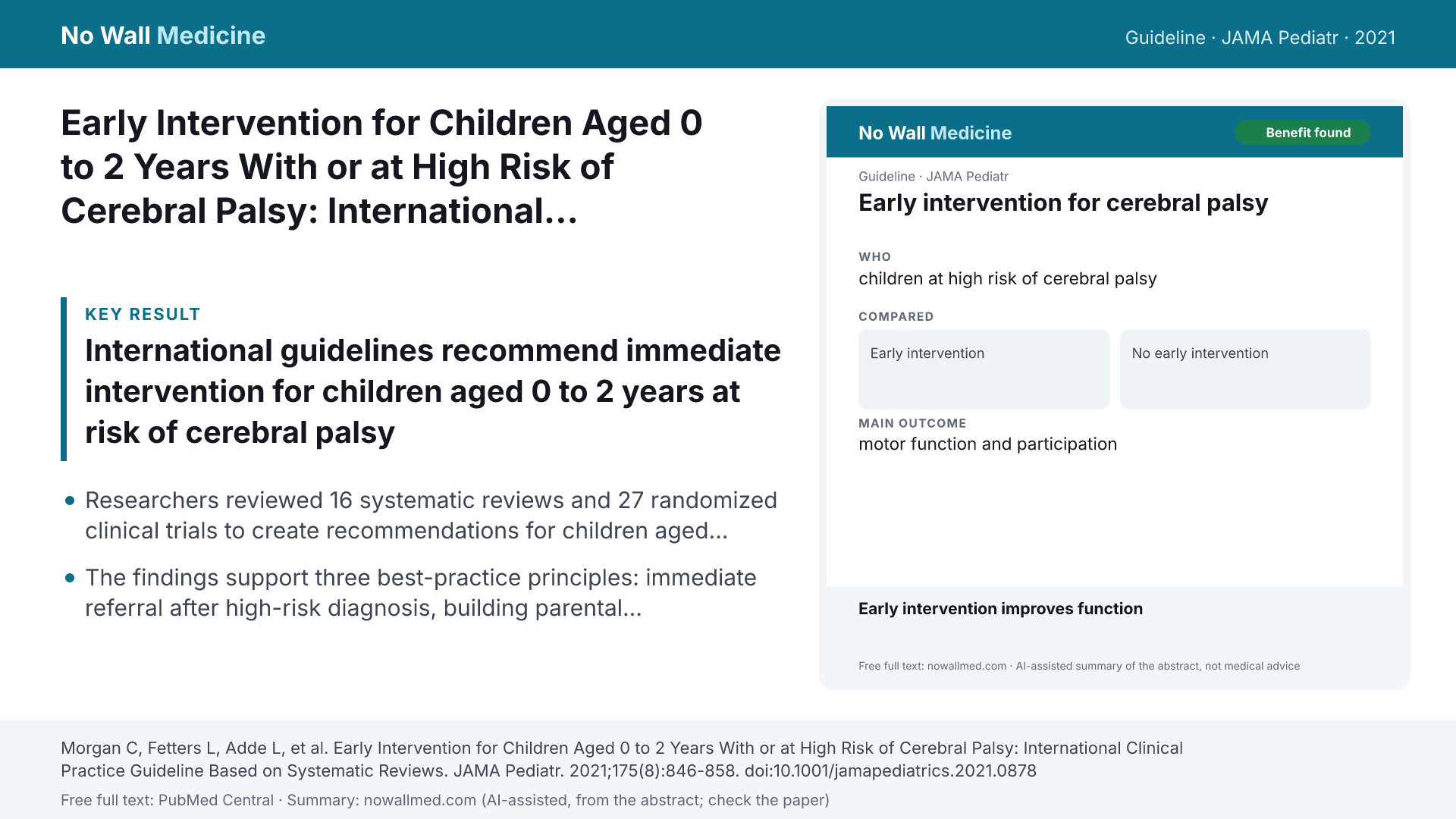
International guidelines recommend immediate intervention for children aged 0 to 2 years at risk of cerebral palsy
Early Intervention for Children Aged 0 to 2 Years With or at High Risk of Cerebral Palsy: International Clinical Practice Guideline Based on Systematic Reviews
GuidelineBenefit found
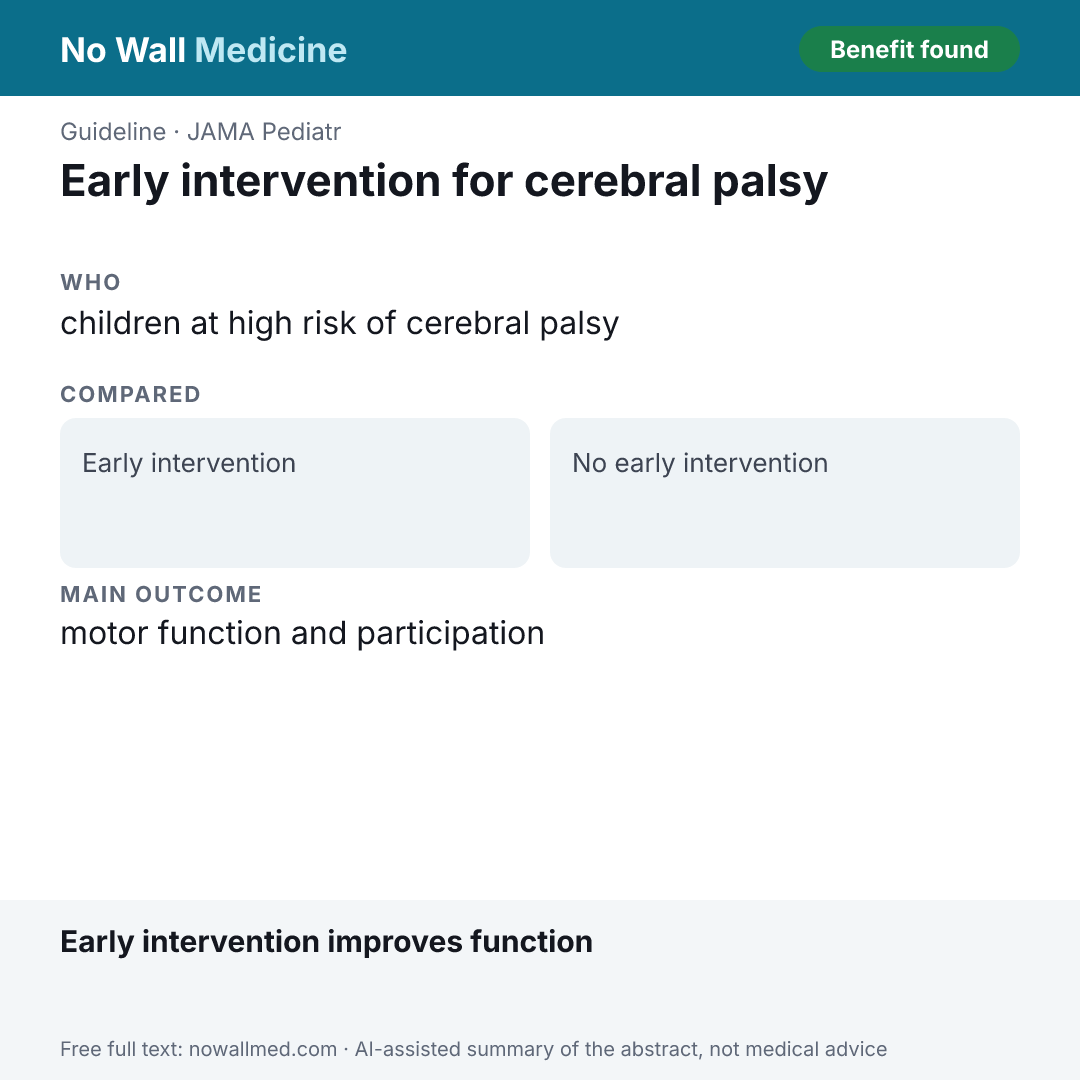
Early intervention for cerebral palsy
Who
children at high risk of cerebral palsy
Compared
Early intervention
No early intervention
Main outcome
motor function and participation
Bottom line: Early intervention improves function
JAMA Pediatr · 2021-05-18 · Save PNG
Key points
- Researchers reviewed 16 systematic reviews and 27 randomized clinical trials to create recommendations for children aged 0 to 2 years with or at high risk of cerebral palsy.
- The findings support three best-practice principles: immediate referral after high-risk diagnosis, building parental capacity for attachment, and parental goal-setting at the start of intervention.
- The guideline provides 28 specific recommendations across nine domains including motor function, communication, sleep, and vision.
Headline and key points written with AI from the paper’s abstract, with every number checked against it. Read the paper before relying on them.
Was this summary helpful?
Subject terms
Headline, design, result, key points, caveat and citation as plain text.
Cite this article
Morgan C, Fetters L, Adde L, et al. Early Intervention for Children Aged 0 to 2 Years With or at High Risk of Cerebral Palsy: International Clinical Practice Guideline Based on Systematic Reviews. JAMA Pediatr. 2021;175(8):846-858. doi:10.1001/jamapediatrics.2021.0878
Spotted a mistake? Suggest a correction