Early Intervention for Children With Developmental Disabilities and Their Families via Telehealth: Systematic Review
Systematic reviewBenefit found
How does telehealth compare to in-person interventions for children with developmental disabilities?
Who
Infants and toddlers aged 0-3 years with developmental disabilities
Compared
Telehealth
In-person
Main outcome
Developmental outcomes and family well-being
Bottom line: Telehealth is a viable alternative to traditional in-person early interventions for young children with developmental disabilities.
Limitation: Focus on specific conditions and limited research on cognitive development.
J Med Internet Res · 2025-01-17Download image
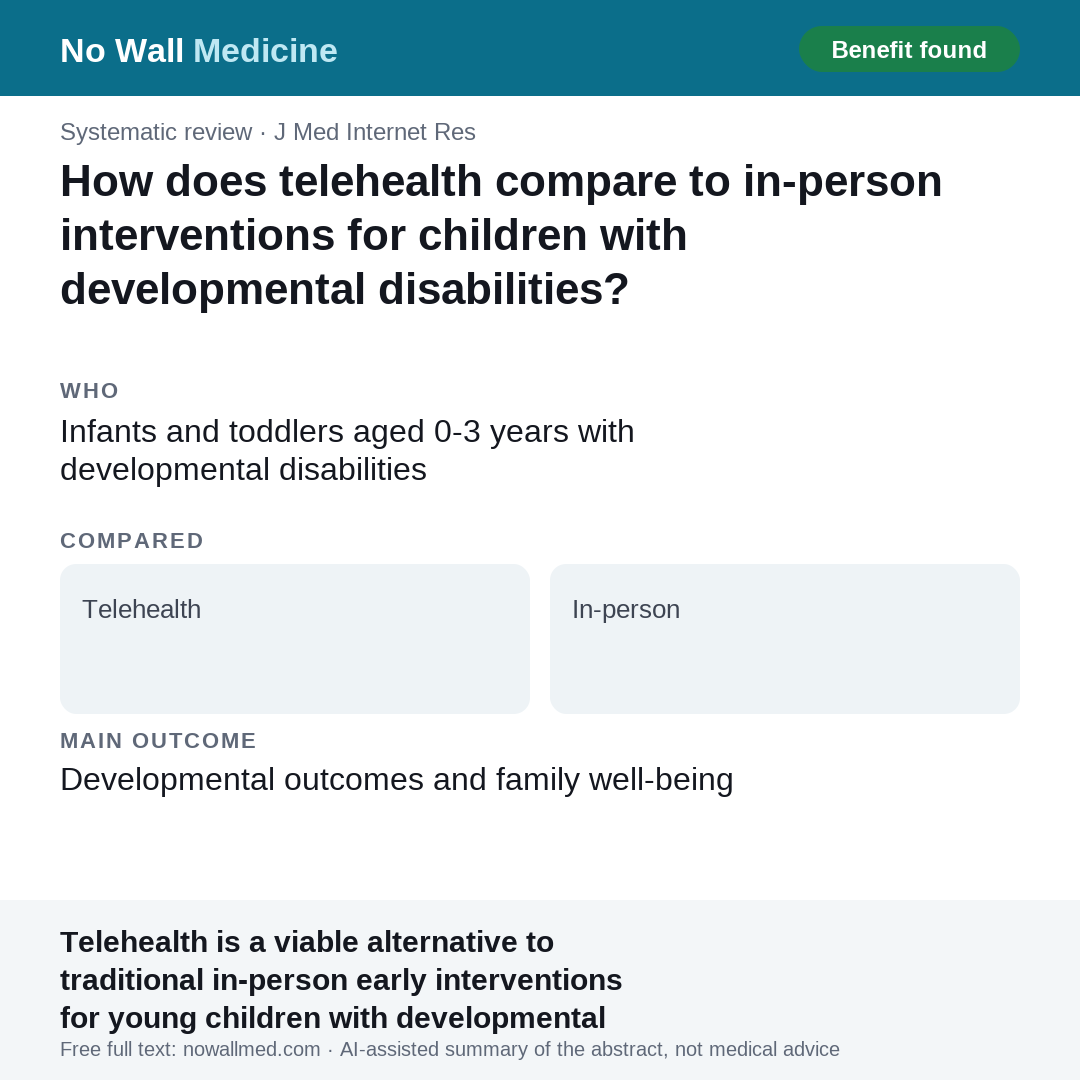
Clinical question: How does telehealth compare to in-person interventions for children with developmental disabilities?
Abstract
Background
Early intervention during the first 3 years of life is crucial for children with developmental disabilities to optimize developmental outcomes. However, access to such services is often limited by geographical distance and resource constraints. Telehealth can be part of a solution for overcoming these barriers, enabling the delivery of early intervention services. However, a comprehensive understanding of the efficacy and implementation of telehealth in early interventions remains elusive, particularly for children aged 0-3 years. Objective
This systematic review aims to synthesize existing research on the effectiveness and implementation of telehealth interventions in infants and toddlers (aged 0-3 years) who are at risk of or diagnosed with developmental disabilities. The primary objective of the study is to evaluate the ways that telehealth compares to conventional in-person interventions in improving developmental outcomes for children and supporting family well-being. Methods
A systematic search was conducted of 4 electronic databases (PubMed, Embase, CINAHL, and Web of Science), focusing on studies published between 2010 and 2024. The inclusion criteria were studies involving telehealth interventions for children aged 0-3 years who were at high risk or had developmental disabilities, which involved active interactions between the providers and the families. Study quality was assessed using the mixed methods appraisal tool, and a narrative synthesis was used to analyze the data. Results
Eighteen studies met the inclusion criteria: 12 single-case designs, 4 randomized controlled trials, and 2 nonequivalent control group designs. All studies involved caregiver-child dyads, with child ages ranging from 5 to 37 months and having or at risk of autistic spectrum disorder (n=10, 56%), cerebral palsy (n=4, 22%), and other conditions (n=4, 22%). Synchronous videoconferencing was the primary modality for caregiver training and coaching (n=17, 94%) while 1 intervention used an Internet of Things system. Outcomes were identified in child communication (n=9, 50%), physical (n=6, 33%), social or emotional (n=6, 33%), and adaptive behavior (n=4, 22%), as well as caregiver implementation (n=12, 66%). Telehealth demonstrated comparable or superior effectiveness to traditional in-person methods in 2 studies. However, the focus on specific conditions and limited research on cognitive development were notable gaps. Conclusions
Telehealth can be a viable alternative to traditional in-person early interventions for young children who have developmental disabilities and their families. It enhances accessibility and interactions between families and providers at a distance while promoting family-centered care. Challenges exist, including those of technological literacy, and the lack of research on cognitive outcomes must be addressed. Future work should explore more comprehensive interventions, including multidisciplinary approaches and expanded family outcomes, to solidify the role that telehealth plays in early intervention. Trial registration
PROSPERO CRD42024551286; https://www.crd.york.ac.uk/prospero/display_record.php?RecordID=551286.
Topics
Cite this article
Shin Y, Park EJ, Lee A. Early Intervention for Children With Developmental Disabilities and Their Families via Telehealth: Systematic Review. J Med Internet Res. 2025. doi:10.2196/66442
Spotted a mistake? Suggest a correction