Early pulsed dye laser treatment improved patient-rated scar quality for hypertrophic burn scars
Early Laser for Burn Scars (ELABS) - Randomised controlled trial of pulsed dye laser treatment and standard care versus standard care alone for the treatment of hypertrophic burn scars
Parallel arm randomised controlled trialMixed results
Does early pulsed dye laser treatment improve hypertrophic burn scar quality and quality of life?
Who
138
Patients with burn injury within three months of wound healing · Seven centres in the United Kingdom
Compared
Pulsed dye laser and standard care: statistically significant improvement in patient-rated scar quality (p = 0·041)
Standard care alone
Main outcome
Patient-rated scar quality at six months
Bottom line: Early pulsed dye laser improves patient-rated scar quality but not quality of life or cost-effectiveness at six months.
Burns · 2025-04-17Download image
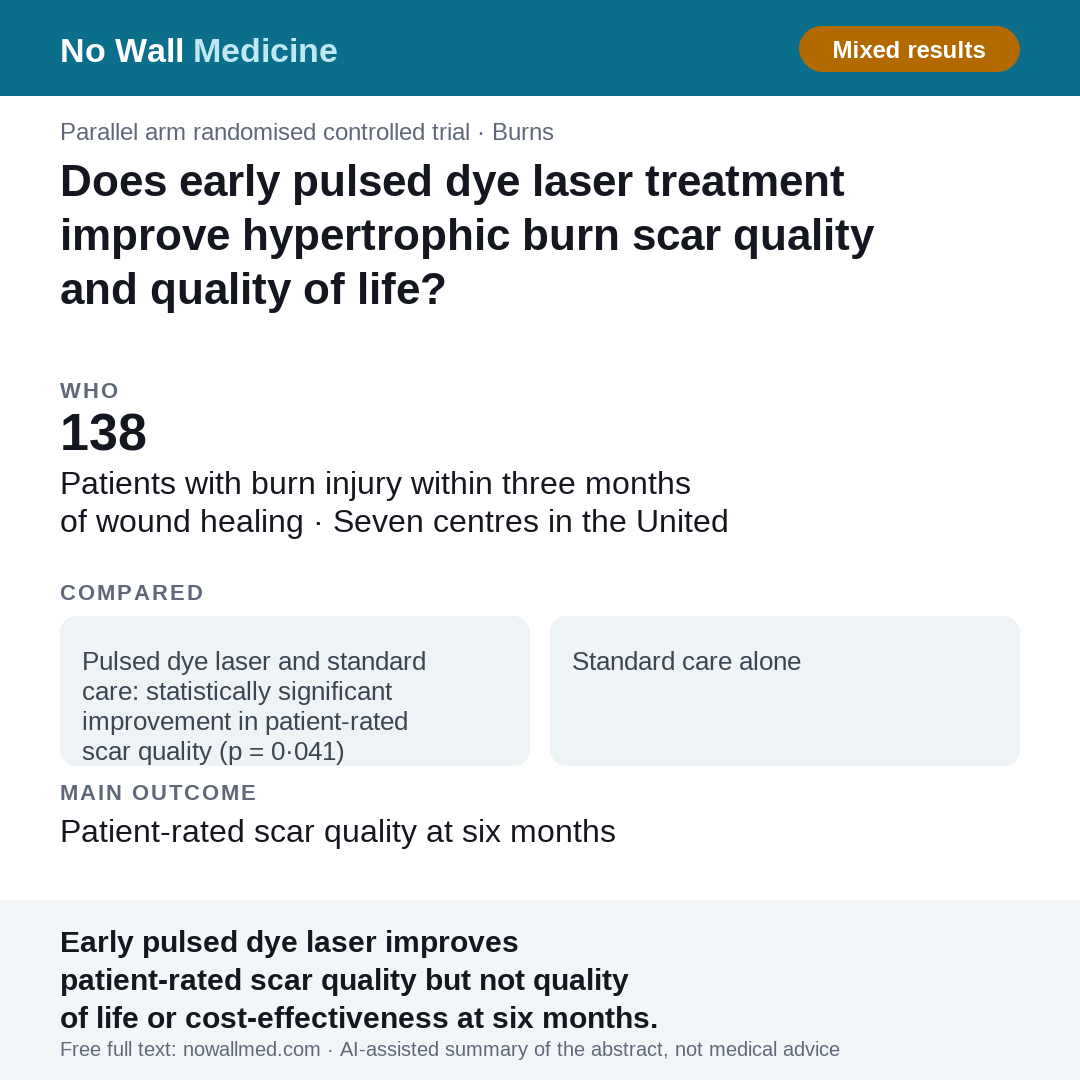
Clinical question: Does early pulsed dye laser treatment improve hypertrophic burn scar quality and quality of life?
Why it matters: Hypertrophic burn scarring is considered a major unmet challenge following burn injuries, and the effectiveness of early laser treatment is unclear.
Key points
- Researchers conducted a randomized controlled trial with 138 participants to compare three pulsed dye laser treatments with standard care alone.
- At six months, early pulsed dye laser treatment showed a statistically significant improvement in patient-rated scar quality (p = 0.041) and participant perception of change (p = 0.01).
- The intervention was not cost-effective at the £20,000 per Quality-Adjusted-Life-Year threshold and showed no significant difference in quality of life or observer-rated scar quality.
Headline and key points written with AI from the paper’s abstract, with every number checked against it. Read the paper before relying on them.
Was this summary helpful?
Subject terms
Cite this article
Brewin MP, Docherty S, Heaslip V, Rhodes S, Ukoumunne OC, Burnett-Fry NC. Early Laser for Burn Scars (ELABS) - Randomised controlled trial of pulsed dye laser treatment and standard care versus standard care alone for the treatment of hypertrophic burn scars. Burns. 2025. doi:10.1016/j.burns.2025.107500
Spotted a mistake? Suggest a correction
Top studies every Monday
The week’s key trials and guidelines in your specialties, plus any topics you follow. By email, free.
Get the weekly digest