Trial protocol evaluates methylene blue for mortality in septic shock patients requiring high-dose vasopressors
Early Methylene Blue for Mortality Reduction in High-Dose VasoPREssor-Dependent Septic Shock (EMPRESS): protocol for a multicenter randomized controlled trial
Multicenter, open-label, blinded endpoint randomized controlled trialUnclear result
Does early methylene blue reduce mortality in high-dose vasopressor-dependent septic shock?
Who
566
Adult septic shock patients requiring norepinephrine equivalent doses > 0.3 μg/kg/min · Multiple centers in China
Compared
Methylene blue treatment
5% dextrose control
Main outcome
28-day all-cause mortality
Bottom line: This protocol describes a trial to evaluate if methylene blue reduces mortality in severe septic shock.
Scand J Trauma Resusc Emerg Med · 2026-01-24Download image
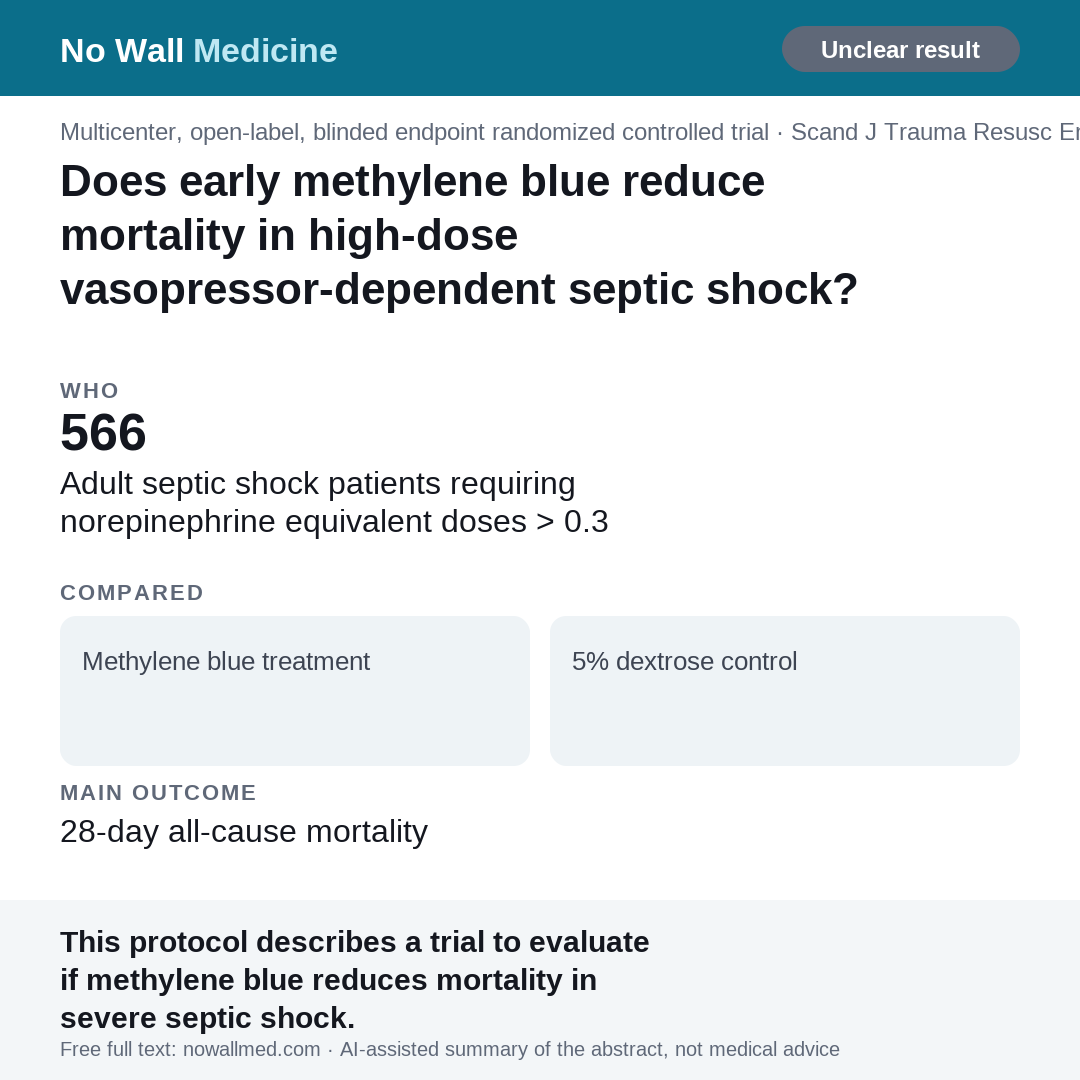
Clinical question: Does early methylene blue reduce mortality in high-dose vasopressor-dependent septic shock?
Why it matters: Large-scale randomized controlled trials evaluating methylene blue for mortality benefit in patients requiring high-dose vasopressors for septic shock are currently lacking.
Key points
- The study will enroll 566 adult septic shock patients requiring norepinephrine doses > 0.3 μg/kg/min to compare methylene blue against a 5% dextrose control.
- The primary goal is to determine if early methylene blue administration affects 28-day all-cause mortality in this specific patient group.
- Secondary measures include days free from intensive care, ventilators, or vasopressors, as well as in-hospital mortality and Sequential Organ Failure Assessment score improvement.
Headline and key points written with AI from the paper’s abstract, with every number checked against it. Read the paper before relying on them.
Topics
Cite this article
Luo JC, Ma L, Luo MH, Ibarra-Estrada M, Yan PJ, Zhang ZA. Early Methylene Blue for Mortality Reduction in High-Dose VasoPREssor-Dependent Septic Shock (EMPRESS): protocol for a multicenter randomized controlled trial. Scand J Trauma Resusc Emerg Med. 2026. doi:10.1186/s13049-026-01563-y
Spotted a mistake? Suggest a correction