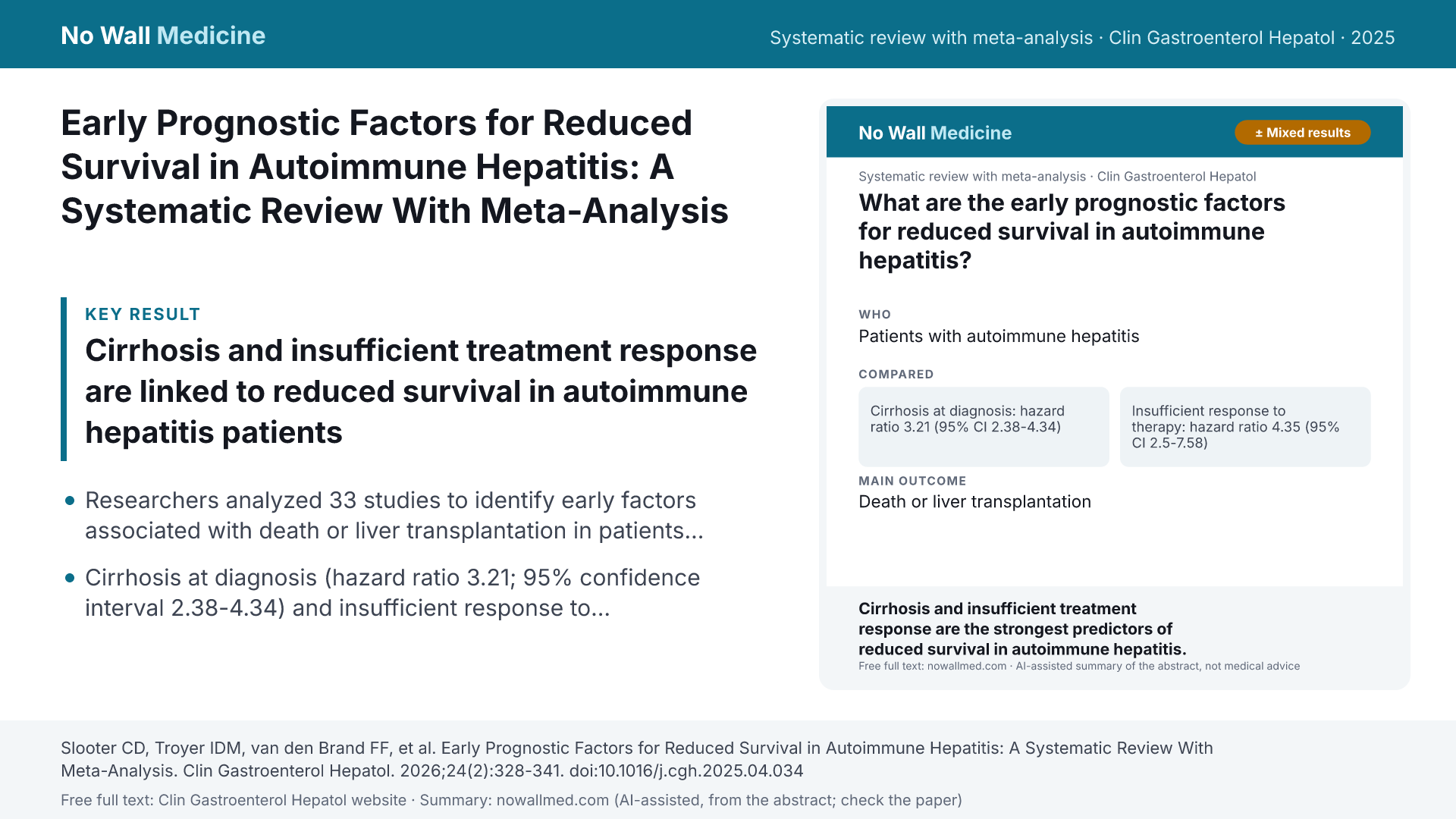
Cirrhosis and insufficient treatment response are linked to reduced survival in autoimmune hepatitis patients
Early Prognostic Factors for Reduced Survival in Autoimmune Hepatitis: A Systematic Review With Meta-Analysis
Systematic review with meta-analysisMixed results
What are the early prognostic factors for reduced survival in autoimmune hepatitis?
Who
Patients with autoimmune hepatitis
Compared
Cirrhosis at diagnosis: hazard ratio 3.21 (95% CI 2.38-4.34)
Insufficient response to therapy: hazard ratio 4.35 (95% CI 2.5-7.58)
Main outcome
Death or liver transplantation
Bottom line: Cirrhosis and insufficient treatment response are the strongest predictors of reduced survival in autoimmune hepatitis.
Clin Gastroenterol Hepatol · 2025-07-23 · Save PNG
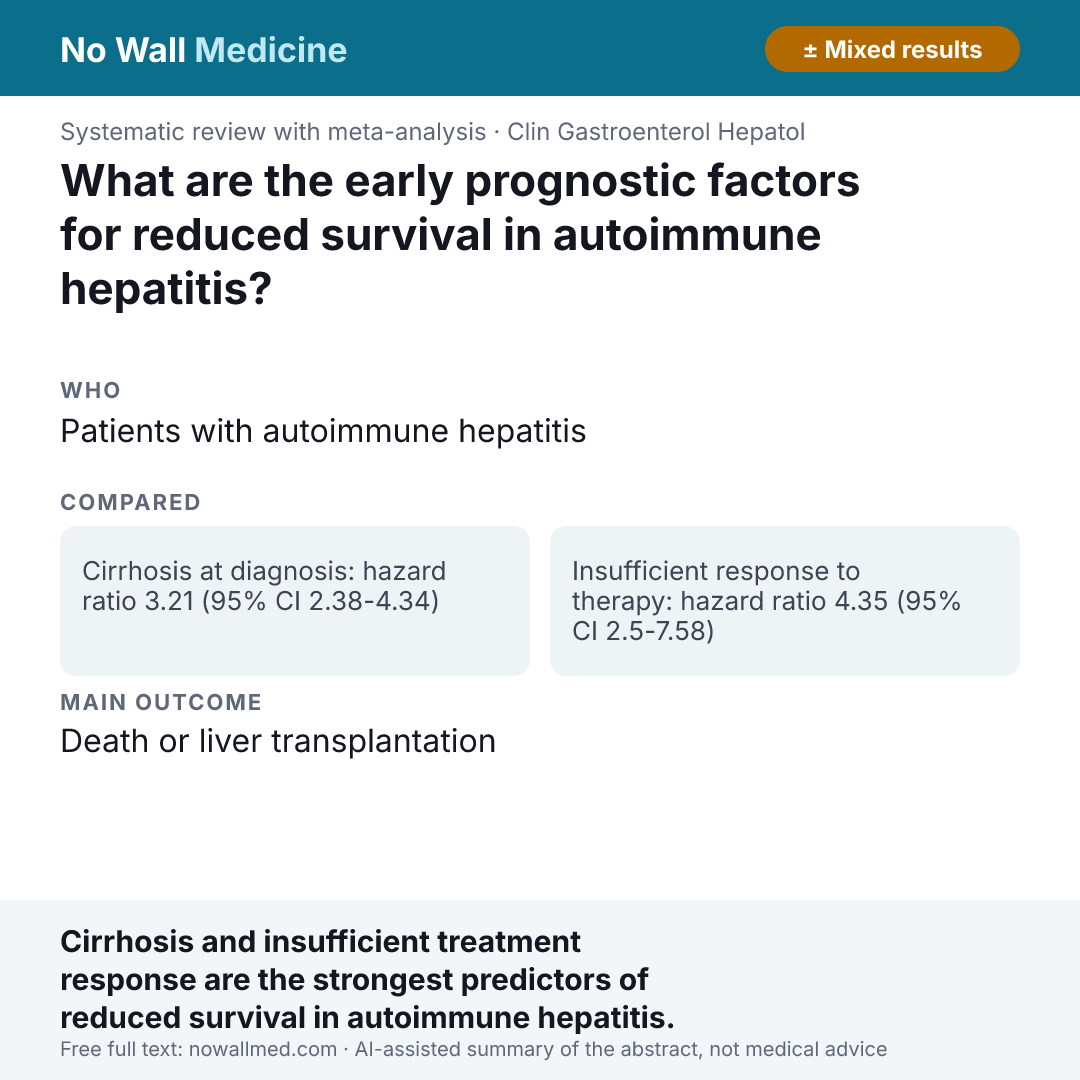
Clinical question: What are the early prognostic factors for reduced survival in autoimmune hepatitis?
Why it matters: The specific factors that predict early death or the need for liver transplantation in patients with autoimmune hepatitis were not clearly ranked.
Key points
- Researchers analyzed 33 studies to identify early factors associated with death or liver transplantation in patients with autoimmune hepatitis.
- Cirrhosis at diagnosis (hazard ratio 3.21; 95% confidence interval 2.38-4.34) and insufficient response to therapy (hazard ratio 4.35; 95% confidence interval 2.5-7.58) were linked to the highest risk.
- Other factors associated with reduced survival included advanced age, non-Caucasian ethnicity, and higher relapse rates, while elevated albumin levels were linked to protection.
Headline and key points written with AI from the paper’s abstract, with every number checked against it. Read the paper before relying on them.
Was this summary helpful?
Subject terms
Headline, design, result, key points, caveat and citation as plain text.
Cite this article
Slooter CD, Troyer IDM, van den Brand FF, et al. Early Prognostic Factors for Reduced Survival in Autoimmune Hepatitis: A Systematic Review With Meta-Analysis. Clin Gastroenterol Hepatol. 2026;24(2):328-341. doi:10.1016/j.cgh.2025.04.034
Spotted a mistake? Suggest a correction