Optimised statistical surveillance methods did not decrease surgical site infection rates in community hospitals
Early recognition and response to increases in surgical site infections using optimised statistical process control charts-The early 2RIS trial: A multicentre stepped wedge cluster randomised controlled trial
Stepped wedge cluster randomised trialNo clear difference
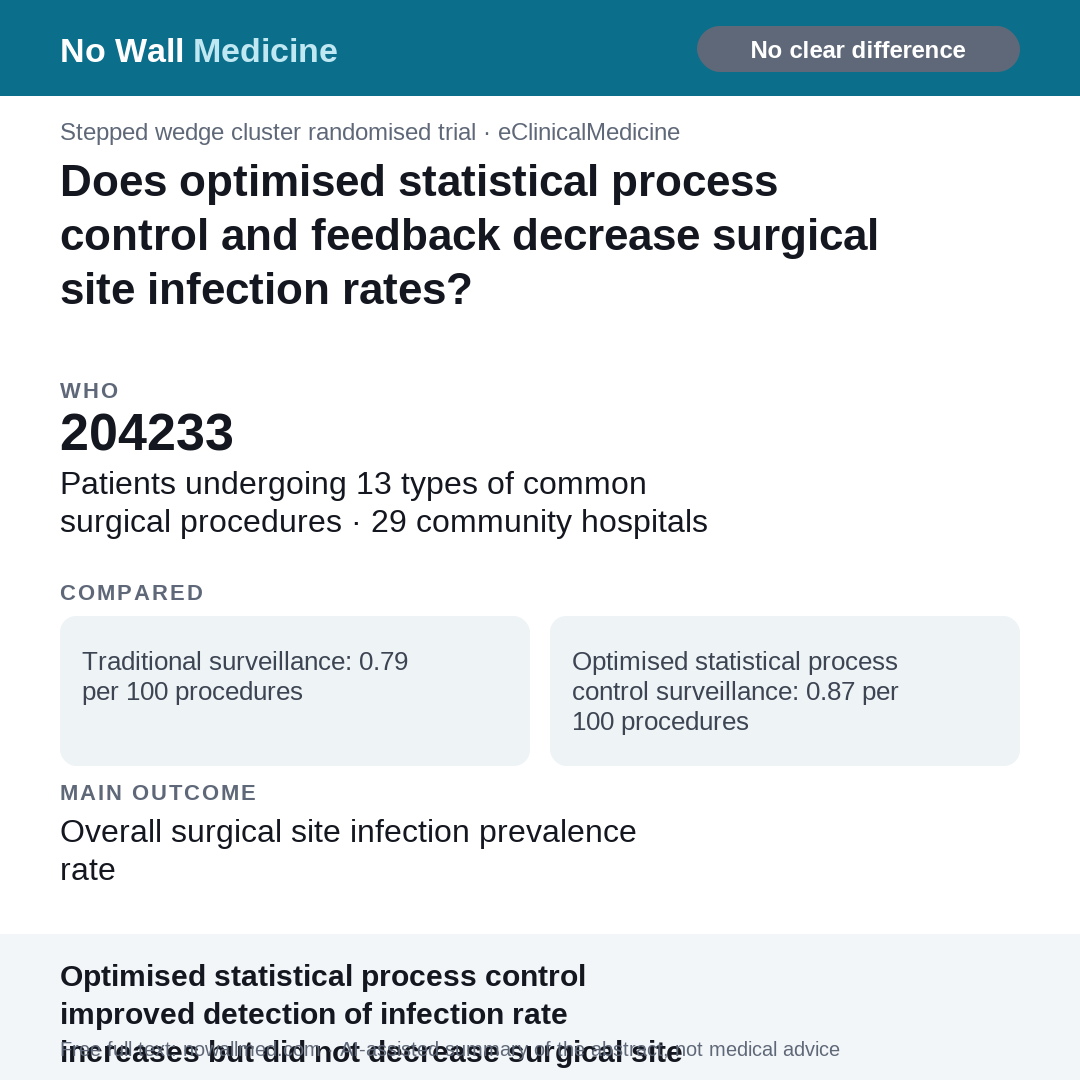
Does optimised statistical process control and feedback decrease surgical site infection rates?
Who
204233
Patients undergoing 13 types of common surgical procedures · 29 community hospitals in the Southeastern United States
Compared
Traditional surveillance: 0.79 per 100 procedures
Optimised statistical process control surveillance: 0.87 per 100 procedures
Main outcome
Overall surgical site infection prevalence rate
Result: model-based prevalence rate ratio 1.10 (95% CI 0.94-1.30)
Bottom line: Optimised statistical process control improved detection of infection rate increases but did not decrease surgical site infection rates.
Funded by: Agency for Healthcare Research and Quality
eClinicalMedicine · 2022-10-17Download image
Clinical question: Does optimised statistical process control and feedback decrease surgical site infection rates?
Why it matters: Traditional surgical site infection surveillance methods may have deficiencies that delay the detection of outbreaks and increases in infection rates.
Key points
- Researchers studied 204,233 patients undergoing 237,704 surgical procedures across 29 community hospitals using a stepped wedge cluster randomised trial.
- The infection prevalence rate was 0.79 per 100 procedures with traditional surveillance compared to 0.87 per 100 procedures with the optimised statistical methods.
- Optimised surveillance generated 74 formal investigations identifying 458 infections with best practice deficiencies, while traditional surveillance generated 24 investigations identifying 120 infections.
Headline and key points written with AI from the paper’s abstract, with every number checked against it. Read the paper before relying on them.
Was this summary helpful?
Cite this article
Baker AW, Ilieş I, Benneyan JC, Lokhnygina Y, Foy KR, Lewis SS. Early recognition and response to increases in surgical site infections using optimised statistical process control charts-The early 2RIS trial: A multicentre stepped wedge cluster randomised controlled trial. eClinicalMedicine. 2022. doi:10.1016/j.eclinm.2022.101698
Spotted a mistake? Suggest a correction
Top studies every Monday
The week’s key trials and guidelines in your specialties, plus any topics you follow. By email, free.
Get the weekly digest