Early Restrictive or Liberal Fluid Management for Sepsis-Induced Hypotension
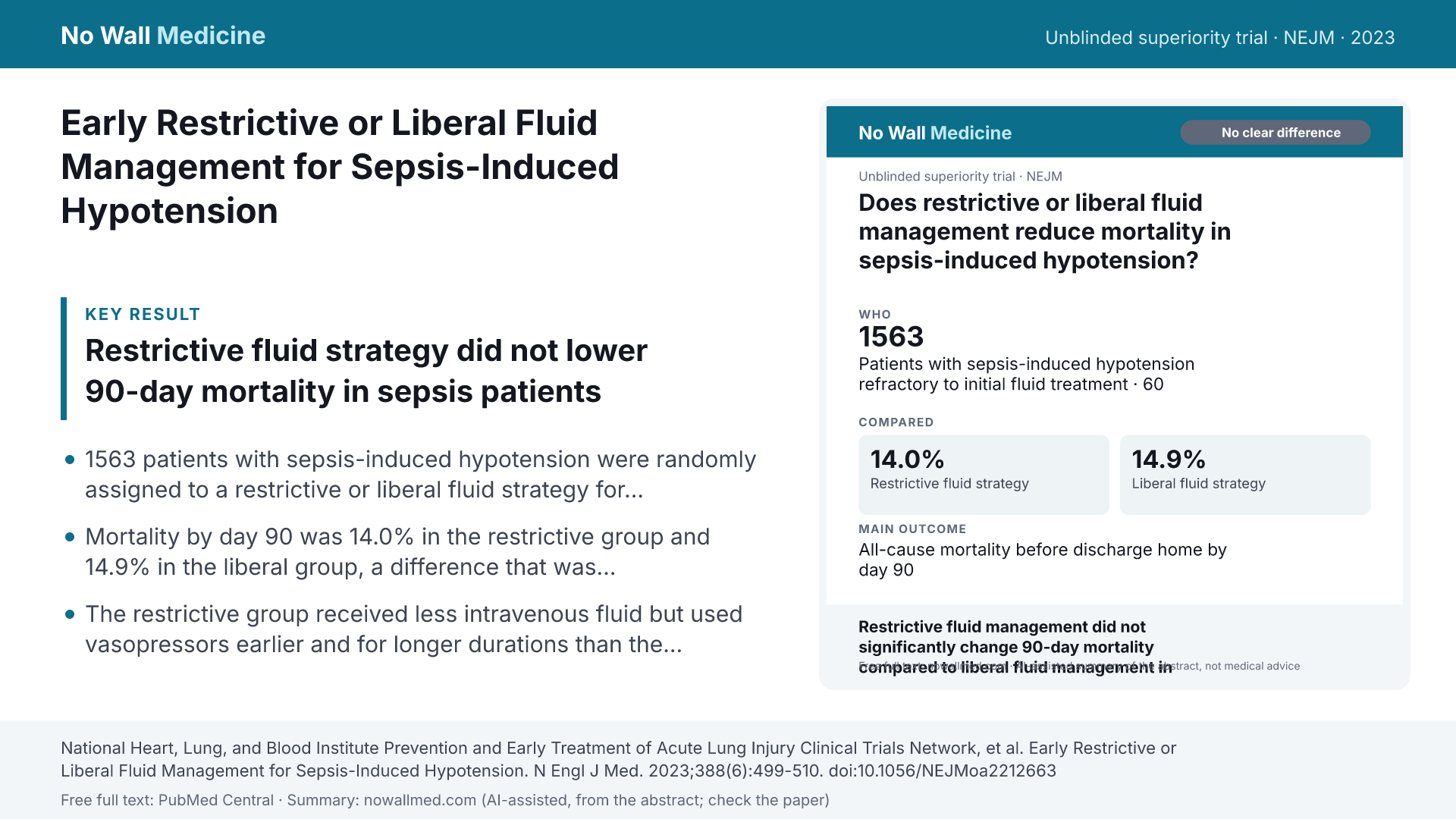
Key result: Restrictive fluid strategy did not lower 90-day mortality in sepsis patients
Unblinded superiority trialNo clear difference
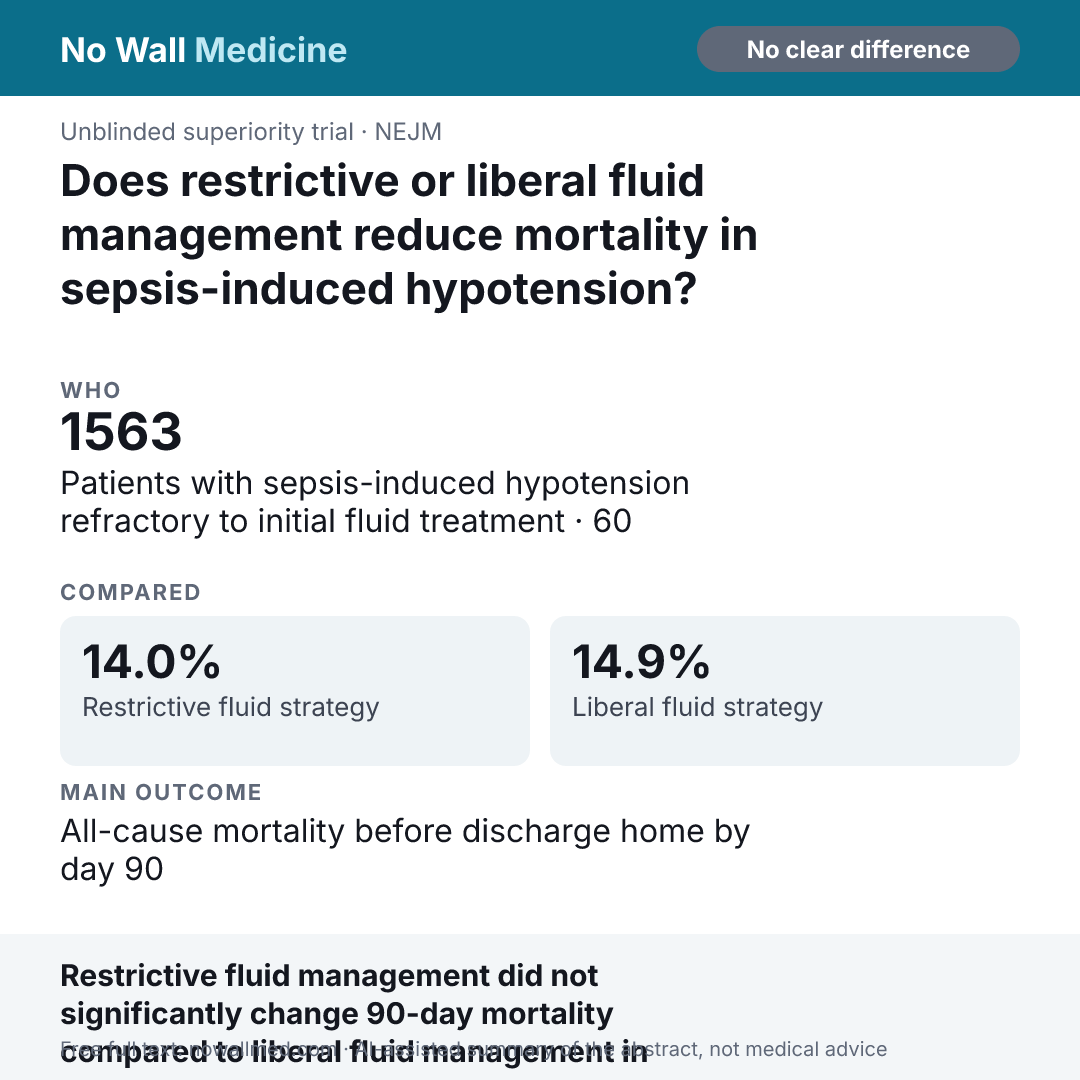
Does restrictive or liberal fluid management reduce mortality in sepsis-induced hypotension?
Who
1563
Patients with sepsis-induced hypotension refractory to initial fluid treatment · 60 United States centers
Compared
14.0%Restrictive fluid strategy (109 patients)
14.9%Liberal fluid strategy (116 patients)
Main outcome
All-cause mortality before discharge home by day 90
Result: estimated difference, -0.9 percentage points; 95% CI, -4.4 to 2.6
Bottom line: Restrictive fluid management did not significantly change 90-day mortality compared to liberal fluid management in sepsis-induced hypotension.
Funded by: National Heart, Lung, and Blood Institute
NEJM · 2023-01-21 · Save PNG
Key points
- 1563 patients with sepsis-induced hypotension were randomly assigned to a restrictive or liberal fluid strategy for 24 hours.
- Mortality by day 90 was 14.0% in the restrictive group and 14.9% in the liberal group, a difference that was not statistically significant.
- The restrictive group received less intravenous fluid but used vasopressors earlier and for longer durations than the liberal group.
Why it matters: Comparative data for prioritizing intravenous fluids versus vasopressor agents in early sepsis resuscitation are limited.
Discussion prompts
- Would these patients look like yours? Who was left out?
- Is the main outcome one that matters to patients?
- Is the difference large enough to change what you do?
Cite: National Heart, Lung, and Blood Institute Prevention and Early Treatment of Acute Lung Injury Clinical Trials Network, et al. Early Restrictive or Liberal Fluid Management for Sepsis-Induced Hypotension. N Engl J Med. 2023;388(6):499-510. doi:10.1056/NEJMoa2212663
Free full text: PubMed Central · Summary and visual abstract: nowallmed.com/a/early-restrictive-or-liberal-fluid-management-for-sepsis-induced-1hl0t5j/ (AI-assisted from the abstract; check the paper before relying on it).