Brain imaging and electrical activity predict death by neurological criteria after cardiac arrest
Early risk stratification for progression to death by neurological criteria following out-of-hospital cardiac arrest
Retrospective observational study with modelingBenefit found
Do initial brain imaging, electroencephalography, and arrest characteristics predict progression to death by neurological criteria?
Who
1569
Comatose out-of-hospital cardiac arrest patients · Single quaternary care facility in Western Pennsylvania
Compared
Fast and frugal tree model: 87% sensitivity and 81% specificity
Ridge regression model: 91% sensitivity and 83% specificity
Main outcome
Progression to death by neurological criteria
Bottom line: Sulcal effacement or EEG suppression with grey-to-white ratio ≤ 1.23 predicts death by neurological criteria.
Resuscitation · 2022-07-29Download image
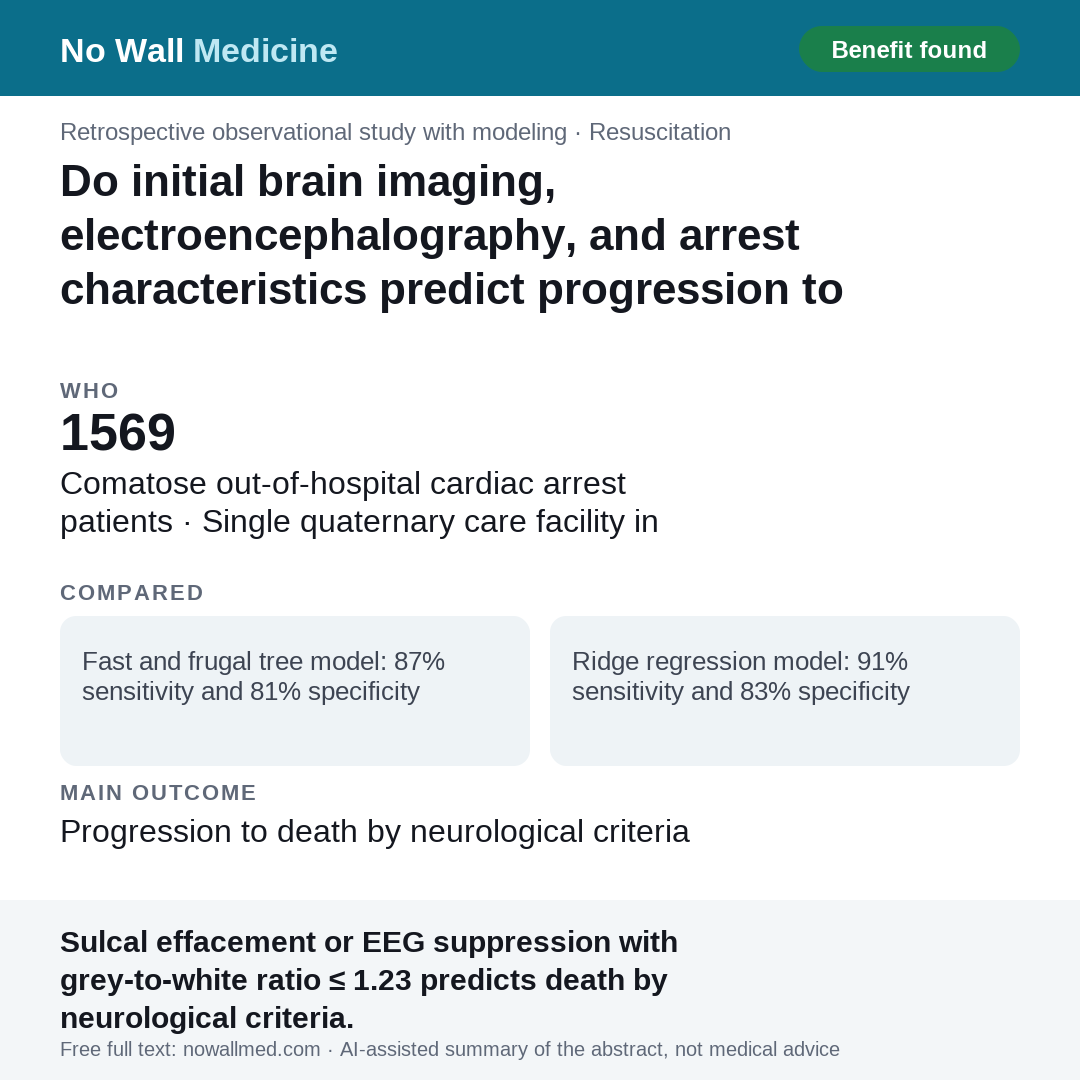
Clinical question: Do initial brain imaging, electroencephalography, and arrest characteristics predict progression to death by neurological criteria?
Why it matters: It is unknown if initial brain imaging, electrical brain activity, and arrest characteristics can predict which patients will progress to death by neurological criteria.
Key points
- Researchers studied 1,569 comatose patients after out-of-hospital cardiac arrest, finding that 147 (9%) progressed to death by neurological criteria.
- A clinical tool using sulcal effacement on brain scans or a combination of EEG suppression and a grey-to-white ratio ≤ 1.23 had a mean sensitivity of 87% and specificity of 81%.
- A ridge regression model using all available predictors showed a mean sensitivity of 91% and a mean specificity of 83%.
Headline and key points written with AI from the paper’s abstract, with every number checked against it. Read the paper before relying on them.
Was this summary helpful?
Subject terms
Cite this article
Coppler PJ, Flickinger KL, Darby JM, Doshi A, Guyette FX, Faro J. Early risk stratification for progression to death by neurological criteria following out-of-hospital cardiac arrest. Resuscitation. 2022. doi:10.1016/j.resuscitation.2022.07.029
Spotted a mistake? Suggest a correction
Top studies every Monday
The week’s key trials and guidelines in your specialties, plus any topics you follow. By email, free.
Get the weekly digest