Early skin inflammatory biomarker is predictive of development and persistence of atopic dermatitis in infants
Randomized, open-label trialKey finding
Are early skin inflammatory biomarkers predictive of atopic dermatitis development in infants?
Who
Infants with a parent with allergic disease
Compared
Infants with filaggrin wild-type genotype and high S100A8/9: predicted development of atopic dermatitis
Infants with filaggrin loss-of-function mutation
Main outcome
Development and persistence of atopic dermatitis
Bottom line: Higher S100A8/9 titers at eight weeks in filaggrin wild-type infants predict atopic dermatitis development.
JACI · 2024-03-07Download image
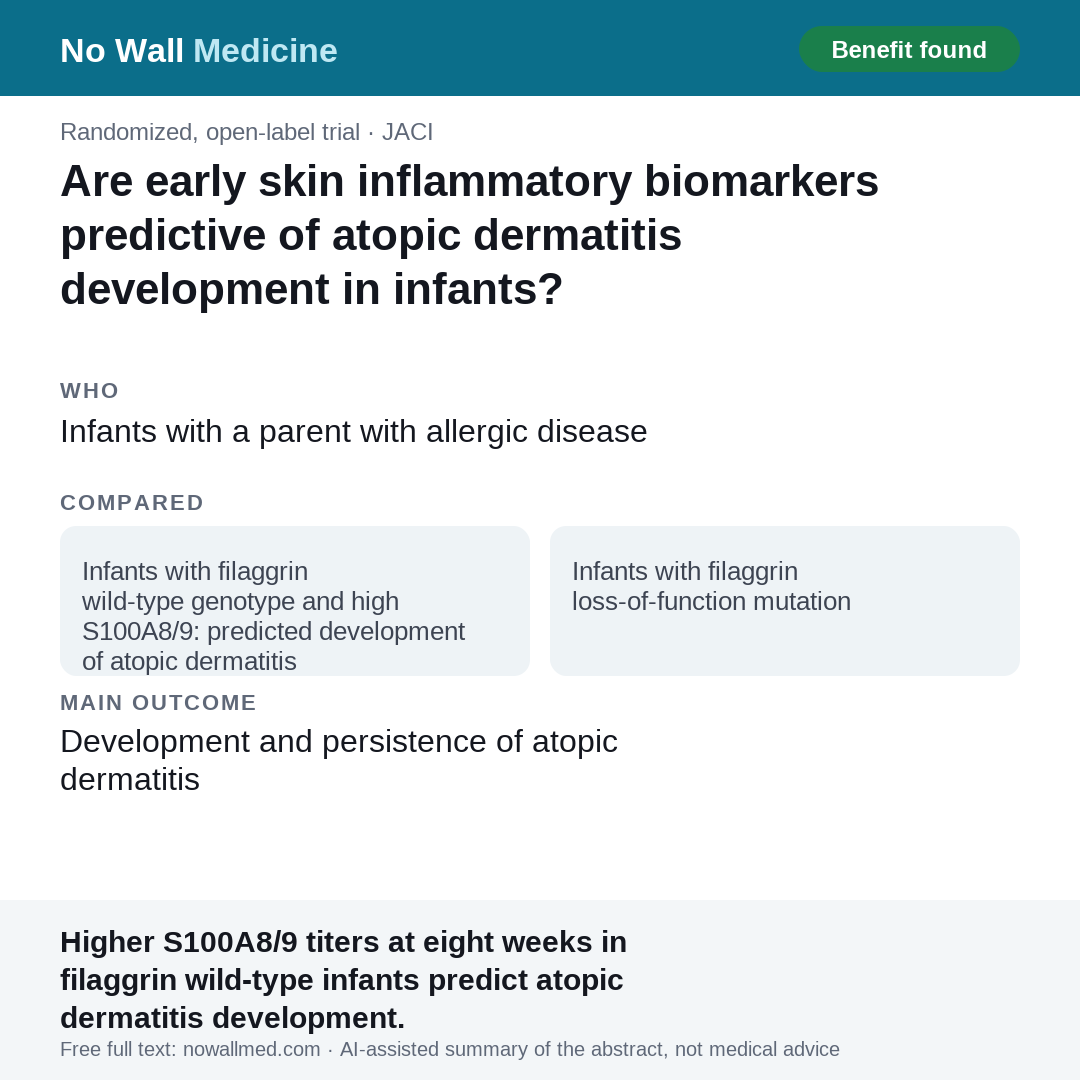
Clinical question: Are early skin inflammatory biomarkers predictive of atopic dermatitis development in infants?
Abstract
Background
The Short-Term Topical Application for Prevention of Atopic Dermatitis (STOP AD) study, a randomized, open-label trial evaluating the effect of short-term (from the first 4 postnatal days to age 8 weeks) skin barrier protection using Aveeno Dermexa Fast & Long-Lasting Balm (Johnson & Johnson, New Brunswick, NJ) in infants with a parent with allergic disease, demonstrated decreased cumulative incidence and decreased prevalence of atopic dermatitis (AD) at age 12 months. Objective
In the STOP AD study, we aimed to identify skin biomarkers that are associated with risk of development of AD. Methods
Skin swabs were collected from the cheek and antecubital fossa (AF) at baseline, age 8 weeks, and age 12 months from subsets of study participants from the intervention arm (n = 43 of 119) and control arm (n = 43 of 138) and were analyzed for specific cytokines (CCL27, CXCL2, human β-defensin-1 [hBD-1], IL-18, IL-8, IL-1α, IL-1 receptor antagonist [IL-1RA], IL-1β, S100A8/9, and IL-36γ) by ELISA. Results
Higher titers of S100A8/9 at the AF at age 8 weeks in infants with the filaggrin wild-type genotype (FLGwt), but not in those with filaggrin loss-of-function mutation (FLGmut), predicted (1) development of AD in the first year of life (P = .033), (2) presence of AD at ages 6 or 12 months (P = .009 and .035, respectively), (3) persistence of AD between ages 6 and 12 months (P < .001), and (4) development of AD with the emollient intervention. Conclusion
Increased titers of S100A8/9 from skin swabs of the AF in high-risk infants at age 8 weeks with FLGwt were predictive of AD development in the first year of life and other AD features. These findings suggest that there are different molecular pathways leading to AD in individuals with FLGmut and in individuals with FLGwt. Early identification of infants who are likely to develop AD will allow more targeted interventions.
Subject terms
Cite this article
Stamatas GN, Sato T, Chaoimh CN, et al. Early skin inflammatory biomarker is predictive of development and persistence of atopic dermatitis in infants. J Allergy Clin Immunol. 2024;153(6):1597-1603.e4. doi:10.1016/j.jaci.2024.02.018
Spotted a mistake? Suggest a correction