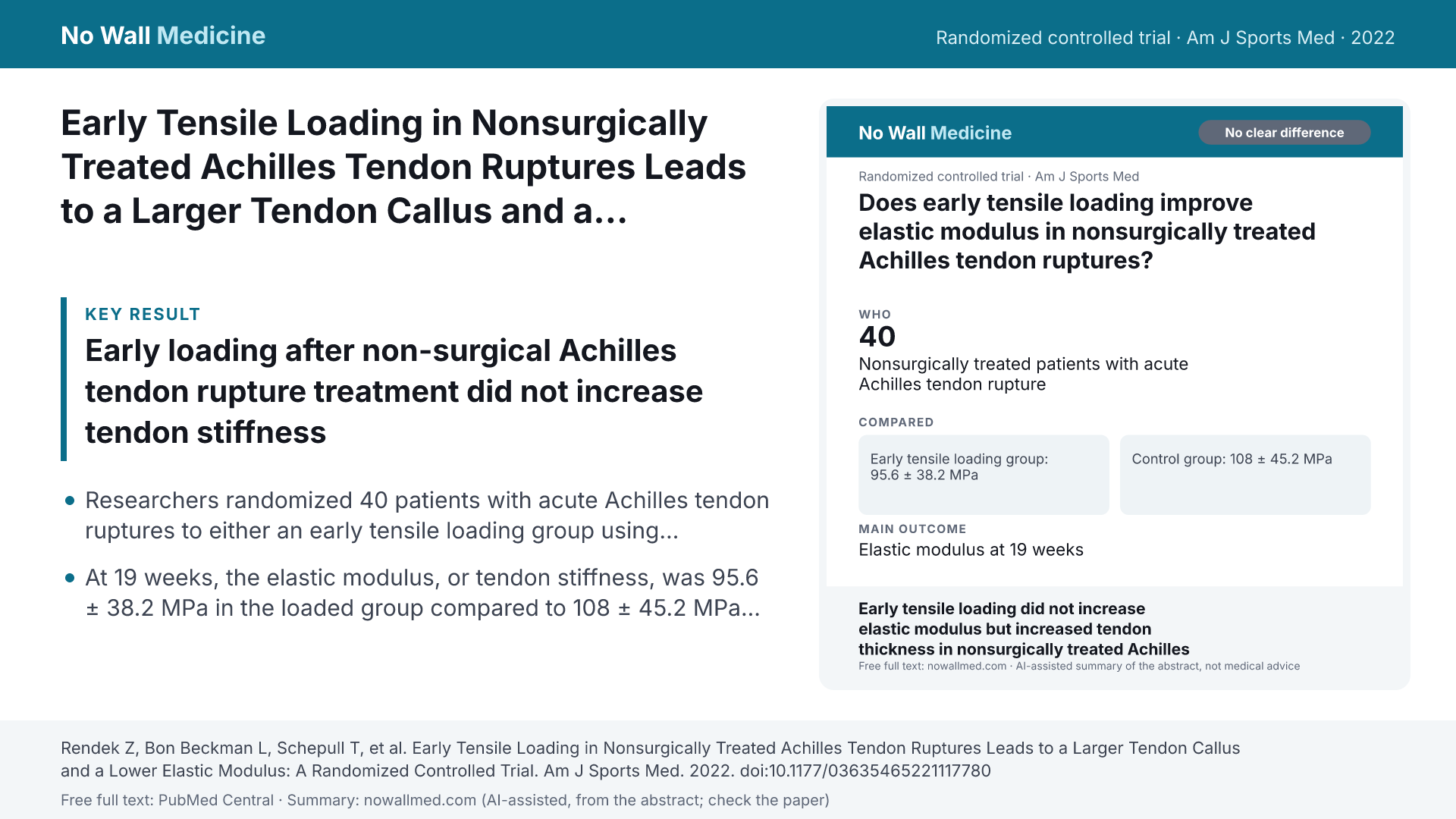
Early Tensile Loading in Nonsurgically Treated Achilles Tendon Ruptures Leads to a Larger Tendon Callus and a Lower Elastic Modulus: A Randomized Controlled Trial
Key result: Early loading after non-surgical Achilles tendon rupture treatment did not increase tendon stiffness
Randomized controlled trialNo clear difference
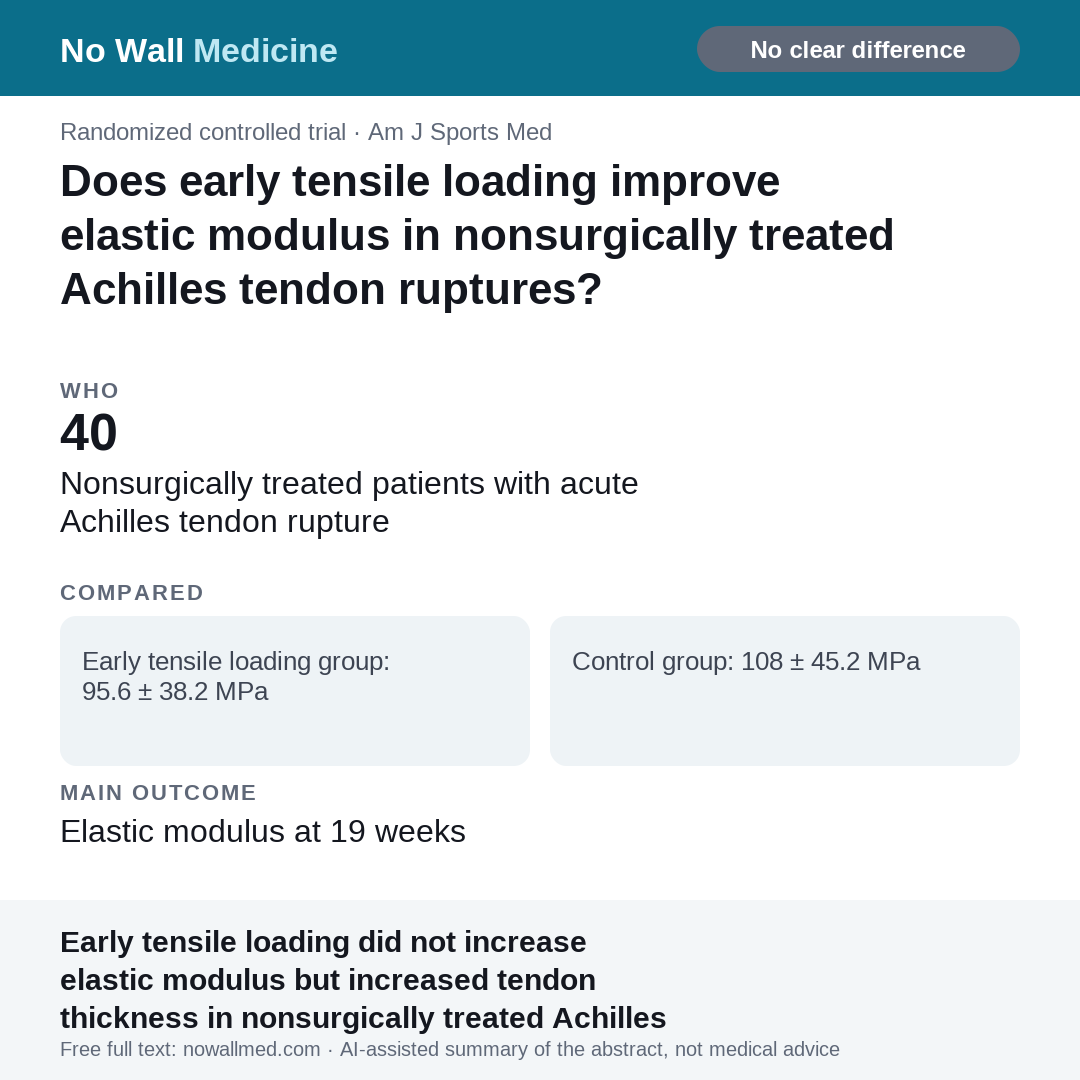
Does early tensile loading improve elastic modulus in nonsurgically treated Achilles tendon ruptures?
Who
40
Nonsurgically treated patients with acute Achilles tendon rupture
Compared
Early tensile loading group: 95.6 ± 38.2 MPa
Control group: 108 ± 45.2 MPa
Main outcome
Elastic modulus at 19 weeks
Bottom line: Early tensile loading did not increase elastic modulus but increased tendon thickness in nonsurgically treated Achilles tendon ruptures.
Am J Sports Med · 2022-08-25Download image
Key points
- Researchers randomized 40 patients with acute Achilles tendon ruptures to either an early tensile loading group using a training pedal or a control group.
- At 19 weeks, the elastic modulus, or tendon stiffness, was 95.6 ± 38.2 MPa in the loaded group compared to 108 ± 45.2 MPa in controls.
- The loaded group showed a larger tendon cross-sectional area of 302 ± 62.4 mm2 compared to 252 ± 49.2 mm2 in controls at 52 weeks.
Discussion prompts
- Would these patients look like yours? Who was left out?
- Is the main outcome one that matters to patients?
- Is the difference large enough to change what you do?
Cite: Rendek Z, Bon Beckman L, Schepull T, et al. Early Tensile Loading in Nonsurgically Treated Achilles Tendon Ruptures Leads to a Larger Tendon Callus and a Lower Elastic Modulus: A Randomized Controlled Trial. Am J Sports Med. 2022. doi:10.1177/03635465221117780
Free full text: PubMed Central · Summary and visual abstract: nowallmed.com/a/early-tensile-loading-in-nonsurgically-treated-achilles-tendon-1bin5us/ (AI-assisted from the abstract; check the paper before relying on it).