Early versus delayed lengthening exercises showed no difference in return to sport for hamstring injuries
Early versus delayed lengthening exercises for acute hamstring injury in male athletes: a randomised controlled clinical trial
Randomised controlled superiority trialNo clear difference
Does early versus delayed lengthening exercises affect return to sport for acute hamstring injury?
Who
90
90 male participants with MRI-confirmed acute hamstring injury
Compared
early lengthening: 23 (IQR 16-35) days
delayed lengthening: 33 (IQR 23-40) days
Main outcome
time to return to sport
Result: adjusted hazard ratio 0.95 (95% CI 0.56 to 1.60)
Bottom line: Early introduction of lengthening exercises did not improve return to sport time or reinjury risk.
Br J Sports Med · 2022-03-25Download image
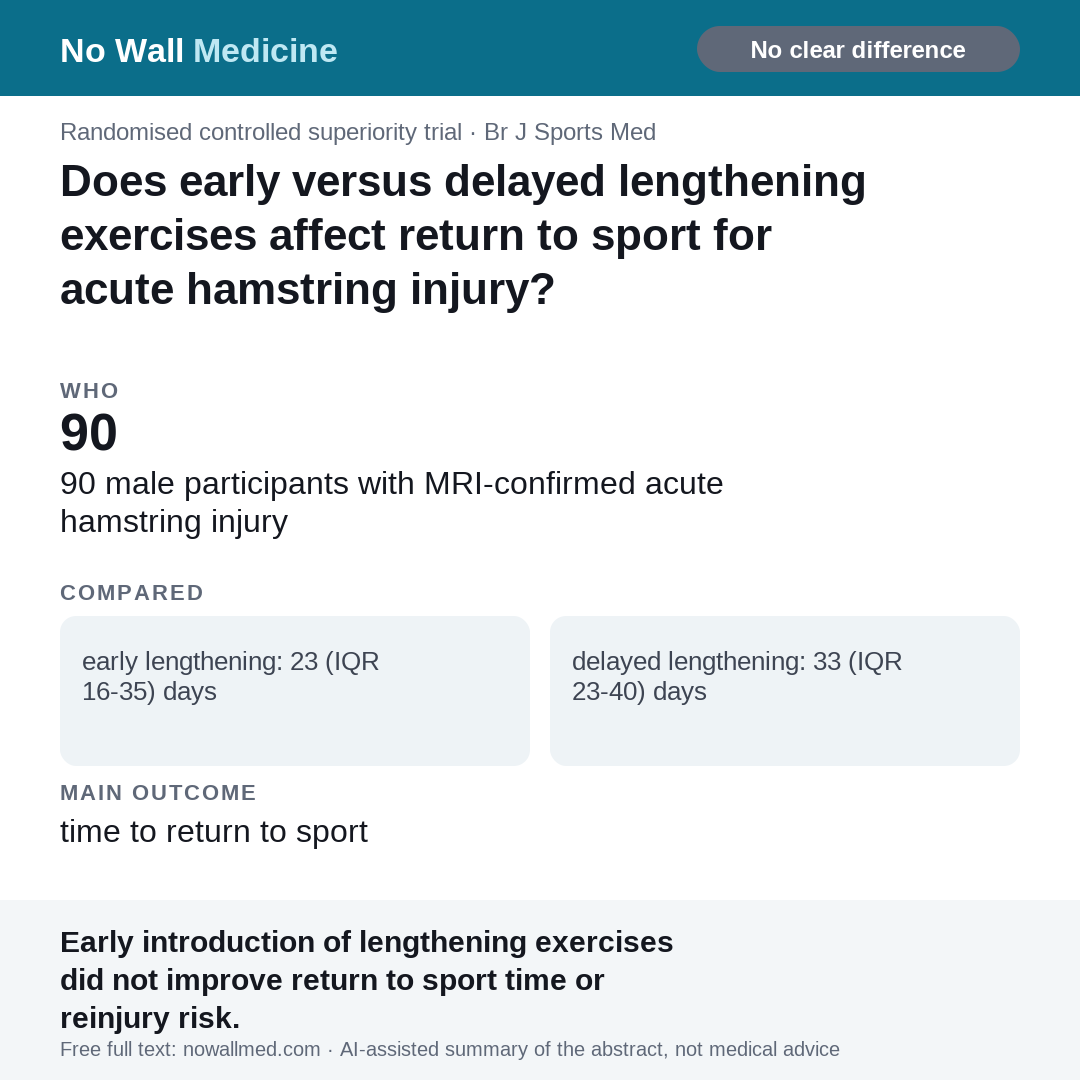
Clinical question: Does early versus delayed lengthening exercises affect return to sport for acute hamstring injury?
Why it matters: It is unknown whether starting eccentric strengthening exercises on the first day of rehabilitation improves the time athletes take to return to sport compared to waiting until they can run at 70% speed.
Key points
- The study followed 90 male participants with MRI-confirmed acute hamstring injuries who were randomized to receive either early or delayed lengthening exercises, which are eccentric strengthening movements.
- The median time to return to sport was 23 (IQR 16-35) days for the early group and 33 (IQR 23-40) days for the delayed group, with no significant difference found.
- There were no significant differences between the groups regarding reinjury rates at 2 months, 2 to 6 months, or 6 to 12 months after returning to sport.
Headline and key points written with AI from the paper’s abstract, with every number checked against it. Read the paper before relying on them.
Was this summary helpful?
Abstract
Background
To evaluate the efficacy of early versus delayed introduction of lengthening (ie, eccentric strengthening) exercises in addition to an established rehabilitation programme on return to sport duration for acute hamstring injuries in a randomised controlled superiority trial. Methods
90 male participants (age: 18-36 years, median 26 years) with an MRI-confirmed acute hamstring injury were randomised into an early lengthening (at day 1 of rehabilitation) group or a delayed lengthening (after being able to run at 70% of maximal speed) group. Both groups received an established rehabilitation programme. The primary outcome was time to return to sport (ie, time from injury to full unrestricted training and/or match play). The secondary outcome was reinjury rate within 12 months after return to sport. Other outcomes at return to sport included the Askling H-test, hamstring strength, clinical examination and readiness questions. Results
The return to sport in the early lengthening group was 23 (IQR 16-35) days and 33 (IQR 23-40) days in the delayed lengthening group. For return to sport (in days), the adjusted HR for the early lengthening group compared with the delayed lengthening group was 0.95 (95% CI 0.56 to 1.60, p=0.84). There was no significant difference between groups for reinjury rates within 2 months (OR=0.94, 95% CI 0.18 to 5.0, p=0.94), from 2 to 6 months (OR=2.00, 95% CI 0.17 to 23.3, p=0.58), and 6 to 12 months (OR=0.57, 95% CI 0.05 to 6.6, p=0.66). Conclusion
Accelerating the introduction of lengthening exercises in the rehabilitation of hamstring injury in male athletes did not improve the time to return to sport nor the risk of reinjury.
Abstract reproduced under the article’s CC BY NC licence.
Subject terms
Cite this article
Vermeulen R, Whiteley R, van der Made AD, van Dyk N, Almusa E, Geertsema C. Early versus delayed lengthening exercises for acute hamstring injury in male athletes: a randomised controlled clinical trial. Br J Sports Med. 2022. doi:10.1136/bjsports-2020-103405
Spotted a mistake? Suggest a correction
Top studies every Monday
The week’s key trials and guidelines in your specialties, plus any topics you follow. By email, free.
Get the weekly digest