Pegcetacoplan treatment for 48 months reduced the growth rate of geographic atrophy area
Early Versus Delayed Pegcetacoplan Treatment for Geographic Atrophy Secondary to Age-Related Macular Degeneration in OAKS, DERBY, and GALE
Phase 3 open-label extension analysisBenefit found
Is early versus delayed pegcetacoplan treatment effective for geographic atrophy?
Who
Eyes with nonsubfoveal or subfoveal geographic atrophy secondary to age-related macular degeneration
Compared
Early treatment group: up to 24% reduction in GA area growth rate
Delayed treatment group: projected sham
Main outcome
Geographic atrophy area growth rate
Bottom line: Early pegcetacoplan treatment slows geographic atrophy progression and maximizes retinal tissue and function preservation.
Am J Ophthalmol · 2026-08-28Download image
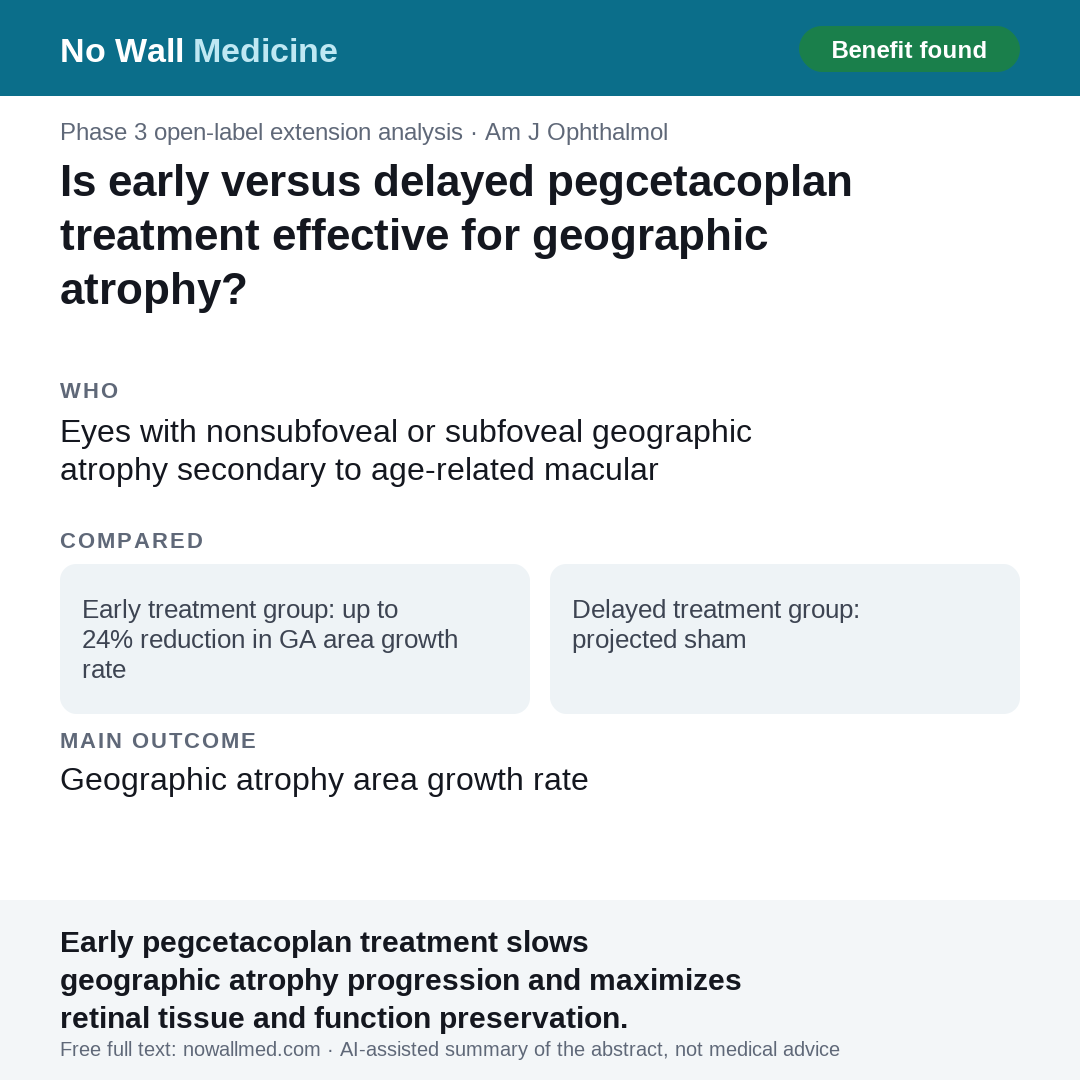
Clinical question: Is early versus delayed pegcetacoplan treatment effective for geographic atrophy?
Why it matters: Researchers investigated whether starting pegcetacoplan treatment early or delaying it would affect the preservation of retinal tissue and vision in patients with geographic atrophy.
Key points
- Researchers analyzed eyes with geographic atrophy, a form of vision loss, comparing early treatment to delayed treatment across the OAKS, DERBY, and GALE studies.
- Continuous treatment for 48 months reduced the growth rate of the atrophy area by up to 24%, preserving 1.88 mm2 of retinal tissue.
- The risk of progressing to an absolute scotoma, or a blind spot, was reduced by 32% for all central 4 loci and 43% for 16 loci.
Headline and key points written with AI from the paper’s abstract, with every number checked against it. Read the paper before relying on them.
Topics
Cite this article
Dhoot DS, Singerman LJ, Ferrone PJ, Wykoff CC, Goldberg RA, Guymer RH. Early Versus Delayed Pegcetacoplan Treatment for Geographic Atrophy Secondary to Age-Related Macular Degeneration in OAKS, DERBY, and GALE. Am J Ophthalmol. 2026. doi:10.1016/j.ajo.2026.08.028
Spotted a mistake? Suggest a correction