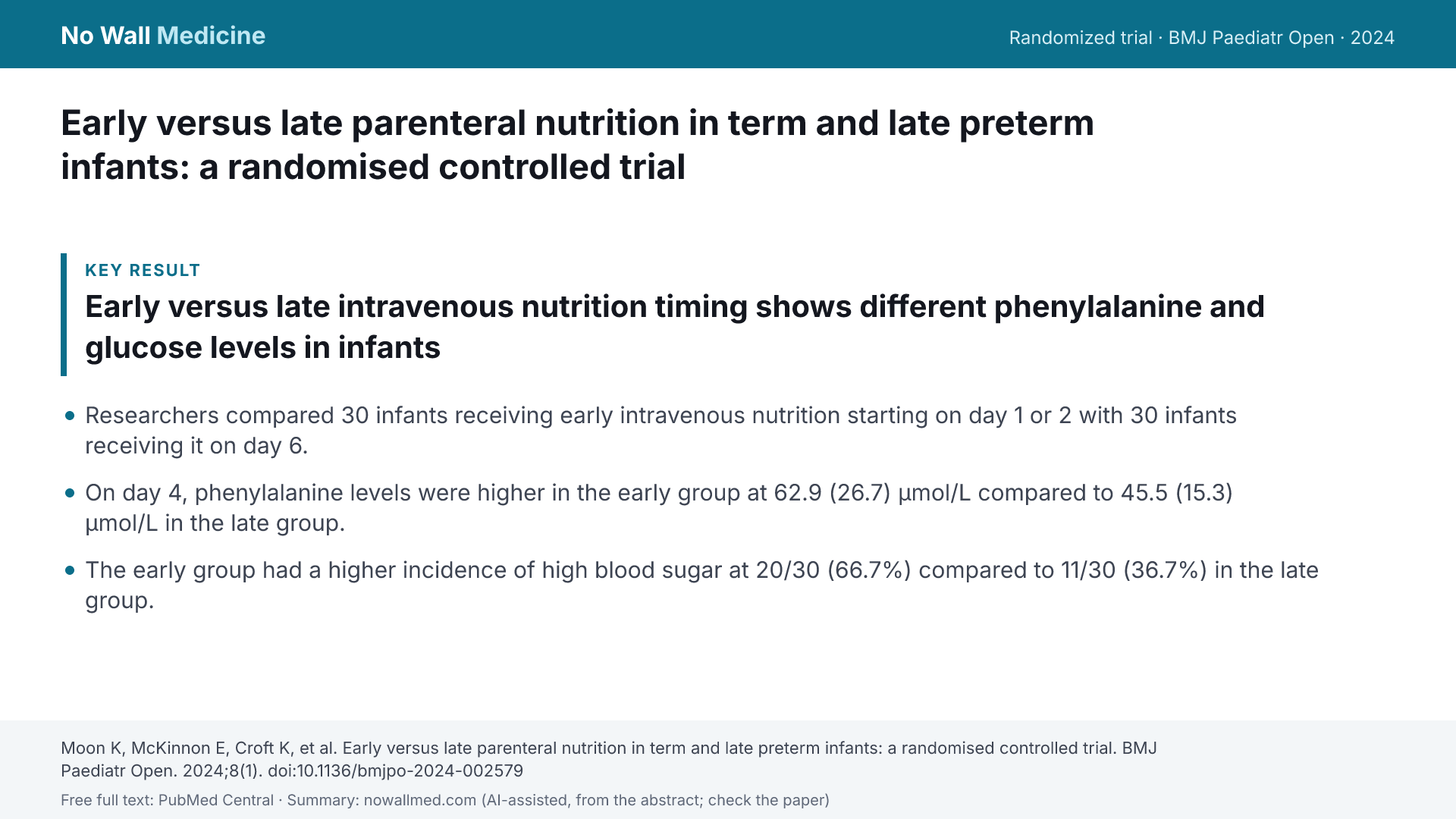
Early versus late intravenous nutrition timing shows different phenylalanine and glucose levels in infants
Early versus late parenteral nutrition in term and late preterm infants: a randomised controlled trial
Key points
- Researchers compared 30 infants receiving early intravenous nutrition starting on day 1 or 2 with 30 infants receiving it on day 6.
- On day 4, phenylalanine levels were higher in the early group at 62.9 (26.7) µmol/L compared to 45.5 (15.3) µmol/L in the late group.
- The early group had a higher incidence of high blood sugar at 20/30 (66.7%) compared to 11/30 (36.7%) in the late group.
Limitation the authors note: This was a single-centre, non-blinded, exploratory randomised controlled trial.
Headline and key points written with AI from the paper’s abstract, with every number checked against it. Read the paper before relying on them.
Was this summary helpful?
Abstract
Background
There is limited evidence regarding the optimal time to commence parenteral nutrition (PN) in term and late preterm infants. Design
Single-centre, non-blinded, exploratory randomised controlled trial. Setting
A level-3 neonatal unit in a stand-alone paediatric hospital. Patients
Infants born ≥34 weeks of gestation and ≤28 days, who needed PN. Eligible infants were randomised on day 1 or day 2 of admission. Interventions
Early (day 1 or day 2 of admission, N=30) or late (day 6 of admission, N=30) PN. Main outcome measures
Plasma phenylalanine and F2-isoprostane levels on day 4 and day 8 of admission. Secondary outcomes were amino-acid and fatty-acid profiles on day 4 and day 8, and clinical outcomes. Results
The postnatal age at randomisation was similar between the groups (2.3 (SD 0.8) vs 2.3 (0.7) days, p=0.90). On day 4, phenylalanine levels in early-PN infants were higher than in late-PN (mean (SD) 62.9 (26.7) vs 45.5 (15.3) µmol/L; baseline-adjusted percentage difference 25.8% (95% CI 11.6% to 39.9%), p<0.001). There was no significant difference in phenylalanine levels between the two groups on day 8. There was no significant difference between the groups for F2-isoprostane levels on day 4 (early-PN mean (SD) 389 (176) vs late-PN 419 (291) pg/mL; baseline-adjusted percentage difference: -4.4% (95% CI -21.5% to 12.8%) p=0.62) and day 8 (mean (SD) 305 (125) vs 354 (113) pg/mL; adjusted mean percentage difference -16.1 (95% CI -34.1 to 1.9) p=0.09).Postnatal growth restriction for weight was less severe in the early-PN group (change in weight z-score from baseline to discharge: -0.6 (0.6) vs -1.0 (0.6); p=0.02). The incidence of hyperglycaemia was greater in the early-PN group (20/30 (66.7%) vs 11/30 (36.7%), p=0.02). Conclusions
The timing of the commencement of PN did not seem to affect the degree of oxidative stress in critically ill term and late preterm infants. The effect of transiently high plasma phenylalanine with early PN on clinical outcomes requires further investigation. Trial registration number
ACTRN12620000324910.
Abstract reproduced under the article’s CC BY NC licence.
Subject terms
Headline, design, result, key points, caveat and citation as plain text.
Cite this article
Moon K, McKinnon E, Croft K, et al. Early versus late parenteral nutrition in term and late preterm infants: a randomised controlled trial. BMJ Paediatr Open. 2024;8(1). doi:10.1136/bmjpo-2024-002579
Spotted a mistake? Suggest a correction