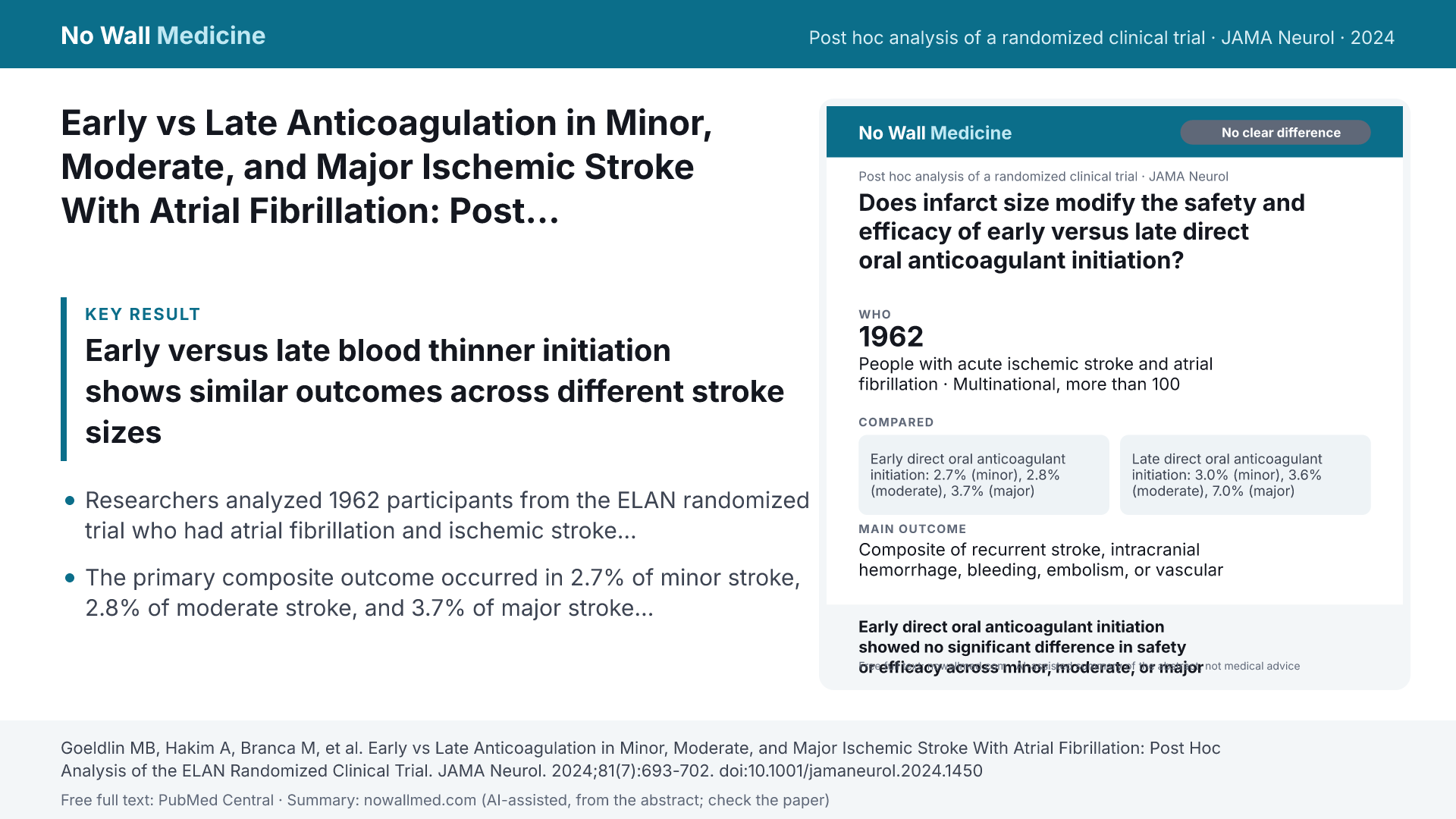
Early versus late blood thinner initiation shows similar outcomes across different stroke sizes
Early vs Late Anticoagulation in Minor, Moderate, and Major Ischemic Stroke With Atrial Fibrillation: Post Hoc Analysis of the ELAN Randomized Clinical Trial
Post hoc analysis of a randomized clinical trialNo clear difference
Does infarct size modify the safety and efficacy of early versus late direct oral anticoagulant initiation?
Who
1962
People with acute ischemic stroke and atrial fibrillation · Multinational, more than 100 sites in 15 countries
Compared
Early direct oral anticoagulant initiation: 2.7% (minor), 2.8% (moderate), 3.7% (major)
Late direct oral anticoagulant initiation: 3.0% (minor), 3.6% (moderate), 7.0% (major)
Main outcome
Composite of recurrent stroke, intracranial hemorrhage, bleeding, embolism, or vascular death
Result: no significant treatment interaction
Bottom line: Early direct oral anticoagulant initiation showed no significant difference in safety or efficacy across minor, moderate, or major strokes.
JAMA Neurol · 2024-05-28Download image
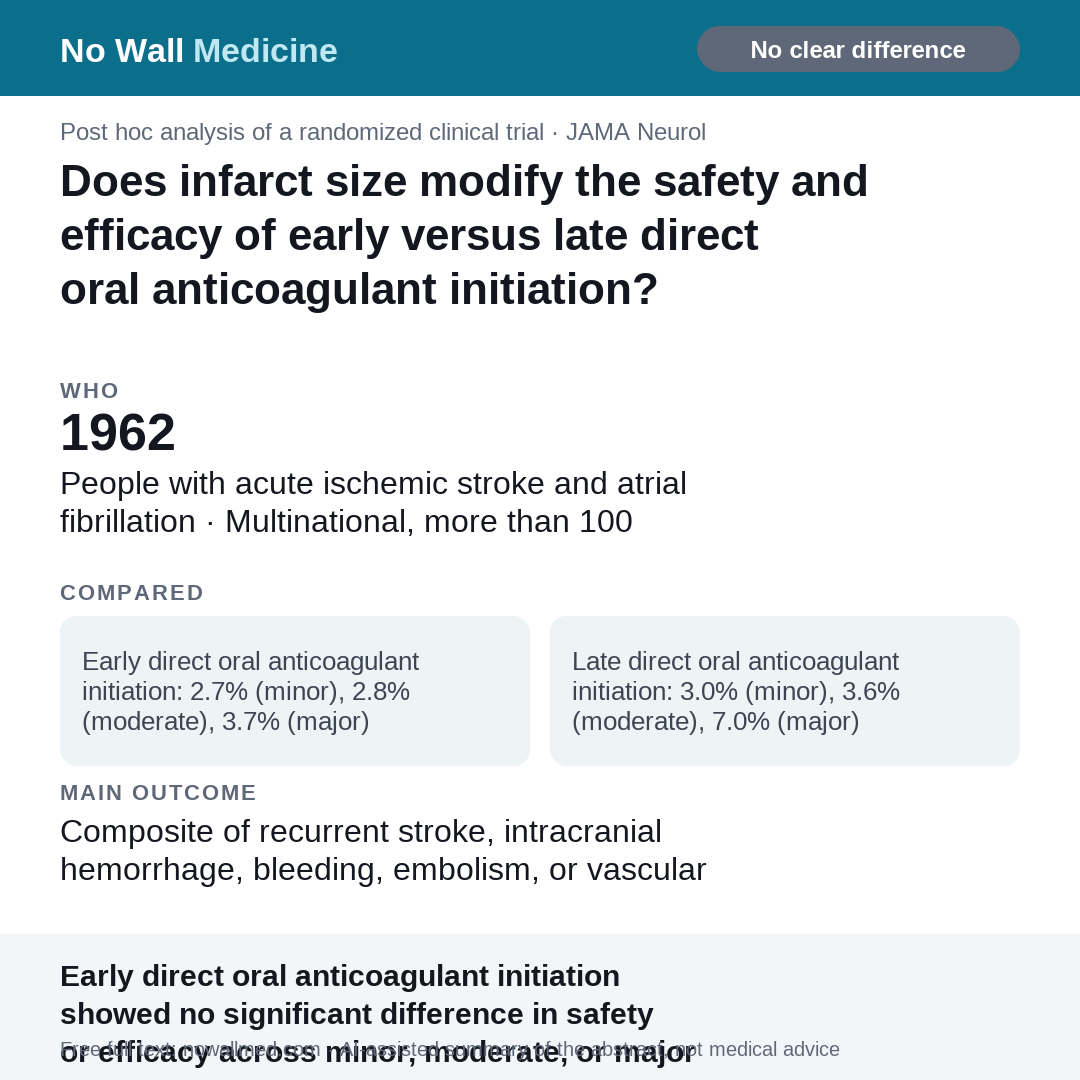
Clinical question: Does infarct size modify the safety and efficacy of early versus late direct oral anticoagulant initiation?
Why it matters: It was unknown if the size of a brain infarct modifies the safety and efficacy of starting direct oral anticoagulants early versus late after a stroke.
Key points
- Researchers analyzed 1962 participants from the ELAN randomized trial who had atrial fibrillation and ischemic stroke with available brain imaging.
- The primary composite outcome occurred in 2.7% of minor stroke, 2.8% of moderate stroke, and 3.7% of major stroke patients receiving early direct oral anticoagulant initiation.
- The primary outcome occurred in 3.0% of minor stroke, 3.6% of moderate stroke, and 7.0% of major stroke patients receiving late direct oral anticoagulant initiation.
Headline and key points written with AI from the paper’s abstract, with every number checked against it. Read the paper before relying on them.
Was this summary helpful?
Subject terms
Cite this article
Goeldlin MB, Hakim A, Branca M, Abend S, Kneihsl M, Valenzuela Pinilla W. Early vs Late Anticoagulation in Minor, Moderate, and Major Ischemic Stroke With Atrial Fibrillation: Post Hoc Analysis of the ELAN Randomized Clinical Trial. JAMA Neurol. 2024. doi:10.1001/jamaneurol.2024.1450
Spotted a mistake? Suggest a correction