Eating Behaviors, Caregiver Feeding Interactions, and Dietary Patterns of Children Born Preterm: A Systematic Review and Meta-Analysis
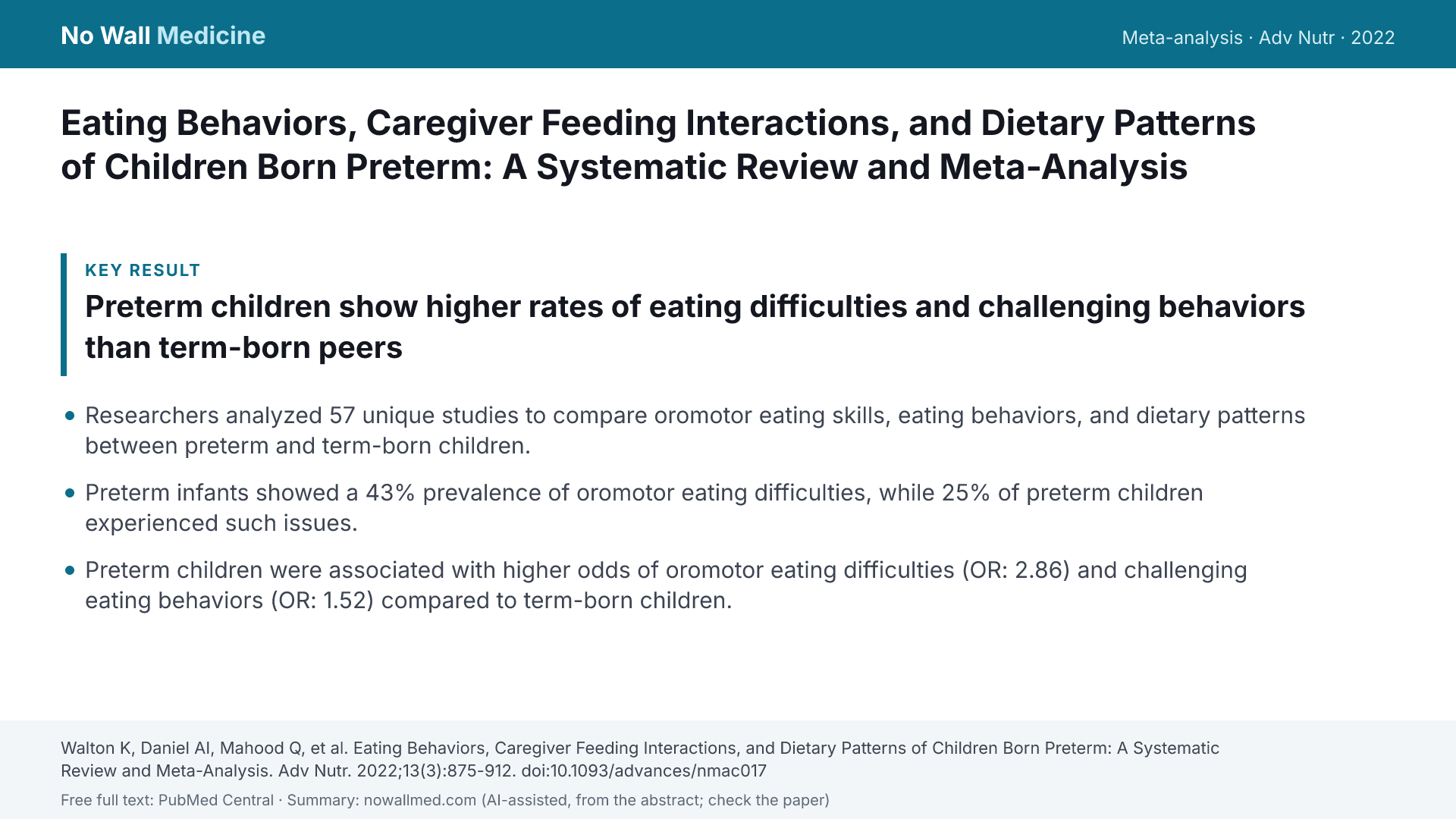
Key result: Preterm children show higher rates of eating difficulties and challenging behaviors than term-born peers
Key points
- Researchers analyzed 57 unique studies to compare oromotor eating skills, eating behaviors, and dietary patterns between preterm and term-born children.
- Preterm infants showed a 43% prevalence of oromotor eating difficulties, while 25% of preterm children experienced such issues.
- Preterm children were associated with higher odds of oromotor eating difficulties (OR: 2.86) and challenging eating behaviors (OR: 1.52) compared to term-born children.
Discussion prompts
- Would these patients look like yours? Who was left out?
- Is the main outcome one that matters to patients?
- Is the difference large enough to change what you do?
Cite: Walton K, Daniel AI, Mahood Q, et al. Eating Behaviors, Caregiver Feeding Interactions, and Dietary Patterns of Children Born Preterm: A Systematic Review and Meta-Analysis. Adv Nutr. 2022;13(3):875-912. doi:10.1093/advances/nmac017
Free full text: PubMed Central · Summary and visual abstract: nowallmed.com/a/eating-behaviors-caregiver-feeding-interactions-and-dietary-patterns-1kp6fov/ (AI-assisted from the abstract; check the paper before relying on it).