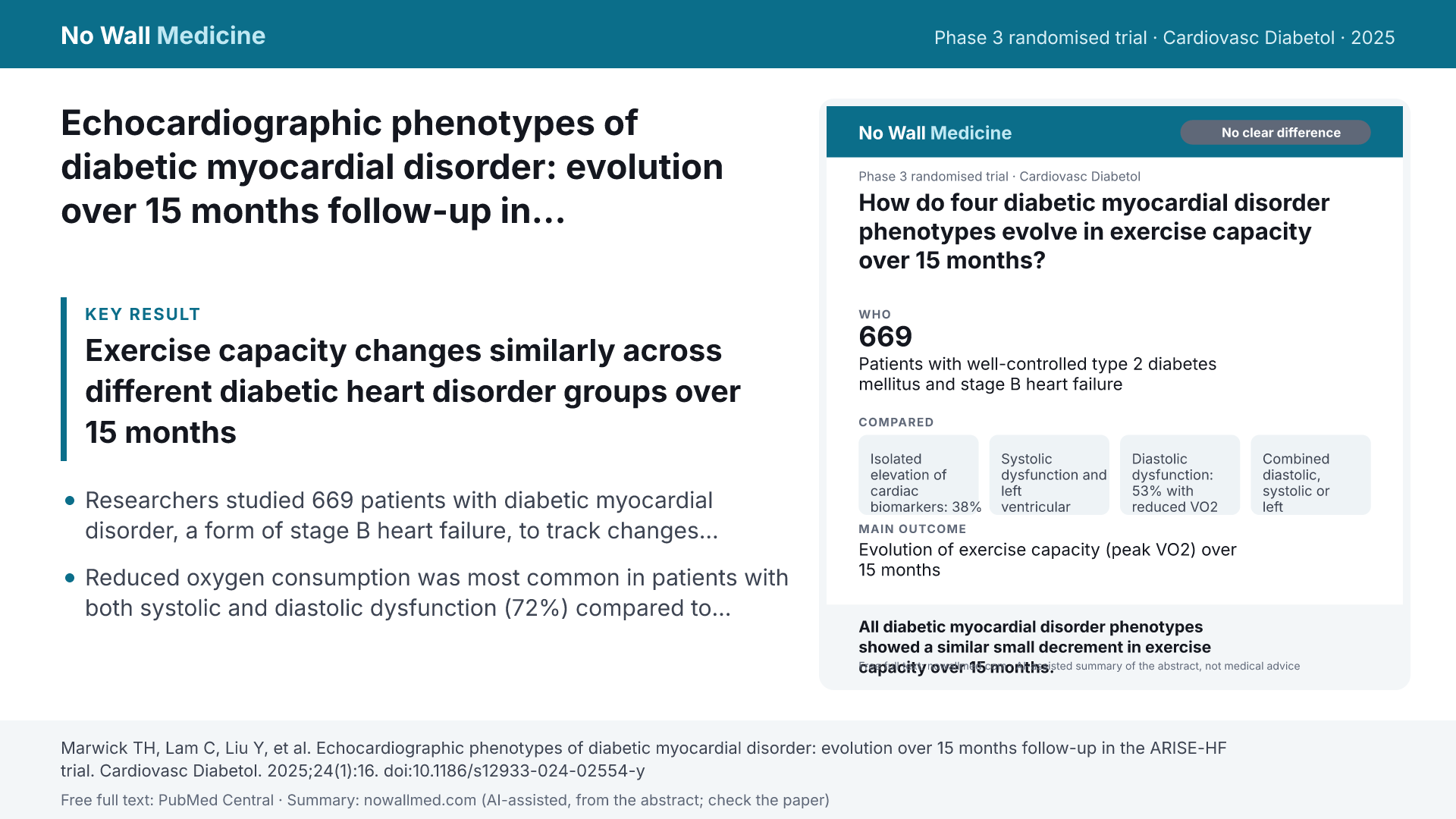
Exercise capacity changes similarly across different diabetic heart disorder groups over 15 months
Echocardiographic phenotypes of diabetic myocardial disorder: evolution over 15 months follow-up in the ARISE-HF trial
Phase 3 randomised trialNo clear difference
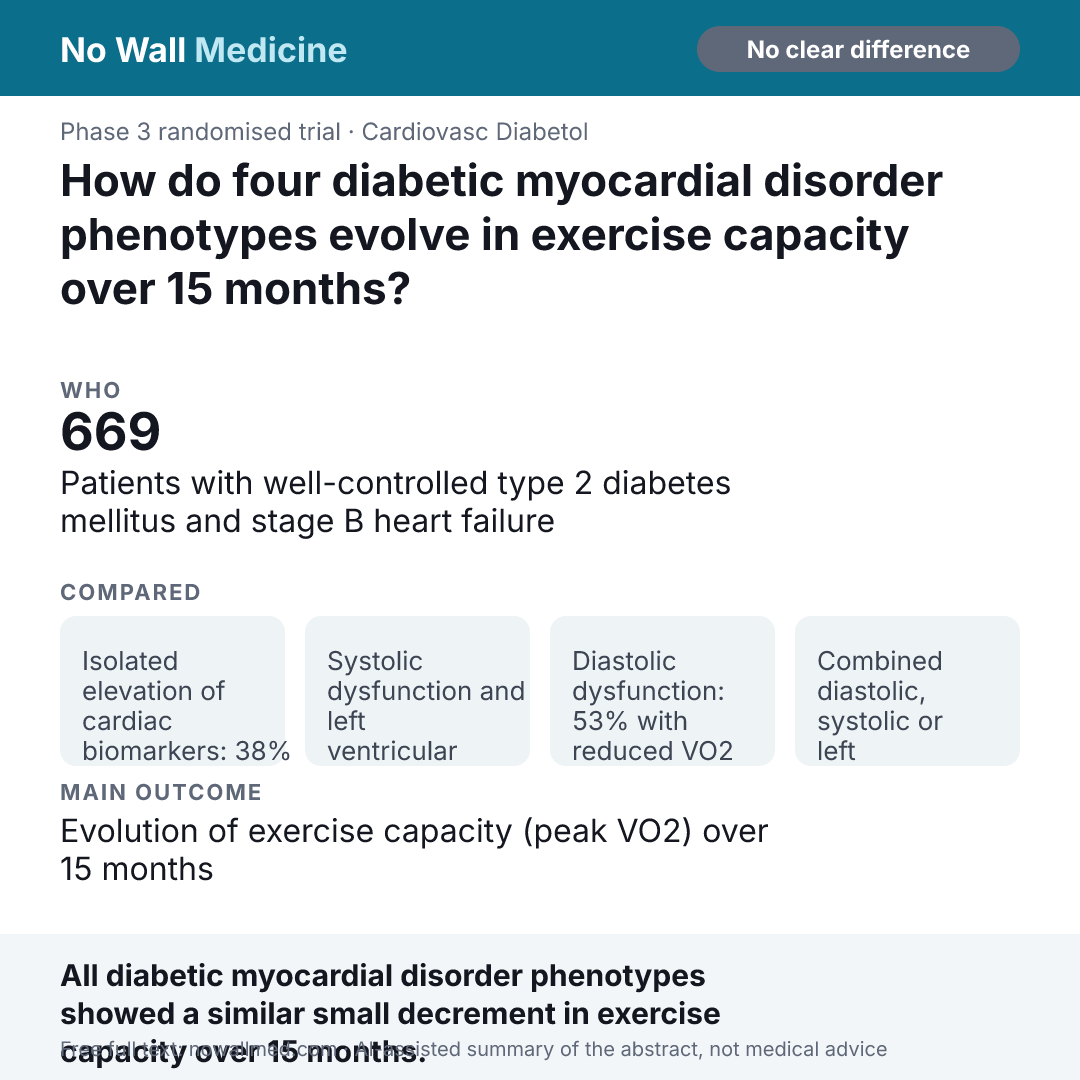
How do four diabetic myocardial disorder phenotypes evolve in exercise capacity over 15 months?
Who
669
Patients with well-controlled type 2 diabetes mellitus and stage B heart failure
Compared
Isolated elevation of cardiac biomarkers: 38% with reduced VO2
Systolic dysfunction and left ventricular hypertrophy: 56% with reduced VO2
Diastolic dysfunction: 53% with reduced VO2
Combined diastolic, systolic or left ventricular geometric abnormalities: 72% with reduced VO2
Main outcome
Evolution of exercise capacity (peak VO2) over 15 months
Bottom line: All diabetic myocardial disorder phenotypes showed a similar small decrement in exercise capacity over 15 months.
Cardiovasc Diabetol · 2025-01-13 · Save PNG
Same trial (NCT04083339)
Papers we list that report this registered trial, oldest first. Read a secondary analysis alongside the main results.
- Main results No clear difference
Selective aldose reductase inhibitor did not significantly stabilize exercise capacity in diabetic cardiomyopathy patients JACC 2024-04 - Secondary analysis Mixed results
NT-proBNP levels were linked to lower functional capacity but not heart structure abnormalities in diabetes Cardiovasc Diabetol 2024-08 - Related analysis No clear difference
This paper Cardiovasc Diabetol 2025-01 - Secondary analysis No clear difference
High-dose AT-001 treatment response was similar for men and women with diabetic cardiomyopathy JACC Heart Fail 2025-05
Clinical question: How do four diabetic myocardial disorder phenotypes evolve in exercise capacity over 15 months?
Key points
- Researchers studied 669 patients with diabetic myocardial disorder, a form of stage B heart failure, to track changes in peak oxygen consumption over 15 months.
- Reduced oxygen consumption was most common in patients with both systolic and diastolic dysfunction (72%) compared to those with biomarkers alone (38%).
- All four identified groups of patients showed a similar small decrease in exercise capacity during the 15-month follow-up period.
Headline and key points written with AI from the paper’s abstract, with every number checked against it. Read the paper before relying on them.
Was this summary helpful?
Subject terms
Headline, design, result, key points, caveat and citation as plain text.
Cite this article
Marwick TH, Lam C, Liu Y, et al. Echocardiographic phenotypes of diabetic myocardial disorder: evolution over 15 months follow-up in the ARISE-HF trial. Cardiovasc Diabetol. 2025;24(1):16. doi:10.1186/s12933-024-02554-y
Spotted a mistake? Suggest a correction