Endometrial scratching shows uncertain cost-effectiveness for increasing live birth rates in second IVF/ICSI cycles
Economic evaluation of endometrial scratching before the second IVF/ICSI treatment: a cost-effectiveness analysis of a randomized controlled trial (SCRaTCH trial)
Multicentre randomized controlled trialUnclear result
Is endometrial scratching before the second IVF/ICSI treatment cost-effective compared to no scratch?
Who
933
933 women with a failed first IVF/ICSI cycle · The Netherlands
Compared
44.1%Endometrial scratch
39.3%No scratch
Main outcome
Chance of a live birth after 12 months of follow-up
Result: risk difference 4.8%, 95% CI -1.6% to +11.2%
Bottom line: Endometrial scratching showed more live births but higher costs, with high uncertainty regarding its cost-effectiveness.
Limitation: High uncertainty surrounding the clinical effect, specifically the difference in the chance of live birth.
Hum Reprod · 2021-12-06Download image
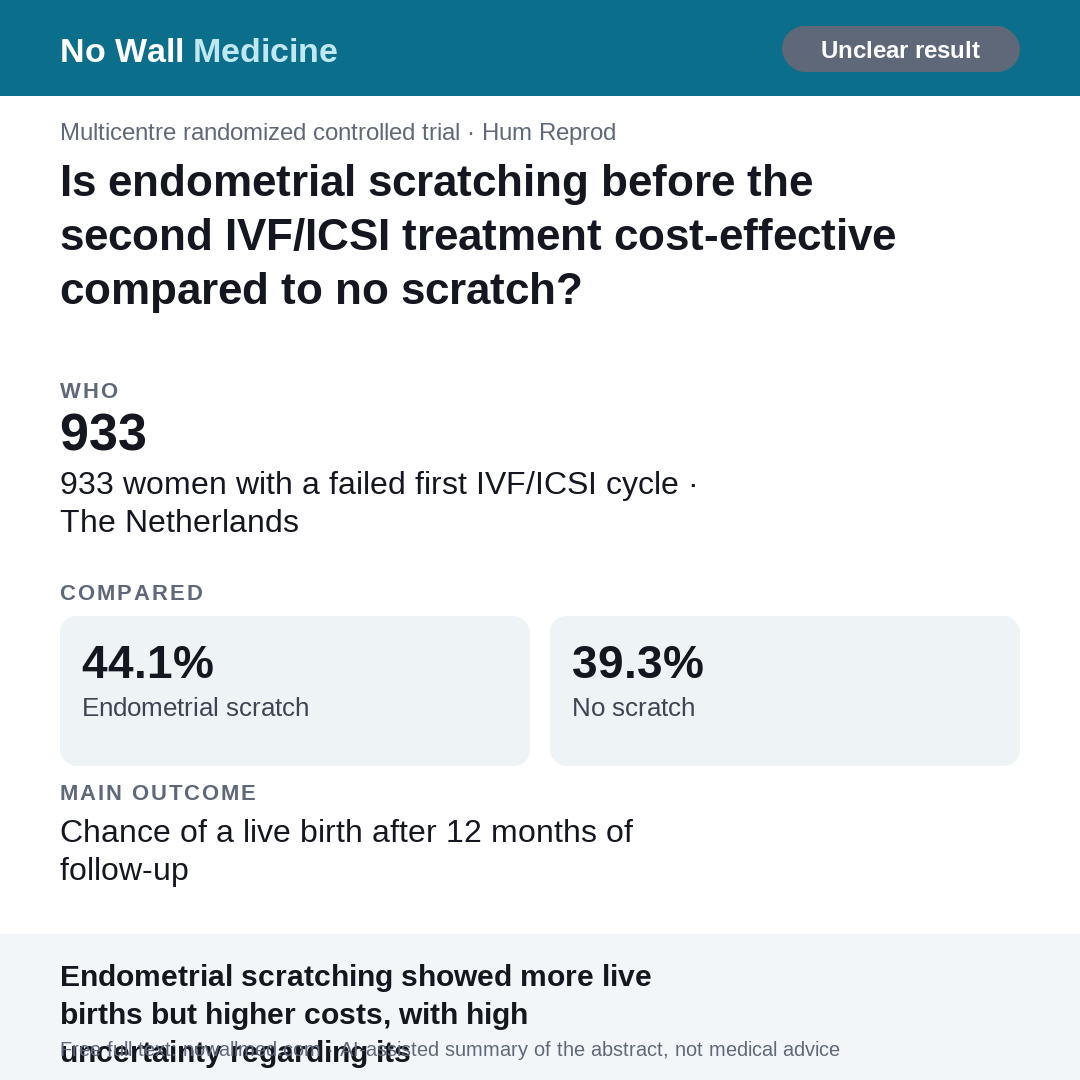
Clinical question: Is endometrial scratching before the second IVF/ICSI treatment cost-effective compared to no scratch?
Why it matters: It was unknown if performing an endometrial scratch before a second IVF/ICSI treatment is a cost-effective method to reduce the number of cycles needed for a live birth.
Key points
- Researchers studied 933 women with a failed first in vitro fertilization/intracytoplasmic sperm injection cycle to compare a single endometrial scratch to no scratch.
- The live birth rate after 12 months was 44.1% in the scratch group compared to 39.3% in the control group, with a risk difference of 4.8%.
- The scratch group had mean costs that were on average €283 higher, resulting in a point average incremental cost-effectiveness ratio of €5846 per additional live birth.
Limitation the authors note: There was a high uncertainty surrounding the clinical effect, specifically the difference in the chance of live birth.
Headline and key points written with AI from the paper’s abstract, with every number checked against it. Read the paper before relying on them.
Was this summary helpful?
Subject terms
Cite this article
van Hoogenhuijze NE, van Eekelen R, Mol F, Schipper I, Groenewoud ER, Traas MAF. Economic evaluation of endometrial scratching before the second IVF/ICSI treatment: a cost-effectiveness analysis of a randomized controlled trial (SCRaTCH trial). Hum Reprod. 2021. doi:10.1093/humrep/deab261
Spotted a mistake? Suggest a correction
Top studies every Monday
The week’s key trials and guidelines in your specialties, plus any topics you follow. By email, free.
Get the weekly digest