Fall prevention exercise programs are likely cost-effective for older adults living in the community
Economic evaluations of fall prevention exercise programs: a systematic review
Systematic reviewBenefit found
Are fall prevention exercise programmes cost-effective for older adults?
Who
31
Older adults living in the community or care facilities
Compared
Community-dwelling older adults: ICER up to US$279 802/QALY gained
Care facilities: ICER up to US$35/fall prevented
Main outcome
Cost-effectiveness and costs of fall prevention exercise programmes
Result: 17/24 results were considered cost-effective
Bottom line: Fall prevention exercise programmes are likely to be cost-effective for older adults.
Limitation: Intervention costs varied and were poorly reported.
Br J Sports Med · 2022-10-27Download image
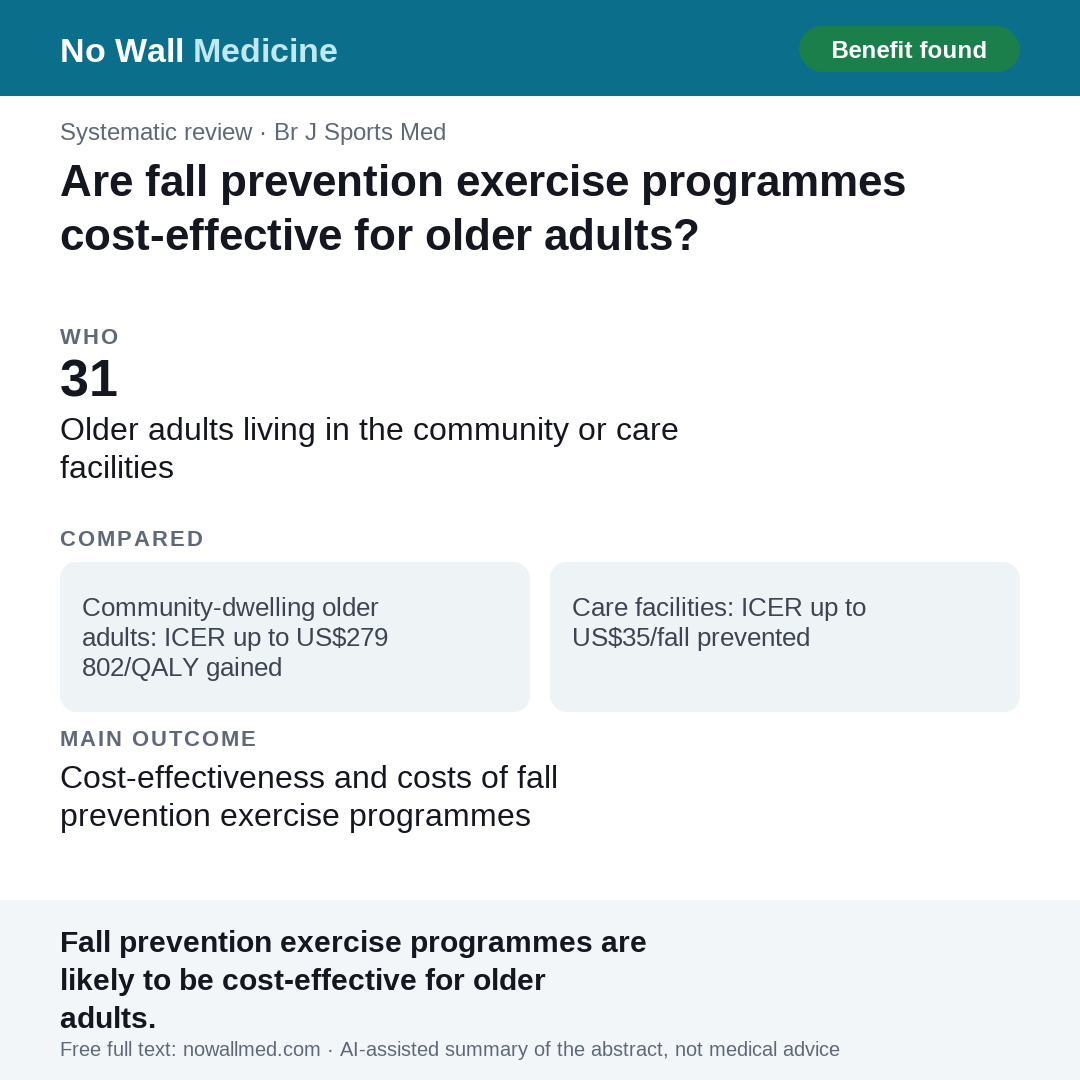
Clinical question: Are fall prevention exercise programmes cost-effective for older adults?
Why it matters: The cost-effectiveness and specific costs of exercise programs designed to prevent falls in older adults were not clearly established.
Key points
- Researchers reviewed 31 studies evaluating the costs and cost-effectiveness of exercise programs to prevent falls in older adults.
- For community-dwelling adults, 17 of 24 results were considered cost-effective based on a threshold of US$100 000 per quality-adjusted life year gained.
- In care facilities, incremental cost-effectiveness ratios ranged from being more effective and less costly to US$35 per fall prevented.
Limitation the authors note: Overall intervention costs varied and were poorly reported.
Headline and key points written with AI from the paper’s abstract, with every number checked against it. Read the paper before relying on them.
Was this summary helpful?
Abstract
Objective
To investigate cost-effectiveness and costs of fall prevention exercise programmes for older adults. Design
Systematic review. Data sources
Medline, Embase, Web of Science, Scopus, National Institute for Health Research Economic Evaluation Database, Health Technology Assessment database, Tufts Cost-Effectiveness Analysis Registry, Research Papers in Economics and EconLit (inception to May 2022). Eligibility criteria for study selection
Economic evaluations (trial-based or model-based) and costing studies investigating fall prevention exercise programmes versus no intervention or usual care for older adults living in the community or care facilities, and reporting incremental cost-effectiveness ratio (ICER) for fall-related outcomes or quality-adjusted life years (QALY, expressed as cost/QALY) and/or intervention costs. Results
31 studies were included. For community-dwelling older adults (21 economic evaluations, 6 costing studies), results ranged from more effective and less costly (dominant) interventions up to an ICER of US$279 802/QALY gained and US$11 986/fall prevented (US$ in 2020). Assuming an arbitrary willingness-to-pay threshold (US$100 000/QALY), most results (17/24) were considered cost-effective (moderate certainty). The greatest value for money (lower ICER/QALY gained and fall prevented) appeared to accrue for older adults and those with high fall risk, but unsupervised exercise appeared to offer poor value for money (higher ICER/QALY). For care facilities (two economic evaluations, two costing studies), ICERs ranged from dominant (low certainty) to US$35/fall prevented (moderate certainty). Overall, intervention costs varied and were poorly reported. Conclusions
Most economic evaluations investigated fall prevention exercise programmes for older adults living in the community. There is moderate certainty evidence that fall prevention exercise programmes are likely to be cost-effective. The evidence for older adults living in care facilities is more limited but promising. Prospero registration number
PROSPERO 2020 CRD42020178023.
Abstract reproduced under the article’s CC BY NC licence.
Subject terms
Cite this article
Pinheiro MB, Sherrington C, Howard K, Caldwell P, Tiedemann A, Wang B. Economic evaluations of fall prevention exercise programs: a systematic review. Br J Sports Med. 2022. doi:10.1136/bjsports-2022-105747
Spotted a mistake? Suggest a correction
Top studies every Monday
The week’s key trials and guidelines in your specialties, plus any topics you follow. By email, free.
Get the weekly digest