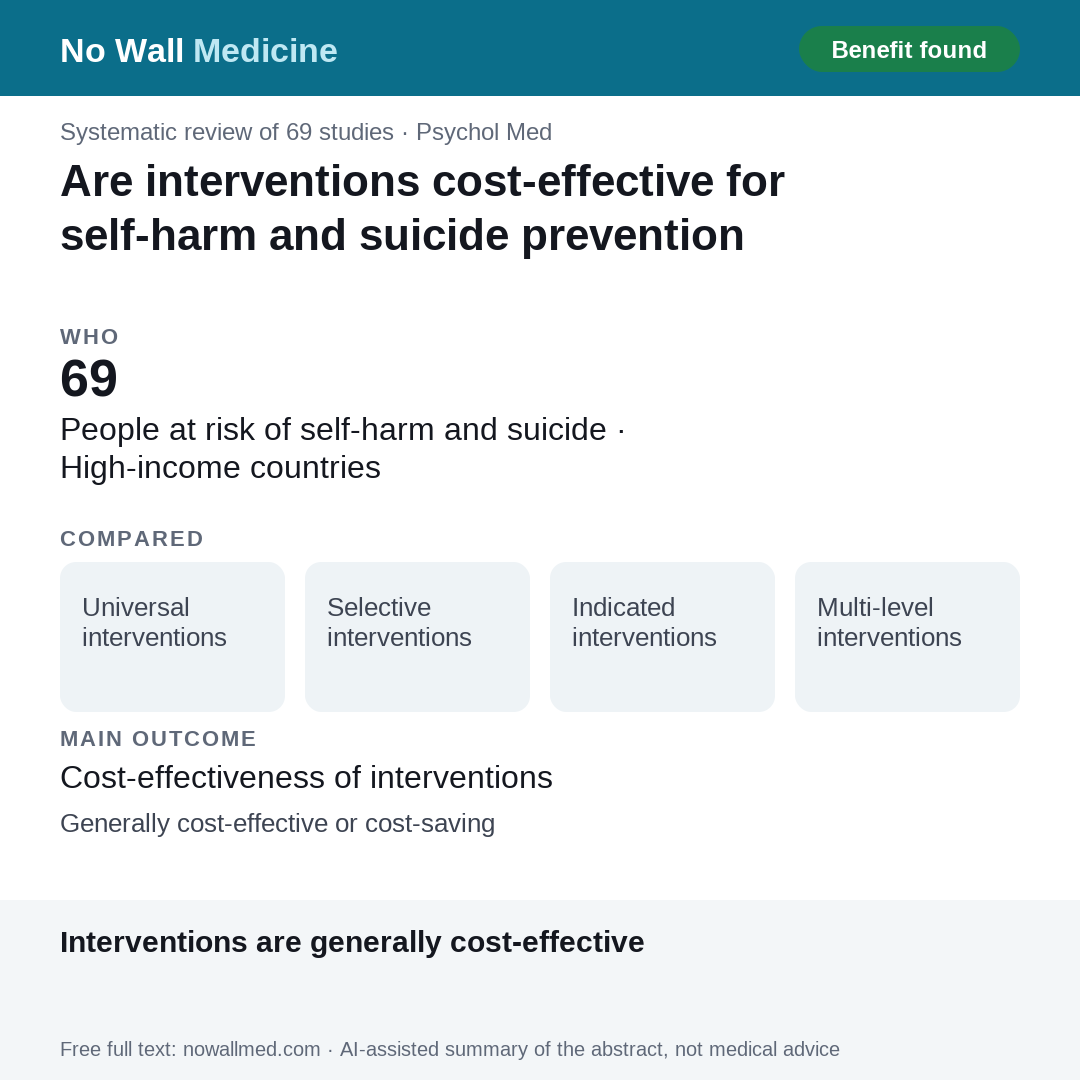
Preventive interventions for self-harm and suicide are generally found to be cost-effective or cost-saving
Economic evaluations of preventive interventions for self-harm and suicide: a systematic review
Psychiatry & Mental HealthAdult and pediatric
Systematic review of 69 studiesBenefit found
Are interventions cost-effective for self-harm and suicide prevention
Who
69
People at risk of self-harm and suicide · High-income countries
Compared
Universal interventions
Selective interventions
Indicated interventions
Multi-level interventions
Main outcome
Cost-effectiveness of interventions
Result: Generally cost-effective or cost-saving
Bottom line: Interventions are generally cost-effective
Limitation: Lack of evidence for older adults and children
Psychol Med · 2026-06-17Download image
Why it matters: Policymakers need to identify and implement cost-effective interventions to address self-harm and suicide as major public health concerns.
Key points
- Researchers reviewed 69 eligible studies evaluating 22 types of interventions for preventing self-harm and suicide.
- The review found that interventions such as psychotherapy, support services, and means restriction were generally cost-effective or cost-saving.
- Most studies were rated as high-quality and were conducted in high-income countries.
Headline and key points written with AI from the paper’s abstract, with every number checked against it. Read the paper before relying on them.
Topics
Cite this article
Le LK, Le DQ, Le PH, Tan EJ, Neil A, Andriessen K. Economic evaluations of preventive interventions for self-harm and suicide: a systematic review. Psychol Med. 2026. doi:10.1017/S0033291726104814
Spotted a mistake? Suggest a correction