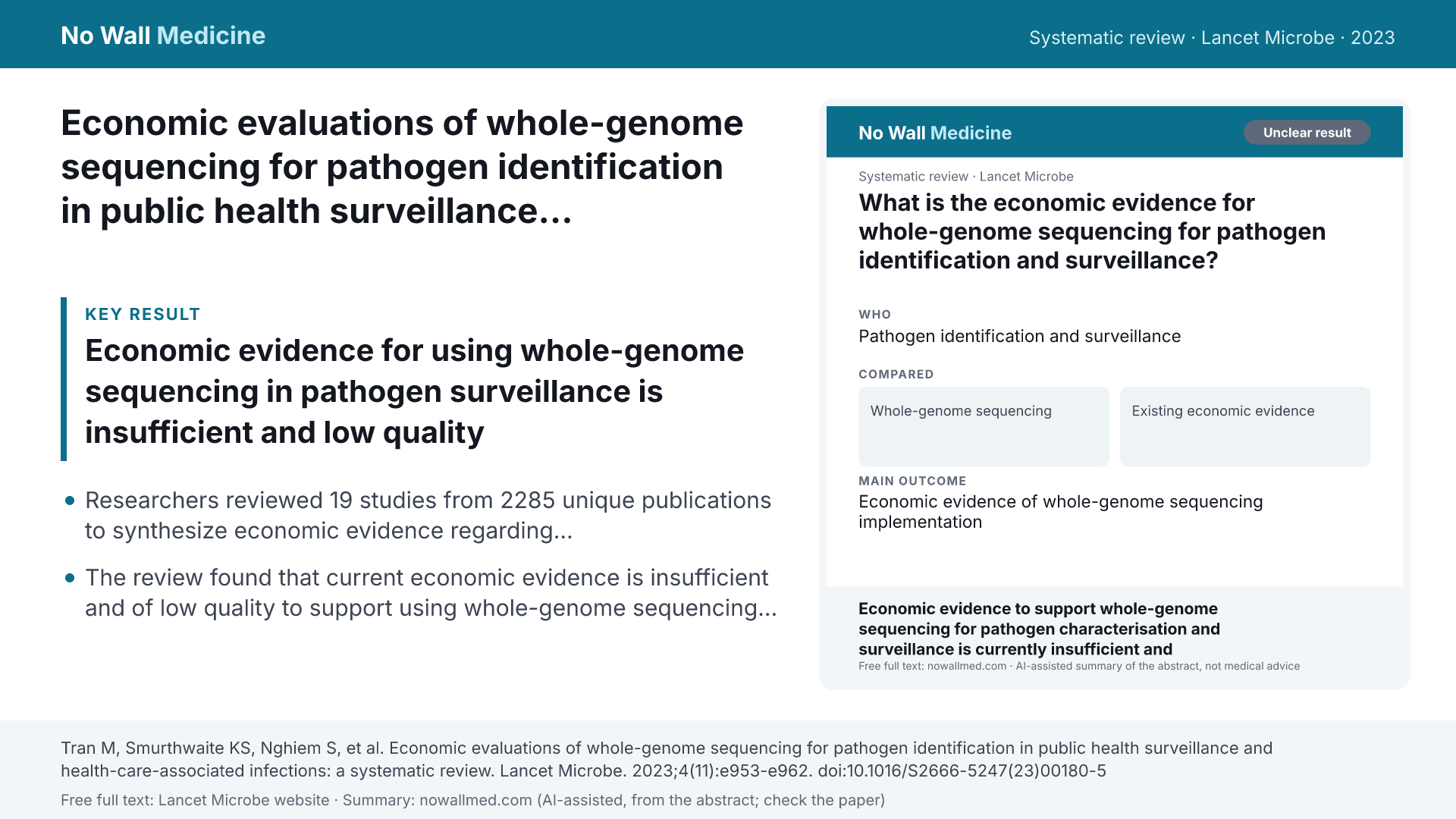
Economic evidence for using whole-genome sequencing in pathogen surveillance is insufficient and low quality
Economic evaluations of whole-genome sequencing for pathogen identification in public health surveillance and health-care-associated infections: a systematic review
Systematic reviewUnclear result
What is the economic evidence for whole-genome sequencing for pathogen identification and surveillance?
Who
Pathogen identification and surveillance
Compared
Whole-genome sequencing
Existing economic evidence
Main outcome
Economic evidence of whole-genome sequencing implementation
Bottom line: Economic evidence to support whole-genome sequencing for pathogen characterisation and surveillance is currently insufficient and of low quality.
Lancet Microbe · 2023-09-06Download image
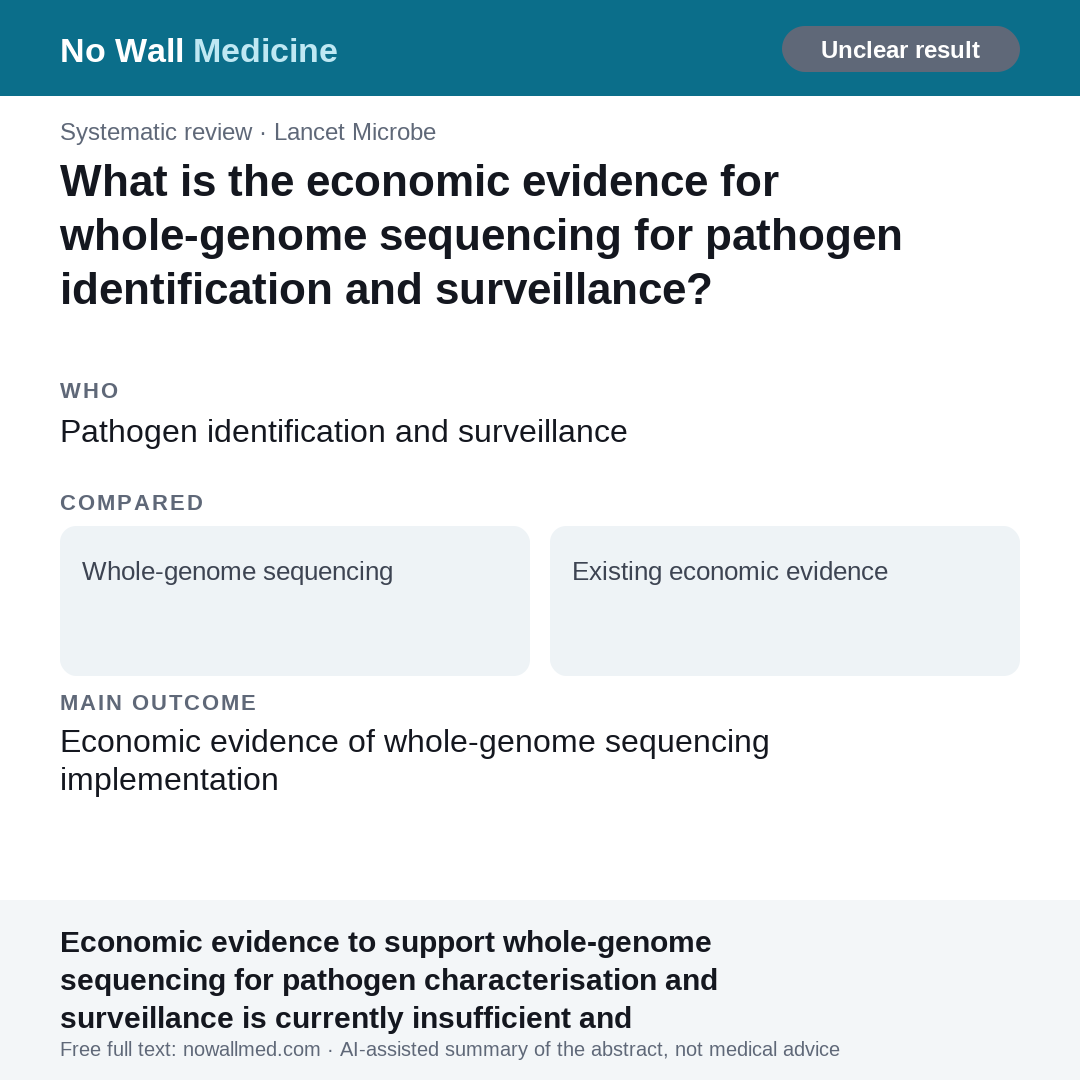
Clinical question: What is the economic evidence for whole-genome sequencing for pathogen identification and surveillance?
Why it matters: It is unknown if the costs and effectiveness of whole-genome sequencing justify its use as a front-line tool for pathogen identification and public health surveillance.
Key points
- Researchers reviewed 19 studies from 2285 unique publications to synthesize economic evidence regarding whole-genome sequencing for identifying pathogens.
- The review found that current economic evidence is insufficient and of low quality to support using whole-genome sequencing as a front-line tool.
- Most existing evaluations focused on a single pathogen rather than broader applications and showed considerable variations in how they were conducted.
Headline and key points written with AI from the paper’s abstract, with every number checked against it. Read the paper before relying on them.
Was this summary helpful?
Abstract
Whole-genome sequencing (WGS) has resulted in improvements to pathogen characterisation for the rapid investigation and management of disease outbreaks and surveillance. We conducted a systematic review to synthesise the economic evidence of WGS implementation for pathogen identification and surveillance. Of the 2285 unique publications identified through online database searches, 19 studies met the inclusion criteria. The economic evidence to support the broader application of WGS as a front-line pathogen characterisation and surveillance tool is insufficient and of low quality. WGS has been evaluated in various clinical settings, but these evaluations are predominantly investigations of a single pathogen. There are also considerable variations in the evaluation approach. Economic evaluations of costs, effectiveness, and cost-effectiveness are needed to support the implementation of WGS in public health settings.
Abstract reproduced under the article’s CC BY NC ND licence.
Subject terms
Cite this article
Tran M, Smurthwaite KS, Nghiem S, et al. Economic evaluations of whole-genome sequencing for pathogen identification in public health surveillance and health-care-associated infections: a systematic review. Lancet Microbe. 2023. doi:10.1016/S2666-5247(23)00180-5
Spotted a mistake? Suggest a correction