Paclitaxel coated devices show limited benefit and possible long term harm for leg artery disease
Editor's Choice - Focused Update on Paclitaxel Coated Technologies, from the 2024 European Society for Vascular Surgery (ESVS) Guidelines on the Management of Asymptomatic Peripheral Arterial Disease and Intermittent Claudication
Narrative systematic review and guideline updateHarm found
Are paclitaxel coated devices effective for infrainguinal revascularisation in intermittent claudication?
Who
Patients with asymptomatic peripheral arterial disease and intermittent claudication
Compared
Paclitaxel coated devices
Uncoated devices
Main outcome
Quality of life and re-intervention rates
Result: difference in six item Vascular Quality of Life Questionnaire score -0.02 (95% confidence interval -0.66 to 0.62)
Bottom line: Paclitaxel coated devices show limited clinical benefit and potential long term mortality risk compared to uncoated devices.
Limitation: The update is based on a narrative systematic review of existing evidence.
Eur J Vasc Endovasc Surg · 2026-05-18Download image
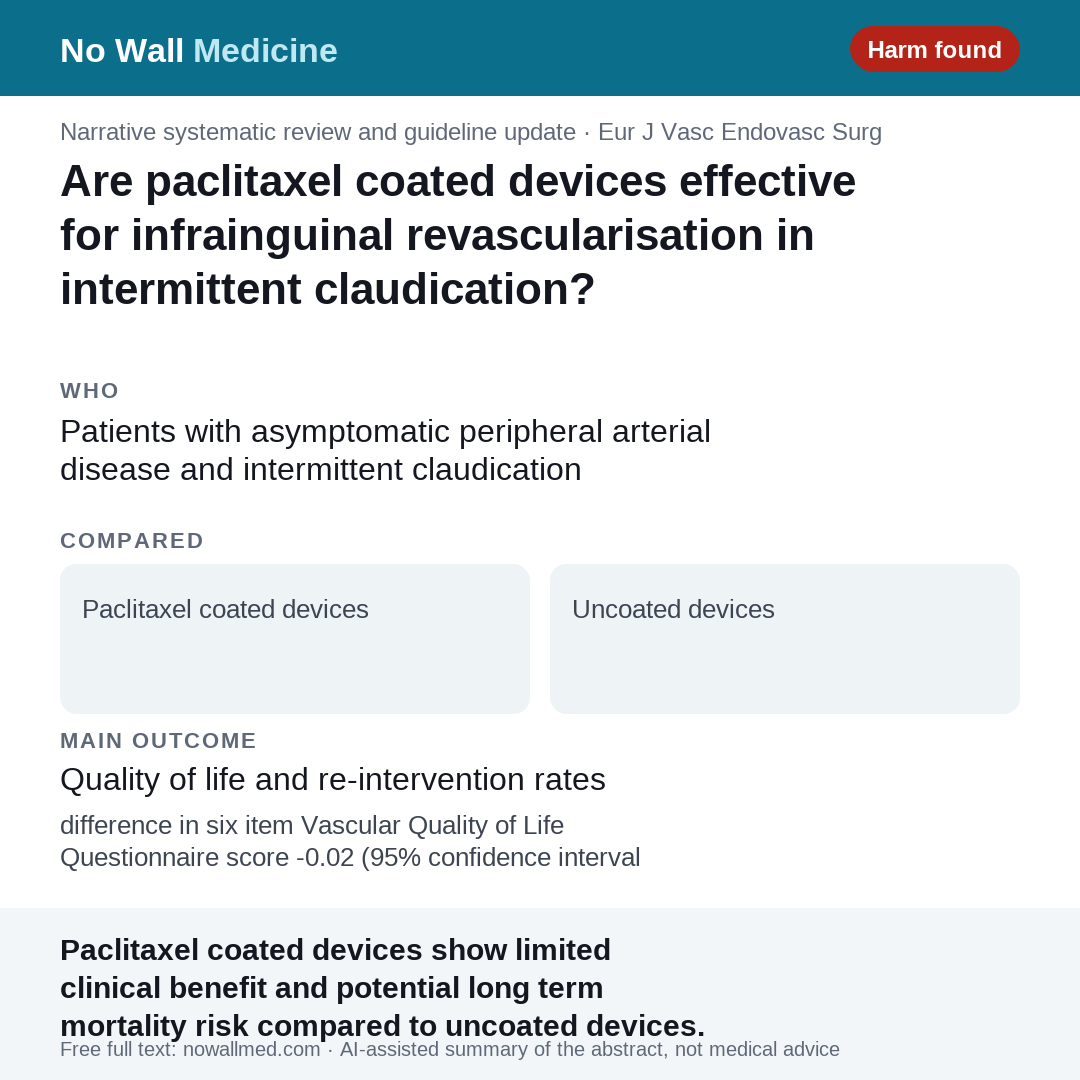
Clinical question: Are paclitaxel coated devices effective for infrainguinal revascularisation in intermittent claudication?
Why it matters: Clinicians needed updated recommendations because recent evidence prompted a re-evaluation of the efficacy and long term risks of paclitaxel coated devices.
Key points
- The European Society for Vascular Surgery reviewed evidence regarding paclitaxel coated balloons and stents for patients with intermittent claudication, a condition causing leg pain during walking.
- The SWEDEPAD 2 trial found no improvement in quality of life or reduced need for repeat procedures at 12 months compared to uncoated devices.
- Evidence suggests a potential increase in long term all cause mortality rate and limited clinical benefits from these drug coated devices.
Headline and key points written with AI from the paper’s abstract, with every number checked against it. Read the paper before relying on them.
Topics
Spotted a mistake? Suggest a correction