Editor's Choice - Paclitaxel Coated Balloon Angioplasty vs. Plain Balloon Angioplasty for Haemodialysis Arteriovenous Access Stenosis: A Systematic Review and a Time to Event Meta-Analysis of Randomised Controlled Trials
Systematic review and meta-analysis of randomized controlled trialsBenefit found
Is paclitaxel coated balloon angioplasty effective for arteriovenous access stenosis?
Who
1682
Patients with arteriovenous access stenosis
Compared
Paclitaxel coated drug coated balloon
Uncoated plain balloon
Main outcome
Loss of target lesion patency and circuit patency
Result: hazard ratio 0.53 (95% CI 0.42 - 0.66) at six months
Bottom line: Paclitaxel coated balloons reduce the risk of loss of target lesion and circuit patency compared to plain balloons.
Limitation: Heterogeneity of the included trials and moderate to low quality of evidence.
Eur J Vasc Endovasc Surg · 2021-08-20Download image
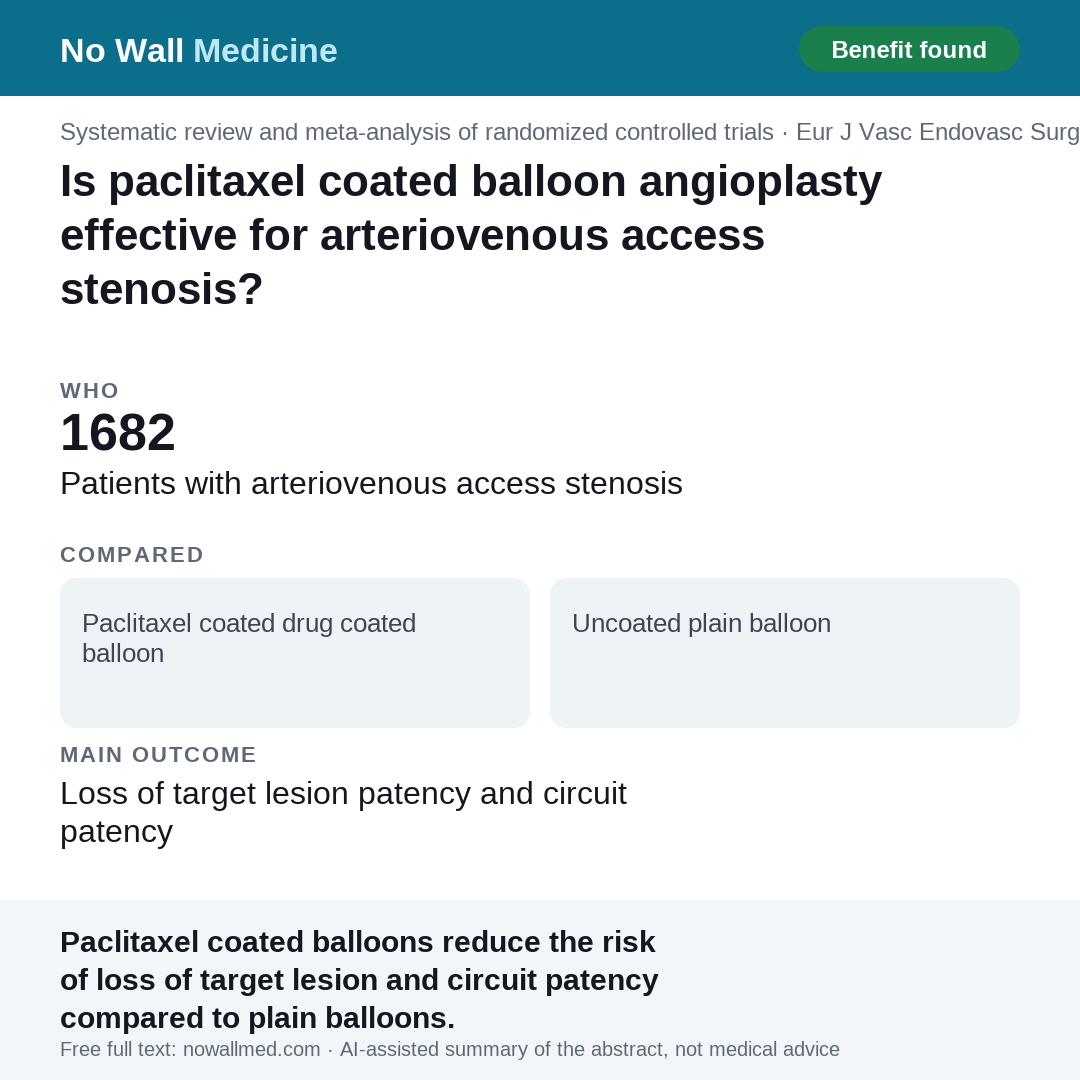
Clinical question: Is paclitaxel coated balloon angioplasty effective for arteriovenous access stenosis?
Abstract
Objective
A systematic review and meta-analysis of randomised controlled trials (RCTs) was performed to determine the effectiveness and safety of drug coated balloon (DCB) angioplasty compared with uncoated plain balloon (PB) angioplasty in treating arteriovenous access stenosis. Methods
MEDLINE, Embase, Scopus, and the Cochrane Central Register of Controlled Trials were searched for RCTs comparing paclitaxel coated DCB and PB angioplasty for arteriovenous access stenosis. The last date of the literature search was 31 December 2020. Risk of bias of the retrieved studies was assessed with the Cochrane Collaboration tool for assessing risk of bias (RoB 2.0). The random effects model was used to estimate the risk of loss of target lesion patency (six and 12 months) and circuit patency (six and 12 months). Procedure related adverse events and mortality rate were also compared. Patency results were pooled using the time to event meta-analytical method and the quality of evidence was assessed according to the GRADE approach. Results
Sixteen eligible trials, including 1 682 lesions, were included in the quantitative analysis for the efficacy and safety of paclitaxel coated DCBs. DCBs were associated with a lower risk of loss of target lesion patency at six months (HR 0.53, 95% CI 0.42 - 0.66) and 12 months (HR 0.60, 95% CI 0.47 - 0.76), and were also associated with improved six and 12 month circuit patency. Overall quality of evidence was moderate to low. Procedural complications were rare, and the risk of death up to 12 months was similar between the two groups (OR 1.03, 95% CI 0.68 - 1.56). Conclusion
Paclitaxel coated DCBs reduced the risk of loss of target lesion patency and circuit patency in arteriovenous access stenosis compared with PBs. Considering the heterogeneity of the included trials, there is a need to investigate optimal treatment regimens regarding drug dose and agent of the DCB and the treatment procedure.
Subject terms
Cite this article
Han A, Park T, Kim HJ, Min S, Ha J, Min SK. Editor's Choice - Paclitaxel Coated Balloon Angioplasty vs. Plain Balloon Angioplasty for Haemodialysis Arteriovenous Access Stenosis: A Systematic Review and a Time to Event Meta-Analysis of Randomised Controlled Trials. Eur J Vasc Endovasc Surg. 2021. doi:10.1016/j.ejvs.2021.05.043
Spotted a mistake? Suggest a correction
Top studies every Monday
The week’s key trials and guidelines in your specialties, plus any topics you follow. By email, free.
Get the weekly digest