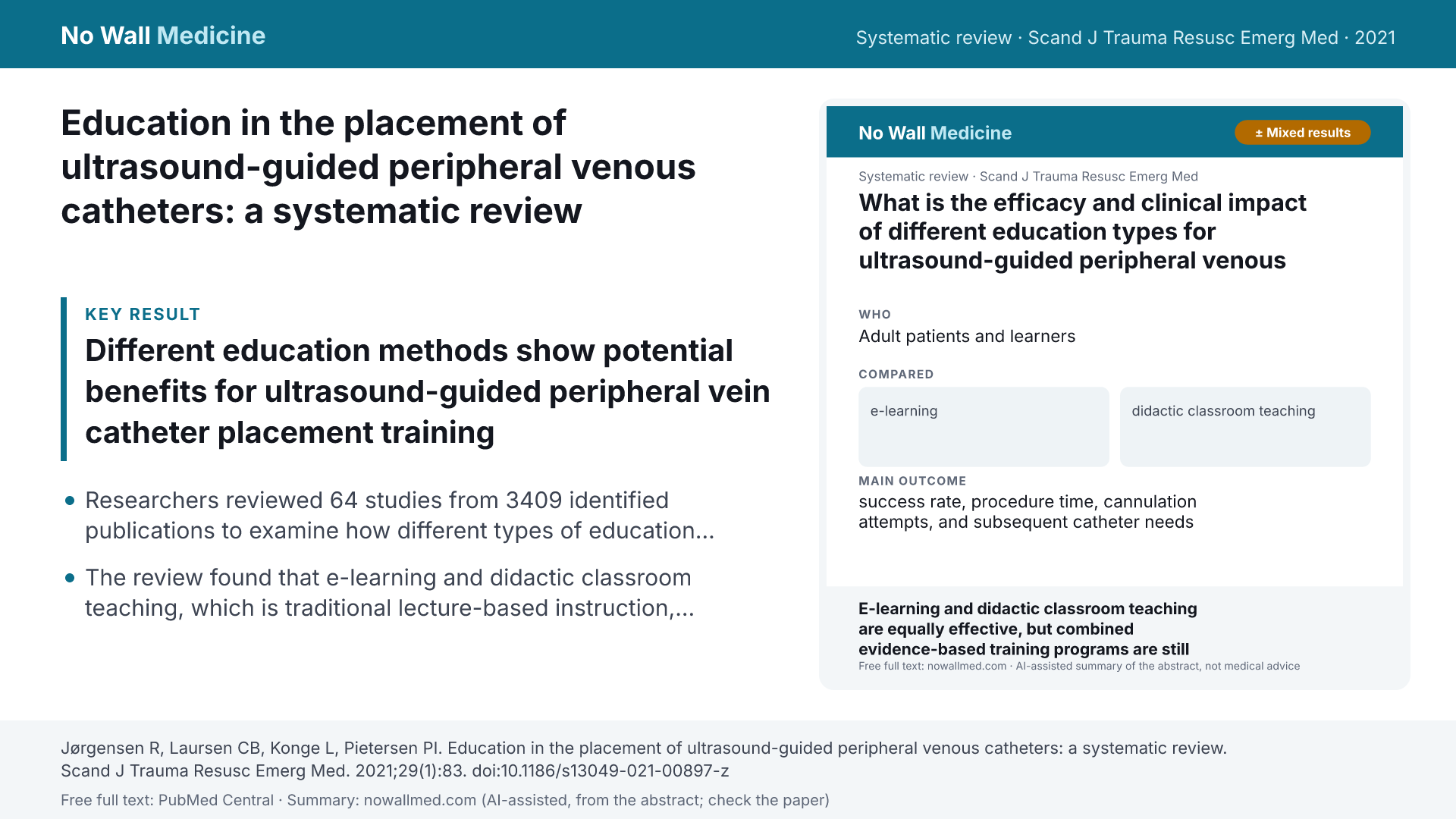
Different education methods show potential benefits for ultrasound-guided peripheral vein catheter placement training
Education in the placement of ultrasound-guided peripheral venous catheters: a systematic review
Systematic reviewMixed results
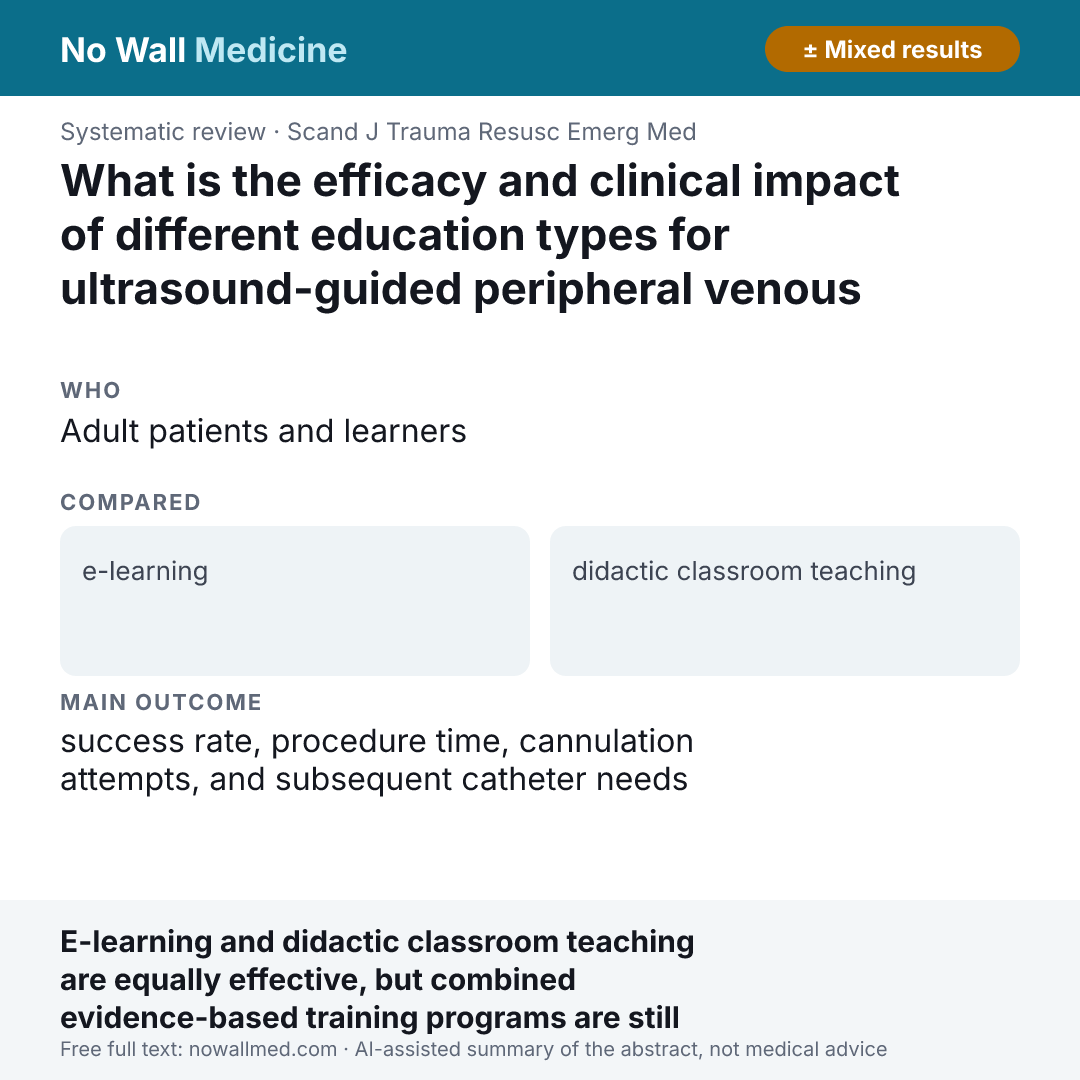
What is the efficacy and clinical impact of different education types for ultrasound-guided peripheral venous catheter placement?
Who
Adult patients and learners
Compared
e-learning
didactic classroom teaching
Main outcome
success rate, procedure time, cannulation attempts, and subsequent catheter needs
Bottom line: E-learning and didactic classroom teaching are equally effective, but combined evidence-based training programs are still warranted.
Limitation: Studies were different in target learners, design, assessment tools, and outcome measures, making direct comparison difficult.
Scand J Trauma Resusc Emerg Med · 2021-06-27 · Save PNG
Clinical question: What is the efficacy and clinical impact of different education types for ultrasound-guided peripheral venous catheter placement?
Key points
- Researchers reviewed 64 studies from 3409 identified publications to examine how different types of education affect ultrasound-guided peripheral vein catheter placement.
- The review found that e-learning and didactic classroom teaching, which is traditional lecture-based instruction, were equally effective.
- Training was associated with potential benefits in success rates, procedure time, number of cannulation attempts, and the need for central venous catheters or peripherally inserted central catheters.
Limitation the authors note: The studies were different in target learners, study design, assessment tools, and outcome measures, which made direct comparison difficult.
Headline and key points written with AI from the paper’s abstract, with every number checked against it. Read the paper before relying on them.
Was this summary helpful?
Subject terms
Headline, design, result, key points, caveat and citation as plain text.
Cite this article
Jørgensen R, Laursen CB, Konge L, Pietersen PI. Education in the placement of ultrasound-guided peripheral venous catheters: a systematic review. Scand J Trauma Resusc Emerg Med. 2021;29(1):83. doi:10.1186/s13049-021-00897-z
Spotted a mistake? Suggest a correction