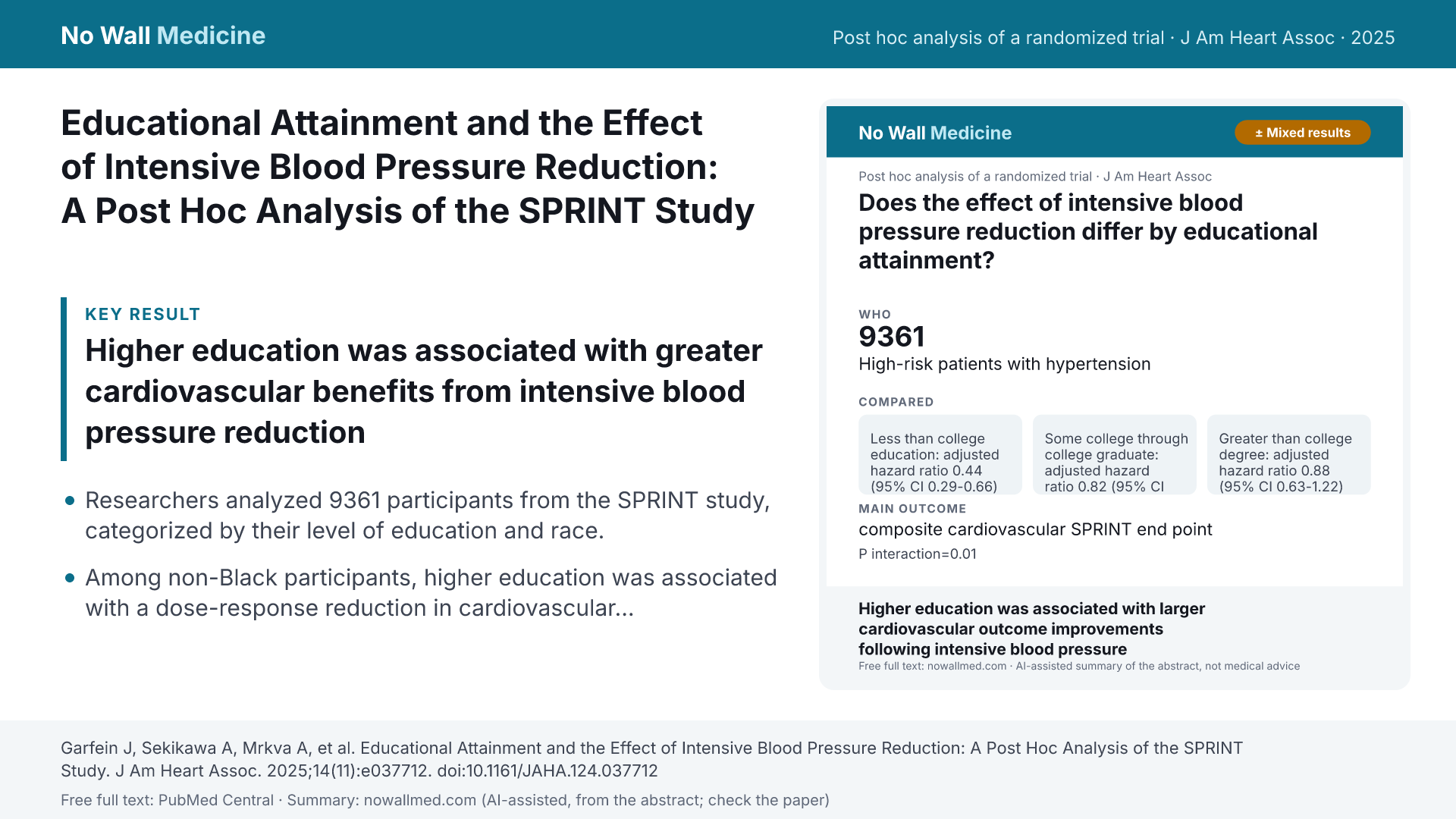
Higher education was associated with greater cardiovascular benefits from intensive blood pressure reduction
Educational Attainment and the Effect of Intensive Blood Pressure Reduction: A Post Hoc Analysis of the SPRINT Study
Post hoc analysis of a randomized trialMixed results
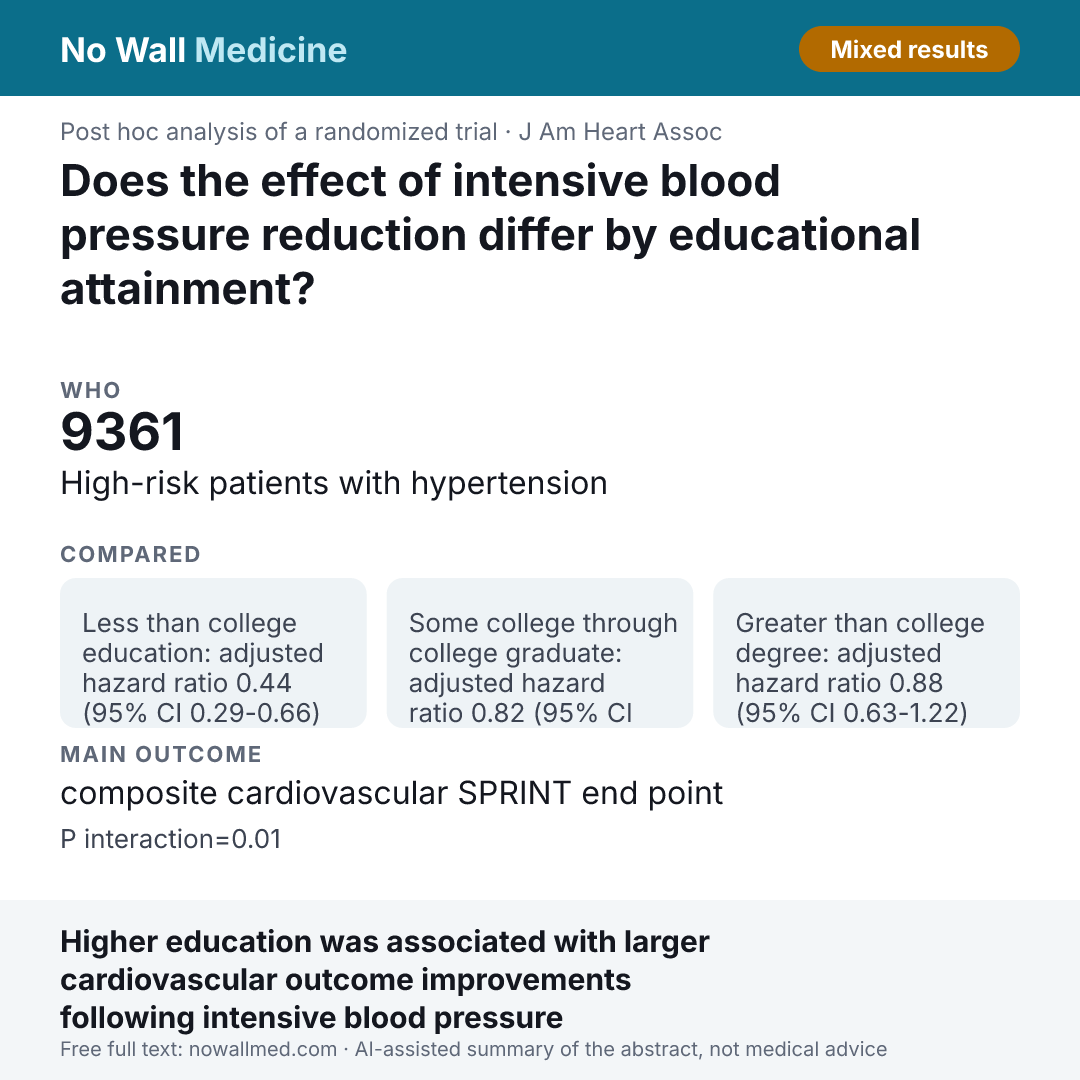
Does the effect of intensive blood pressure reduction differ by educational attainment?
Who
9361
High-risk patients with hypertension
Compared
Less than college education: adjusted hazard ratio 0.44 (95% CI 0.29-0.66)
Some college through college graduate: adjusted hazard ratio 0.82 (95% CI 0.60-1.12)
Greater than college degree: adjusted hazard ratio 0.88 (95% CI 0.63-1.22)
Main outcome
composite cardiovascular SPRINT end point
Result: P interaction=0.01
Bottom line: Higher education was associated with larger cardiovascular outcome improvements following intensive blood pressure reduction, particularly among non-Black individuals.
Limitation: The findings highlight the relevance of social factors in the generalizability of clinical trials.
J Am Heart Assoc · 2025-05-21 · Save PNG
Clinical question: Does the effect of intensive blood pressure reduction differ by educational attainment?
Key points
- Researchers analyzed 9361 participants from the SPRINT study, categorized by their level of education and race.
- Among non-Black participants, higher education was associated with a dose-response reduction in cardiovascular events following intensive blood pressure lowering.
- For Black participants, the association between lowering systolic blood pressure and cardiovascular outcomes did not differ significantly by education level.
Headline and key points written with AI from the paper’s abstract, with every number checked against it. Read the paper before relying on them.
Was this summary helpful?
Subject terms
Headline, design, result, key points, caveat and citation as plain text.
Cite this article
Garfein J, Sekikawa A, Mrkva A, et al. Educational Attainment and the Effect of Intensive Blood Pressure Reduction: A Post Hoc Analysis of the SPRINT Study. J Am Heart Assoc. 2025;14(11):e037712. doi:10.1161/JAHA.124.037712
Spotted a mistake? Suggest a correction