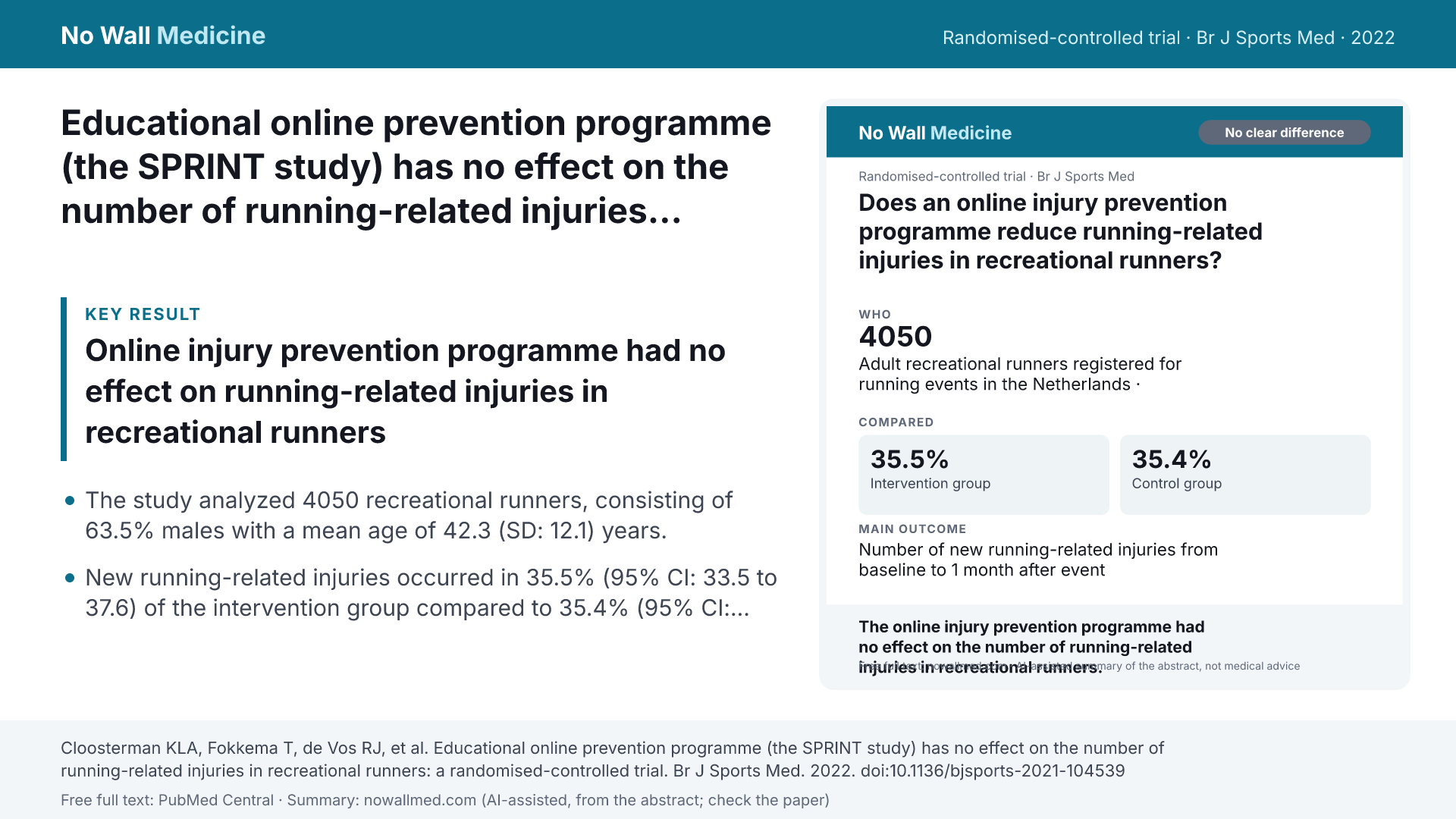
Online injury prevention programme had no effect on running-related injuries in recreational runners
Educational online prevention programme (the SPRINT study) has no effect on the number of running-related injuries in recreational runners: a randomised-controlled trial
Randomised-controlled trialNo clear difference
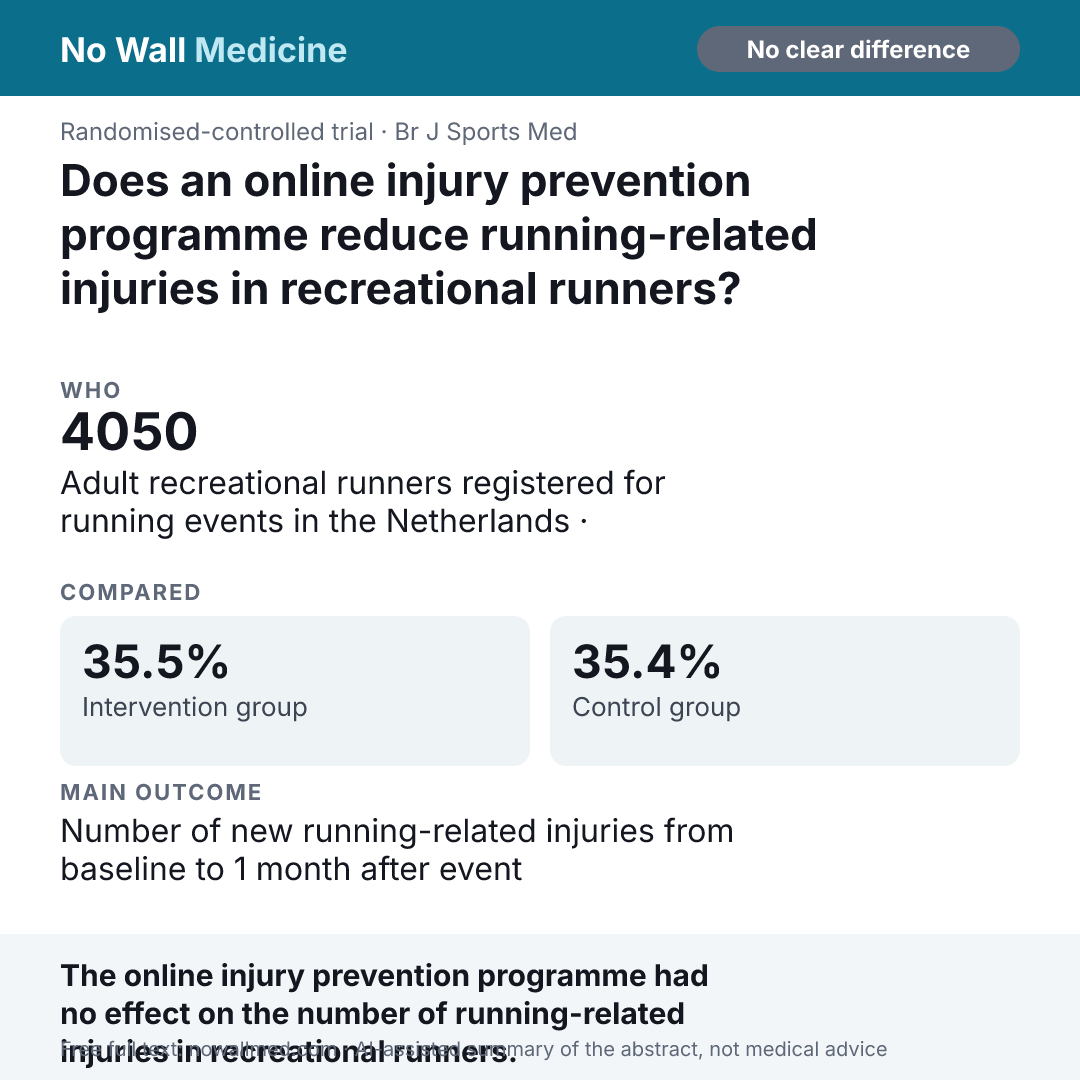
Does an online injury prevention programme reduce running-related injuries in recreational runners?
Who
4050
Adult recreational runners registered for running events in the Netherlands · Netherlands
Compared
35.5%Intervention group (95% CI: 33.5 to 37.6)
35.4%Control group (95% CI: 33.3 to 37.5)
Main outcome
Number of new running-related injuries from baseline to 1 month after event
Result: OR: 1.03; 95% CI: 0.90 to 1.17
Bottom line: The online injury prevention programme had no effect on the number of running-related injuries in recreational runners.
Br J Sports Med · 2022-02-23 · Save PNG
Clinical question: Does an online injury prevention programme reduce running-related injuries in recreational runners?
Key points
- The study analyzed 4050 recreational runners, consisting of 63.5% males with a mean age of 42.3 (SD: 12.1) years.
- New running-related injuries occurred in 35.5% (95% CI: 33.5 to 37.6) of the intervention group compared to 35.4% (95% CI: 33.3 to 37.5) of the control group.
- Following more items in the prevention programme was associated with a slightly higher injury rate (OR: 1.05; 95% CI: 1.00 to 1.11).
Headline and key points written with AI from the paper’s abstract, with every number checked against it. Read the paper before relying on them.
Was this summary helpful?
Abstract
Objectives
The aim of this study was to examine the effectiveness of an enhanced online injury prevention programme on the number of running-related injuries (RRIs) in recreational runners. Methods
We conducted a randomised-controlled trial in runners who registered for running events (distances: 10-42.195 km) in the Netherlands. Adult runners who provided informed consent were randomised into the intervention or control group. Participants in the intervention group received access to the online prevention programme, which included items to prevent RRIs. Participants in the control group followed their regular preparation for the running event. The primary outcome measure was the number of new RRIs from baseline to 1 month after the running event. To determine differences between injury proportions, univariate and multivariate logistic regression analyses were performed. Results
This study included 4050 recreational runners (63.5% males; mean (SD) age: 42.3 (12.1) years) for analyses. During follow-up, 35.5% (95% CI: 33.5 to 37.6) of the participants in the intervention group sustained a new RRI compared with 35.4% (95% CI: 33.3 to 37.5) of the participants in the control group, with no between-group difference (OR: 1.03; 95% CI: 0.90 to 1.17). There was a positive association between the number of items followed in the injury prevention programme and the number of RRIs (OR: 1.05; 95% CI: 1.00 to 1.11). Conclusion
The enhanced online injury prevention programme had no effect on the number of RRIs in recreational runners, and being compliant with the programme paradoxically was associated with a slightly higher injury rate. Future studies should focus on individual targeted prevention with emphasis on the timing and application of preventive measures. Trial registration number
NL7694.
Abstract reproduced under the article’s CC BY NC licence.
Subject terms
Headline, design, result, key points, caveat and citation as plain text.
Cite this article
Cloosterman KLA, Fokkema T, de Vos RJ, et al. Educational online prevention programme (the SPRINT study) has no effect on the number of running-related injuries in recreational runners: a randomised-controlled trial. Br J Sports Med. 2022. doi:10.1136/bjsports-2021-104539
Spotted a mistake? Suggest a correction