Using brain wave monitoring to guide anesthesia reduces delirium in children undergoing surgery
EEG-Guided Titration of Sevoflurane and Pediatric Anesthesia Emergence Delirium: A Randomized Clinical Trial
Single-center, parallel-group, 2-arm, superiority randomized clinical trialBenefit found
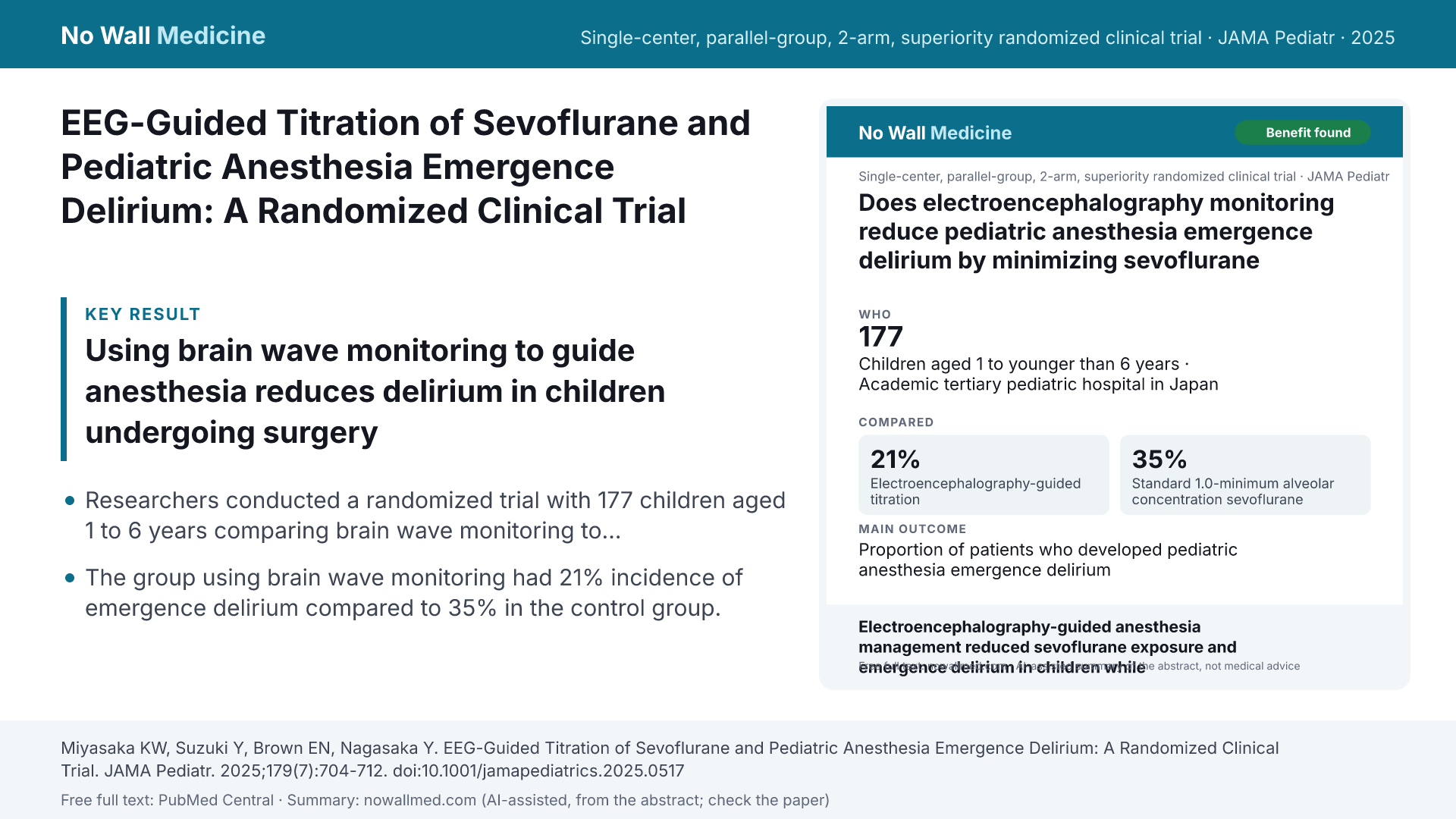
Does electroencephalography monitoring reduce pediatric anesthesia emergence delirium by minimizing sevoflurane exposure?
Who
177
Children aged 1 to younger than 6 years · Academic tertiary pediatric hospital in Japan
Compared
21%Electroencephalography-guided titration
35%Standard 1.0-minimum alveolar concentration sevoflurane
Main outcome
Proportion of patients who developed pediatric anesthesia emergence delirium
Result: difference, 14%; 96.65% CI, -0.0019% to 28%; 95% CI, 0.92% to 27%
Bottom line: Electroencephalography-guided anesthesia management reduced sevoflurane exposure and emergence delirium in children while speeding up emergence.
JAMA Pediatr · 2025-04-21 · Save PNG

Clinical question: Does electroencephalography monitoring reduce pediatric anesthesia emergence delirium by minimizing sevoflurane exposure?
Key points
- Researchers conducted a randomized trial with 177 children aged 1 to 6 years comparing brain wave monitoring to standard anesthesia levels.
- The group using brain wave monitoring had 21% incidence of emergence delirium compared to 35% in the control group.
- Children in the brain wave monitoring group emerged from anesthesia 21.4 minutes earlier and spent 16.5 minutes less in the recovery unit.
Headline and key points written with AI from the paper’s abstract, with every number checked against it. Read the paper before relying on them.
Was this summary helpful?
Headline, design, result, key points, caveat and citation as plain text.
Cite this article
Miyasaka KW, Suzuki Y, Brown EN, Nagasaka Y. EEG-Guided Titration of Sevoflurane and Pediatric Anesthesia Emergence Delirium: A Randomized Clinical Trial. JAMA Pediatr. 2025;179(7):704-712. doi:10.1001/jamapediatrics.2025.0517
Spotted a mistake? Suggest a correction