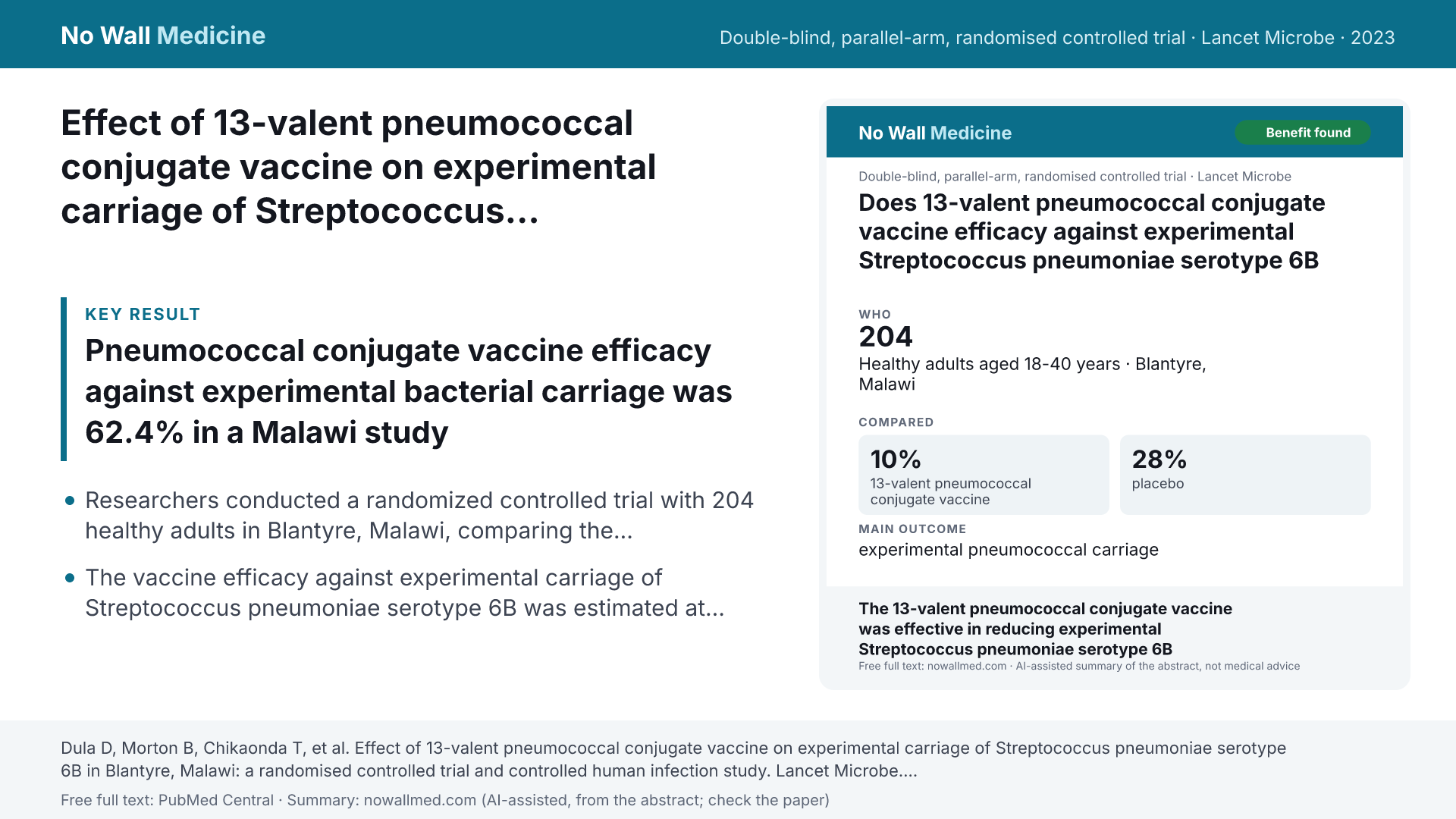
Pneumococcal conjugate vaccine efficacy against experimental bacterial carriage was 62.4% in a Malawi study
Effect of 13-valent pneumococcal conjugate vaccine on experimental carriage of Streptococcus pneumoniae serotype 6B in Blantyre, Malawi: a randomised controlled trial and controlled human infection study
Double-blind, parallel-arm, randomised controlled trialBenefit found
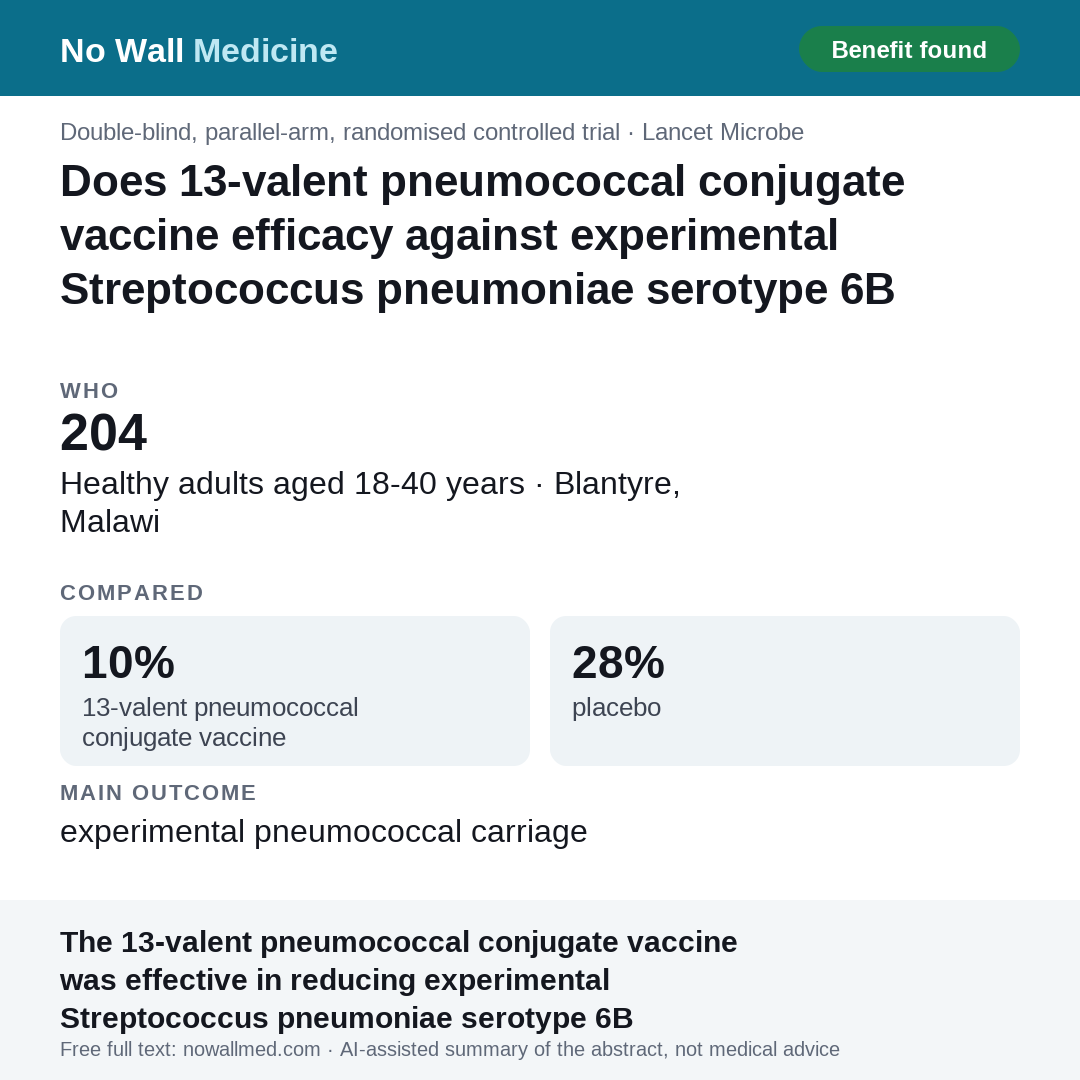
Does 13-valent pneumococcal conjugate vaccine efficacy against experimental Streptococcus pneumoniae serotype 6B carriage?
Who
204
Healthy adults aged 18-40 years · Blantyre, Malawi
Compared
10%13-valent pneumococcal conjugate vaccine (10/98)
28%placebo (30/106)
Main outcome
experimental pneumococcal carriage
Result: 62·4% (95% CI 27·7-80·4)
Bottom line: The 13-valent pneumococcal conjugate vaccine was effective in reducing experimental Streptococcus pneumoniae serotype 6B carriage in healthy adults.
Funded by: Wellcome Trust
Lancet Microbe · 2023-09-03Download image
Clinical question: Does 13-valent pneumococcal conjugate vaccine efficacy against experimental Streptococcus pneumoniae serotype 6B carriage?
Why it matters: The absence of herd effects in Malawi is threatened by persistent vaccine-type pneumococcal carriage in both vaccinated children and the wider community.
In absolute numbers
13-valent pneumococcal conjugate vaccine: 10% · placebo: 28% → a difference of 18 percentage points, so about 6 people would need the treatment for 1 more to benefit (number needed to treat) over the trial’s follow-up.
Worked out by us from the two group results above, not reported by the authors. Check the paper for the exact outcome and timing.
Key points
- Researchers conducted a randomized controlled trial with 204 healthy adults in Blantyre, Malawi, comparing the 13-valent pneumococcal conjugate vaccine to a placebo.
- The vaccine efficacy against experimental carriage of Streptococcus pneumoniae serotype 6B was estimated at 62.4% (95% CI 27.7-80.4).
- Overall carriage rates were 10% in the vaccine group versus 28% in the placebo group, and no severe adverse events related to vaccination or inoculation were reported.
Headline and key points written with AI from the paper’s abstract, with every number checked against it. Read the paper before relying on them.
Was this summary helpful?
Abstract
Background
The effect of childhood pneumococcal conjugate vaccine implementation in Malawi is threatened by absence of herd effect. There is persistent vaccine-type pneumococcal carriage in both vaccinated children and the wider community. We aimed to use a human infection study to measure 13-valent pneumococcal conjugate vaccine (PCV13) efficacy against pneumococcal carriage. Methods
We did a double-blind, parallel-arm, randomised controlled trial investigating the efficacy of PCV13 or placebo against experimental pneumococcal carriage of Streptococcus pneumoniae serotype 6B (strain BHN418) among healthy adults (aged 18-40 years) from Blantyre, Malawi. We randomly assigned participants (1:1) to receive PCV13 or placebo. PCV13 and placebo doses were prepared by an unmasked pharmacist to maintain research team and participant masking with identification only by a randomisation identification number and barcode. 4 weeks after receiving either PCV13 or placebo, participants were challenged with 20 000 colony forming units (CFUs) per naris, 80 000 CFUs per naris, or 160 000 CFUs per naris by intranasal inoculation. The primary endpoint was experimental pneumococcal carriage, established by culture of nasal wash at 2, 7, and 14 days. Vaccine efficacy was estimated per protocol by means of a log-binomial model adjusting for inoculation dose. The trial is registered with the Pan African Clinical Trials Registry, PACTR202008503507113, and is now closed. Findings
Recruitment commenced on April 27, 2021 and the final visit was completed on Sept 12, 2022. 204 participants completed the study protocol (98 PCV13, 106 placebo). There were lower carriage rates in the vaccine group at all three inoculation doses (0 of 21 vs two [11%] of 19 at 20 000 CFUs per naris; six [18%] of 33 vs 12 [29%] of 41 at 80 000 CFUs per naris, and four [9%] of 44 vs 16 [35%] of 46 at 160 000 CFUs per naris). The overall carriage rate was lower in the vaccine group compared with the placebo group (ten [10%] of 98 vs 30 [28%] of 106; Fisher's p value=0·0013) and the vaccine efficacy against carriage was estimated at 62·4% (95% CI 27·7-80·4). There were no severe adverse events related to vaccination or inoculation of pneumococci. Interpretation
This is, to our knowledge, the first human challenge study to test the efficacy of a pneumococcal vaccine against pneumococcal carriage in Africa, which can now be used to establish vaccine-induced correlates of protection and compare alternative strategies to prevent pneumococcal carriage. This powerful tool could lead to new means to enhance reduction in pneumococcal carriage after vaccination. Funding
Wellcome Trust.
Abstract reproduced under the article’s CC BY licence.
Subject terms
Headline, design, result, key points, caveat and citation as plain text.
Cite this article
Dula D, Morton B, Chikaonda T, et al. Effect of 13-valent pneumococcal conjugate vaccine on experimental carriage of Streptococcus pneumoniae serotype 6B in Blantyre, Malawi: a randomised controlled trial and controlled human infection study. Lancet Microbe. 2023;4(9):e683-e691. doi:10.1016/S2666-5247(23)00178-7
Spotted a mistake? Suggest a correction