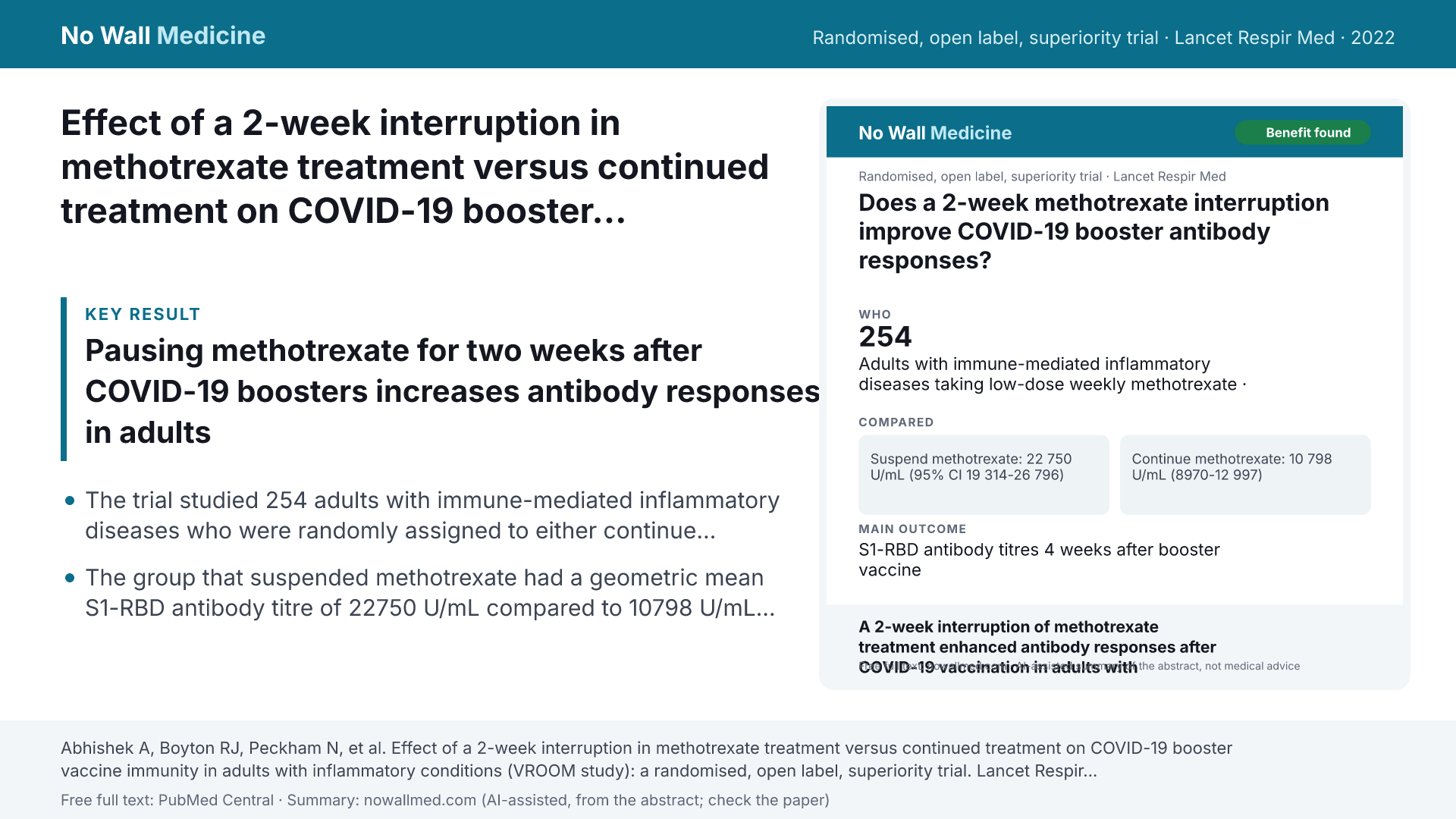
Pausing methotrexate for two weeks after COVID-19 boosters increases antibody responses in adults
Effect of a 2-week interruption in methotrexate treatment versus continued treatment on COVID-19 booster vaccine immunity in adults with inflammatory conditions (VROOM study): a randomised, open label, superiority trial
Randomised, open label, superiority trialBenefit found
Does a 2-week methotrexate interruption improve COVID-19 booster antibody responses?
Who
254
Adults with immune-mediated inflammatory diseases taking low-dose weekly methotrexate · 26 hospitals in the UK
Compared
Suspend methotrexate: 22 750 U/mL (95% CI 19 314-26 796)
Continue methotrexate: 10 798 U/mL (8970-12 997)
Main outcome
S1-RBD antibody titres 4 weeks after booster vaccine
Result: geometric mean ratio 2.19 (95% CI 1.57-3.04)
Bottom line: A 2-week interruption of methotrexate treatment enhanced antibody responses after COVID-19 vaccination in adults with inflammatory diseases.
Funded by: National Institute for Health and Care Research
Lancet Respir Med · 2022-06-27Download image
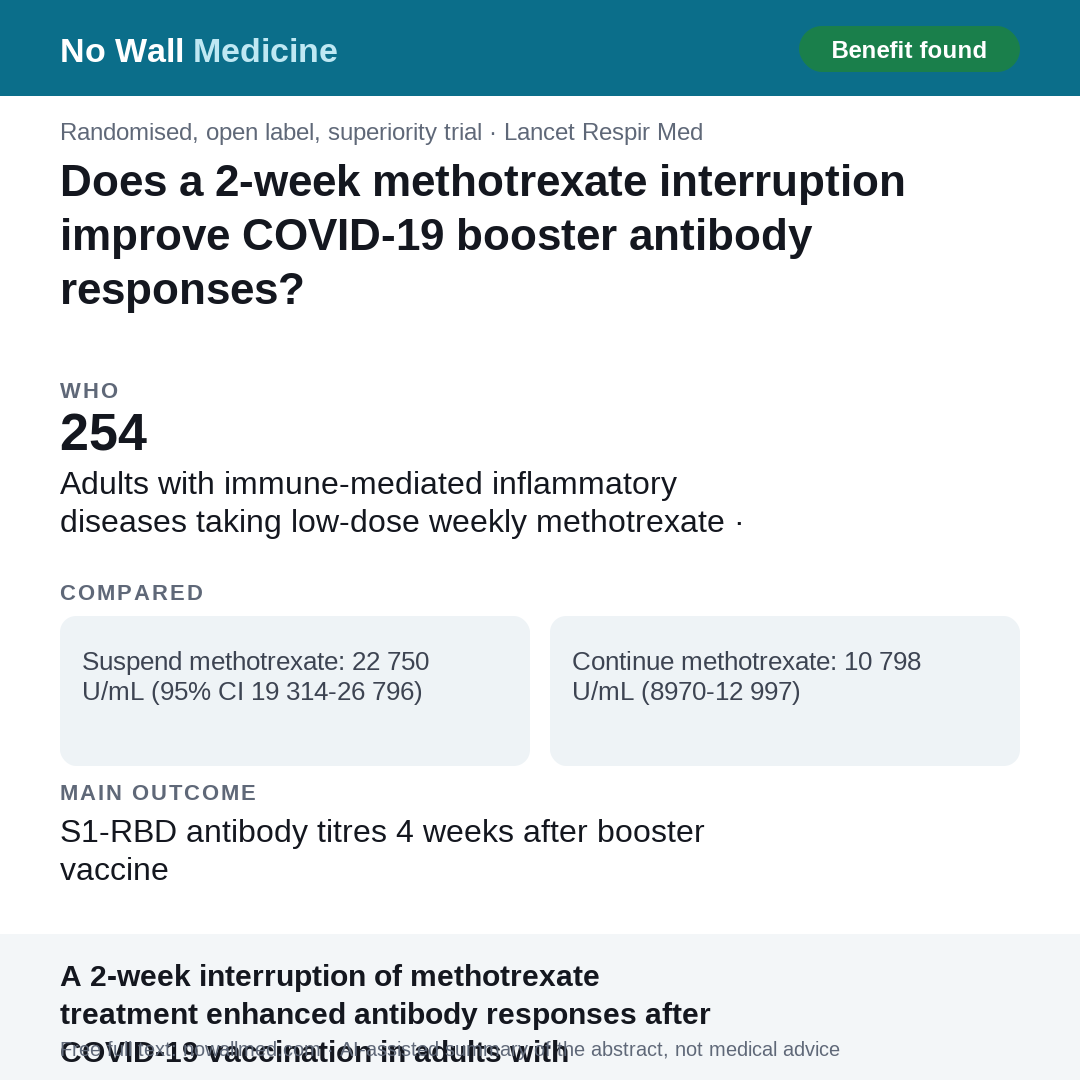
Clinical question: Does a 2-week methotrexate interruption improve COVID-19 booster antibody responses?
Why it matters: It was unknown whether temporarily stopping methotrexate treatment after a COVID-19 booster could improve antibody responses in people with inflammatory conditions.
Key points
- The trial studied 254 adults with immune-mediated inflammatory diseases who were randomly assigned to either continue weekly methotrexate or suspend it for 2 weeks after a booster.
- The group that suspended methotrexate had a geometric mean S1-RBD antibody titre of 22750 U/mL compared to 10798 U/mL in the group that continued treatment.
- The increased antibody response was consistent across different disease types, ages, and methotrexate doses, with no serious adverse events related to the intervention.
Headline and key points written with AI from the paper’s abstract, with every number checked against it. Read the paper before relying on them.
Was this summary helpful?
Abstract
Background
Immunosuppressive treatments inhibit vaccine-induced immunity against SARS-CoV-2. We evaluated whether a 2-week interruption of methotrexate treatment immediately after the COVID-19 vaccine booster improved antibody responses against the S1 receptor-binding domain (S1-RBD) of the SARS-CoV-2 spike protein compared with uninterrupted treatment in patients with immune-mediated inflammatory diseases. Methods
We did an open-label, prospective, two-arm, parallel-group, multicentre, randomised, controlled, superiority trial in 26 hospitals in the UK. We recruited adults from rheumatology and dermatology clinics who had been diagnosed with an immune-mediated inflammatory disease (eg, rheumatoid arthritis, psoriasis with or without arthritis, axial spondyloarthritis, atopic dermatitis, polymyalgia rheumatica, and systemic lupus erythematosus) and who were taking low-dose weekly methotrexate (≤25 mg per week) for at least 3 months. Participants also had to have received two primary vaccine doses from the UK COVID-19 vaccination programme. We randomly assigned the participants (1:1), using a centralised validated computer randomisation program, to suspend methotrexate treatment for 2 weeks immediately after their COVID-19 booster (suspend methotrexate group) or to continue treatment as usual (continue methotrexate group). Participants, investigators, clinical research staff, and data analysts were unmasked, while researchers doing the laboratory analyses were masked to group assignment. The primary outcome was S1-RBD antibody titres 4 weeks after receiving the COVID-19 booster vaccine dose, assessed in the intention-to-treat population. This trial is registered with ISRCT, ISRCTN11442263; following the pre-planned interim analysis, recruitment was stopped early. Findings
Between Sept 30, 2021 and March 3, 2022, we recruited 340 participants, of whom 254 were included in the interim analysis and had been randomly assigned to one of the two groups: 127 in the continue methotrexate group and 127 in the suspend methotrexate group. Their mean age was 59·1 years, 155 (61%) were female, 130 (51%) had rheumatoid arthritis, and 86 (34%) had psoriasis with or without arthritis. After 4 weeks, the geometric mean S1-RBD antibody titre was 22 750 U/mL (95% CI 19 314-26 796) in the suspend methotrexate group and 10 798 U/mL (8970-12 997) in the continue methotrexate group, with a geometric mean ratio (GMR) of 2·19 (95% CI 1·57-3·04; p<0·0001; mixed-effects model). The increased antibody response in the suspend methotrexate group was consistent across methotrexate dose, administration route, type of immune-mediated inflammatory disease, age, primary vaccination platform, and history of SARS-CoV-2 infection. There were no intervention-related serious adverse events. Interpretation
A 2-week interruption of methotrexate treatment for people with immune-mediated inflammatory diseases resulted in enhanced boosting of antibody responses after COVID-19 vaccination. This intervention is simple, low-cost, and easy to implement, and could potentially translate to increased vaccine efficacy and duration of protection for susceptible groups. Funding
National Institute for Health and Care Research.
Abstract reproduced under the article’s CC BY licence.
Subject terms
Cite this article
Abhishek A, Boyton RJ, Peckham N, McKnight Á, Coates LC, Bluett J. Effect of a 2-week interruption in methotrexate treatment versus continued treatment on COVID-19 booster vaccine immunity in adults with inflammatory conditions (VROOM study): a randomised, open label, superiority trial. Lancet Respir Med. 2022. doi:10.1016/S2213-2600(22)00186-2
Spotted a mistake? Suggest a correction