Coaching for physical activity and fall prevention showed no significant effect on falls or activity counts
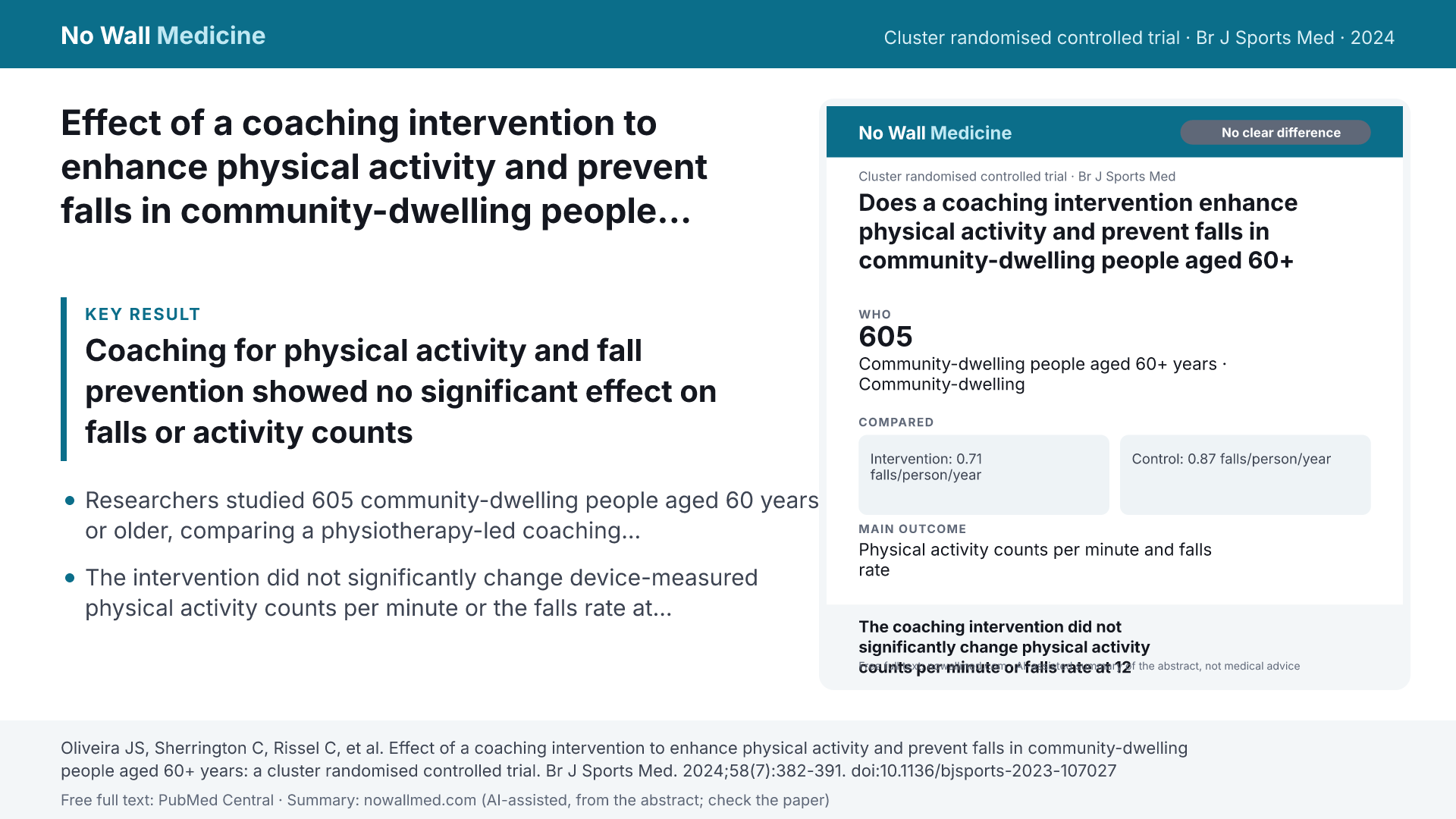
Effect of a coaching intervention to enhance physical activity and prevent falls in community-dwelling people aged 60+ years: a cluster randomised controlled trial
Cluster randomised controlled trialNo clear difference
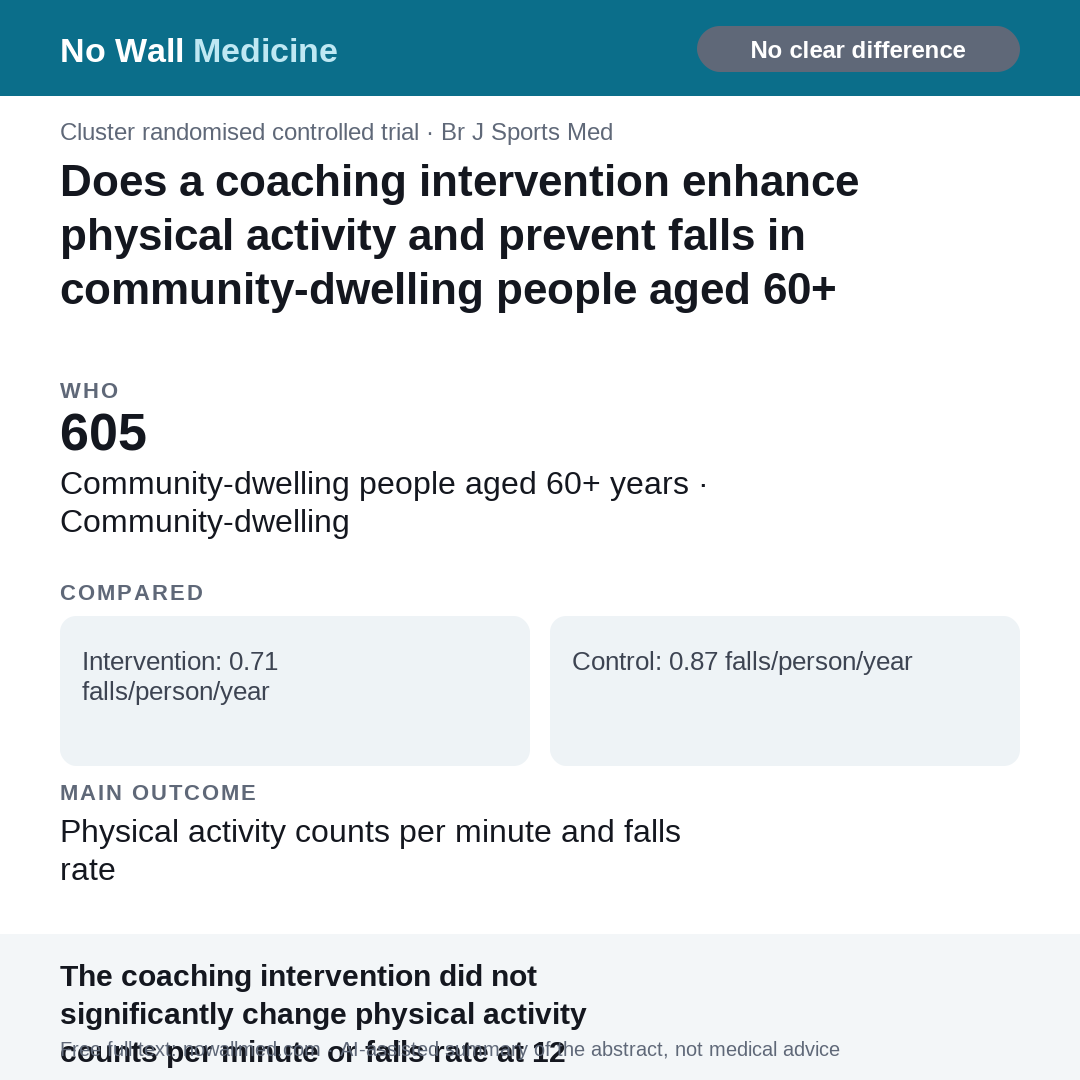
Does a coaching intervention enhance physical activity and prevent falls in community-dwelling people aged 60+ years?
Who
605
Community-dwelling people aged 60+ years · Community-dwelling
Compared
Intervention: 0.71 falls/person/year
Control: 0.87 falls/person/year
Main outcome
Physical activity counts per minute and falls rate
Result: incidence rate ratio 0.86, 95% CI 0.65 to 1.14
Bottom line: The coaching intervention did not significantly change physical activity counts per minute or falls rate at 12 months.
Br J Sports Med · 2024-03-21Download image
Clinical question: Does a coaching intervention enhance physical activity and prevent falls in community-dwelling people aged 60+ years?
Why it matters: It is unknown if a coaching intervention focusing on safe physical activity and fall risk assessment can change physical activity levels and fall rates in older adults.
Key points
- Researchers studied 605 community-dwelling people aged 60 years or older, comparing a physiotherapy-led coaching intervention to a dietary coaching control group.
- The intervention did not significantly change device-measured physical activity counts per minute or the falls rate at 12 months.
- The coaching program was associated with significant increases in daily steps, moderate-to-vigorous physical activity, well-being, quality of life, and disability scores.
Headline and key points written with AI from the paper’s abstract, with every number checked against it. Read the paper before relying on them.
Was this summary helpful?
Abstract
Objectives
To evaluate the effect of a coaching intervention compared with control on physical activity and falls rate at 12 months in community-dwelling people aged 60+ years. Design
Cluster randomised controlled trial. Setting
Community-dwelling older people. Participants
72 clusters (605 participants): 37 clusters (290 participants) randomised to the intervention and 35 (315 participants) to control. Intervention
Intervention group received written information, fall risk assessment and prevention advice by a physiotherapist, activity tracker and telephone-based coaching from a physiotherapist focused on safe physical activity. Control group received written information and telephone-based dietary coaching. Both groups received up to 19 sessions of telephone coaching over 12 months. Outcomes
The co-primary outcomes were device-measured physical activity expressed in counts per minute at 12 months and falls rate over 12 months. Secondary outcomes included the proportion of fallers, device-measured daily steps and moderate-to-vigorous physical activity (MVPA), self-reported hours per week of physical activity, body mass index, eating habits, goal attainment, mobility-related confidence, quality of life, fear of falling, risk-taking behaviour, mood, well-being and disability. Results
The mean age of participants was 74 (SD 8) years, and 70% (n=425) were women. There was no significant effect of the intervention on device-measured physical activity counts per minute (mean difference 5 counts/min/day, 95% CI -21 to 31), or falls at 12 months (0.71 falls/person/year in intervention group and 0.87 falls/person/year in control group; incidence rate ratio 0.86, 95% CI 0.65 to 1.14). The intervention had a positive significant effect on device-measured daily steps and MVPA, and self-reported hours per week of walking, well-being, quality of life, and disability. No significant between-group differences were identified in other secondary outcomes. Conclusion
A physical activity and fall prevention programme including fall risk assessment and prevention advice, plus telephone-based health coaching, did not lead to significant differences in physical activity counts per minute or falls rate at 12 months. However, this programme improved other physical activity measures (ie, daily steps, MVPA, hours per week of walking), overall well-being, quality of life and disability. Trial registration number
ACTRN12615001190594.
Abstract reproduced under the article’s CC BY licence.
Subject terms
Cite this article
Oliveira JS, Sherrington C, Rissel C, Howard K, Tong A, Merom D. Effect of a coaching intervention to enhance physical activity and prevent falls in community-dwelling people aged 60+ years: a cluster randomised controlled trial. Br J Sports Med. 2024. doi:10.1136/bjsports-2023-107027
Spotted a mistake? Suggest a correction