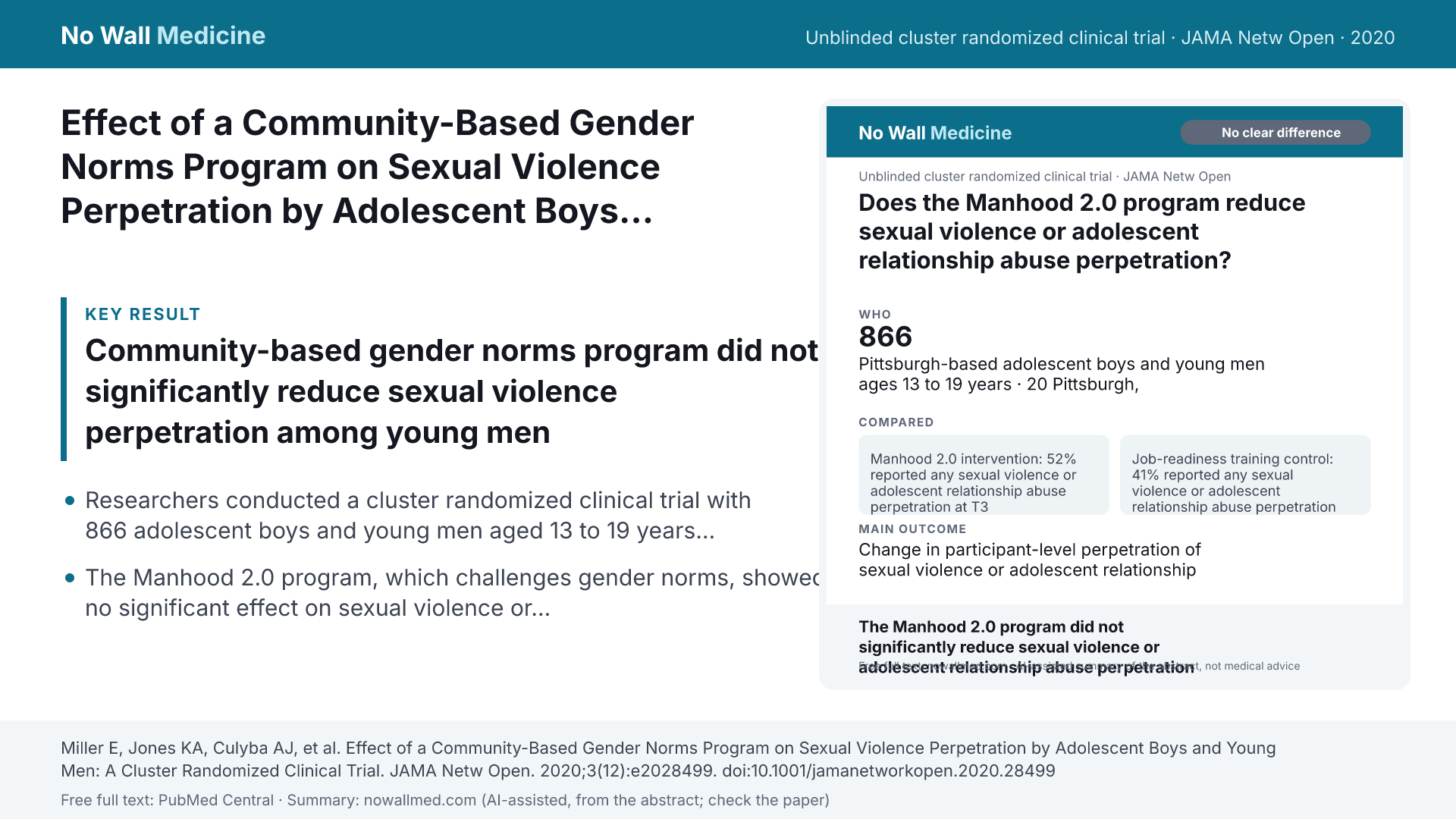
Community-based gender norms program did not significantly reduce sexual violence perpetration among young men
Effect of a Community-Based Gender Norms Program on Sexual Violence Perpetration by Adolescent Boys and Young Men: A Cluster Randomized Clinical Trial
Unblinded cluster randomized clinical trialNo clear difference
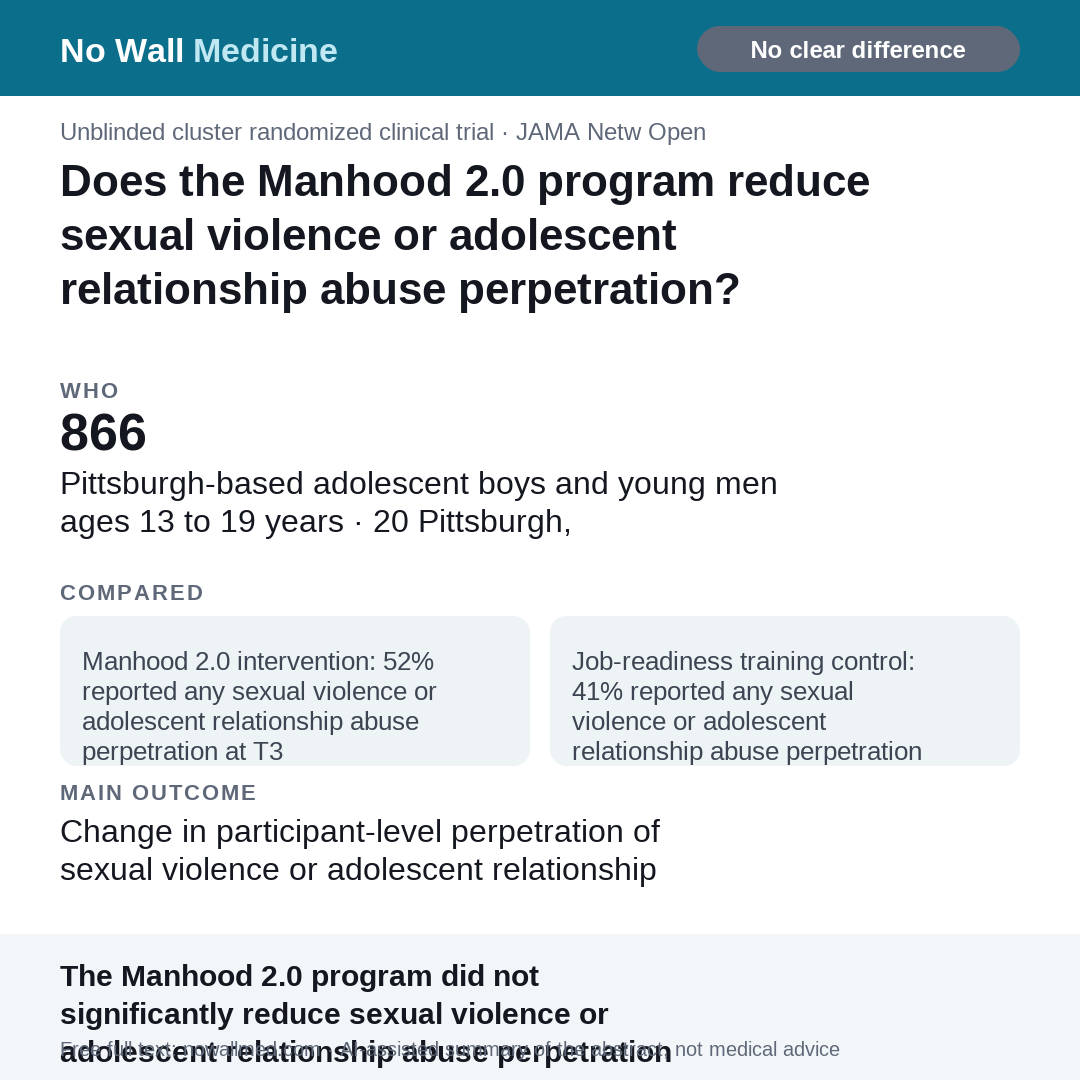
Does the Manhood 2.0 program reduce sexual violence or adolescent relationship abuse perpetration?
Who
866
Pittsburgh-based adolescent boys and young men ages 13 to 19 years · 20 Pittsburgh, Pennsylvania neighborhoods and 1 centrally located site
Compared
Manhood 2.0 intervention: 52% reported any sexual violence or adolescent relationship abuse perpetration at T3
Job-readiness training control: 41% reported any sexual violence or adolescent relationship abuse perpetration at T3
Main outcome
Change in participant-level perpetration of sexual violence or adolescent relationship abuse
Result: adjusted odds ratio 1.32 (95% CI 0.86-2.01)
Bottom line: The Manhood 2.0 program did not significantly reduce sexual violence or adolescent relationship abuse perpetration compared to job-readiness training.
JAMA Netw Open · 2020-12-01Download image
Clinical question: Does the Manhood 2.0 program reduce sexual violence or adolescent relationship abuse perpetration?
Why it matters: It is unknown if a community-based, gender-transformative program can effectively reduce the perpetration of sexual violence and adolescent relationship abuse among adolescent boys and young men.
Key points
- Researchers conducted a cluster randomized clinical trial with 866 adolescent boys and young men aged 13 to 19 years in Pittsburgh neighborhoods.
- The Manhood 2.0 program, which challenges gender norms, showed no significant effect on sexual violence or adolescent relationship abuse compared to job-readiness training (adjusted odds ratio, 1.32; 95% CI, 0.86-2.01; P = .20).
- In the intervention group, 64% reported sexual violence or relationship abuse at baseline and 52% reported it at 9 months, while in the control group, 53% reported it at baseline and 41% at 9 months.
Headline and key points written with AI from the paper’s abstract, with every number checked against it. Read the paper before relying on them.
Was this summary helpful?
Subject terms
Cite this article
Miller E, Jones KA, Culyba AJ, et al. Effect of a Community-Based Gender Norms Program on Sexual Violence Perpetration by Adolescent Boys and Young Men: A Cluster Randomized Clinical Trial. JAMA Netw Open. 2020. doi:10.1001/jamanetworkopen.2020.28499
Spotted a mistake? Suggest a correction