Community and chronic care team intervention did not significantly change systolic blood pressure after stroke
Effect of a Coordinated Community and Chronic Care Model Team Intervention vs Usual Care on Systolic Blood Pressure in Patients With Stroke or Transient Ischemic Attack: The SUCCEED Randomized Clinical Trial
Randomized clinical trialNo clear difference
Does a coordinated community and chronic care model team intervention improve systolic blood pressure?
Who
487
Stroke or transient ischemic attack survivors aged 40 years or older · 5 hospitals in Los Angeles County, California
Compared
Intervention: 133 (20) mm Hg
Usual care: 137 (22) mm Hg
Main outcome
Change in systolic blood pressure at 12 months
Bottom line: The coordinated care intervention did not significantly improve systolic blood pressure compared to usual care at 12 months.
Limitation: Only 14.5% of the intervention group received the intended full dose of the intervention.
JAMA Netw Open · 2021-02-01Download image
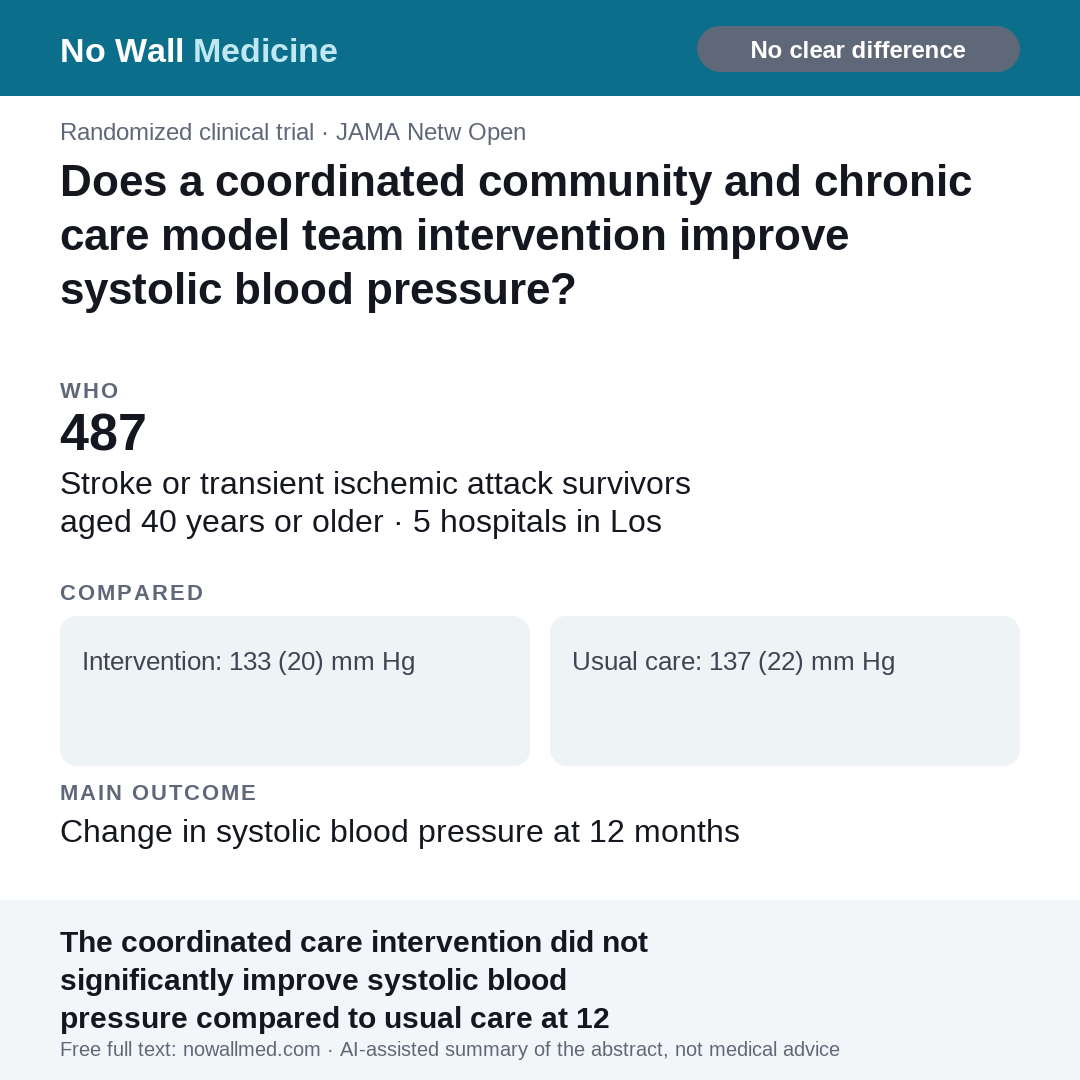
Clinical question: Does a coordinated community and chronic care model team intervention improve systolic blood pressure?
Why it matters: Many stroke survivors, particularly in racial, ethnic, or socioeconomically disadvantaged populations, do not meet recommended cardiovascular goals.
Key points
- Researchers randomized 487 participants who had experienced a stroke or transient ischemic attack to either a coordinated care team intervention or usual care.
- At 12 months, mean systolic blood pressure changed from 143 (17) mm Hg to 133 (20) mm Hg in the intervention group and from 146 (19) mm Hg to 137 (22) mm Hg in the usual care group, with no significant difference between groups.
- The intervention group showed greater improvements in self-reported salt intake and serum C-reactive protein levels, which is a marker of inflammation, compared to the control group.
Limitation the authors note: Only 14.5% of participants in the intervention group received the intended full dose of the program components.
Headline and key points written with AI from the paper’s abstract, with every number checked against it. Read the paper before relying on them.
Was this summary helpful?
Subject terms
Cite this article
Towfighi A, Cheng EM, Ayala-Rivera M, Barry F, McCreath H, Ganz DA. Effect of a Coordinated Community and Chronic Care Model Team Intervention vs Usual Care on Systolic Blood Pressure in Patients With Stroke or Transient Ischemic Attack: The SUCCEED Randomized Clinical Trial. JAMA Netw Open. 2021. doi:10.1001/jamanetworkopen.2020.36227
Spotted a mistake? Suggest a correction
Top studies every Monday
The week’s key trials and guidelines in your specialties, plus any topics you follow. By email, free.
Get the weekly digest