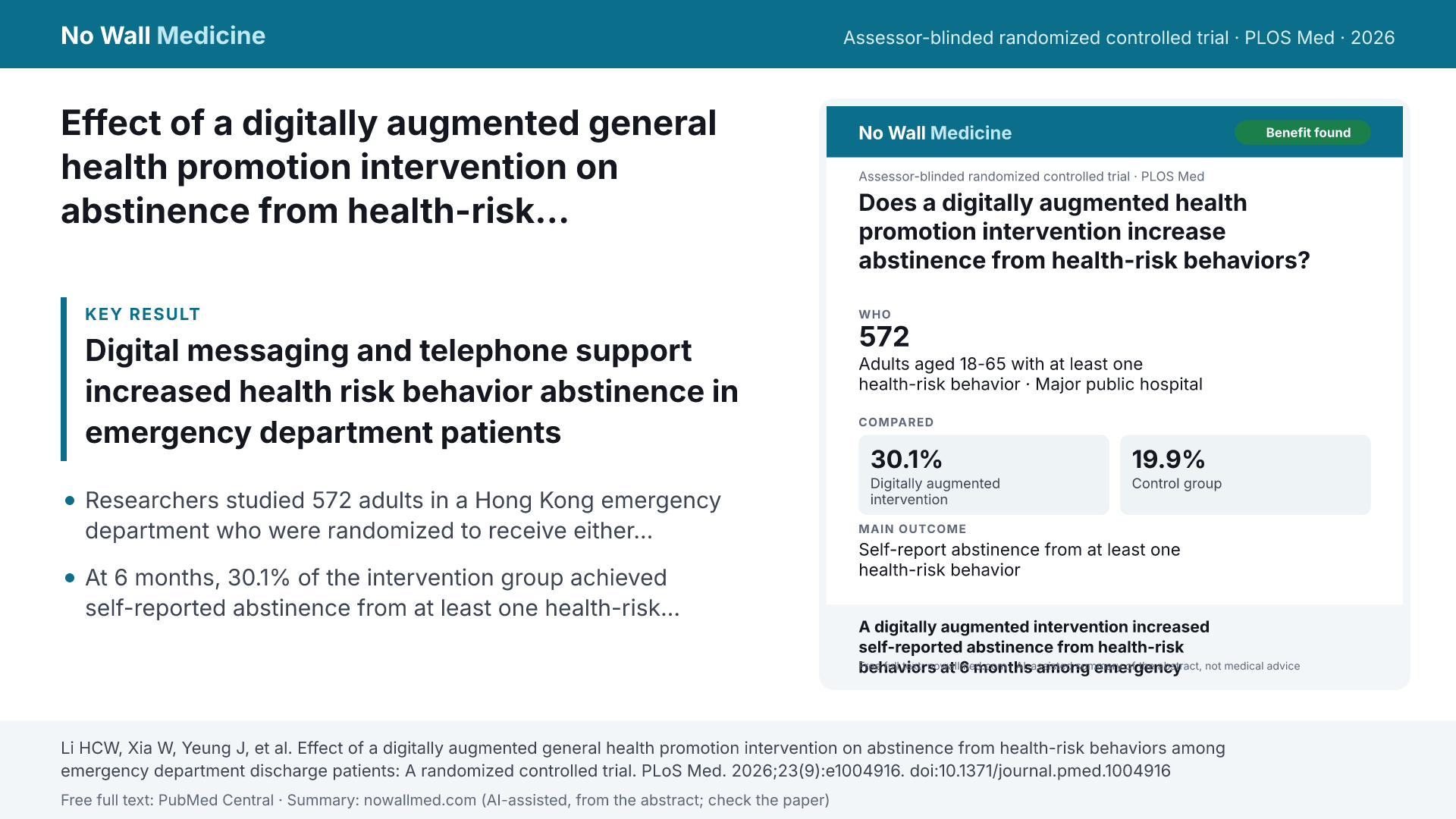
Digital messaging and telephone support increased health risk behavior abstinence in emergency department patients
Effect of a digitally augmented general health promotion intervention on abstinence from health-risk behaviors among emergency department discharge patients: A randomized controlled trial
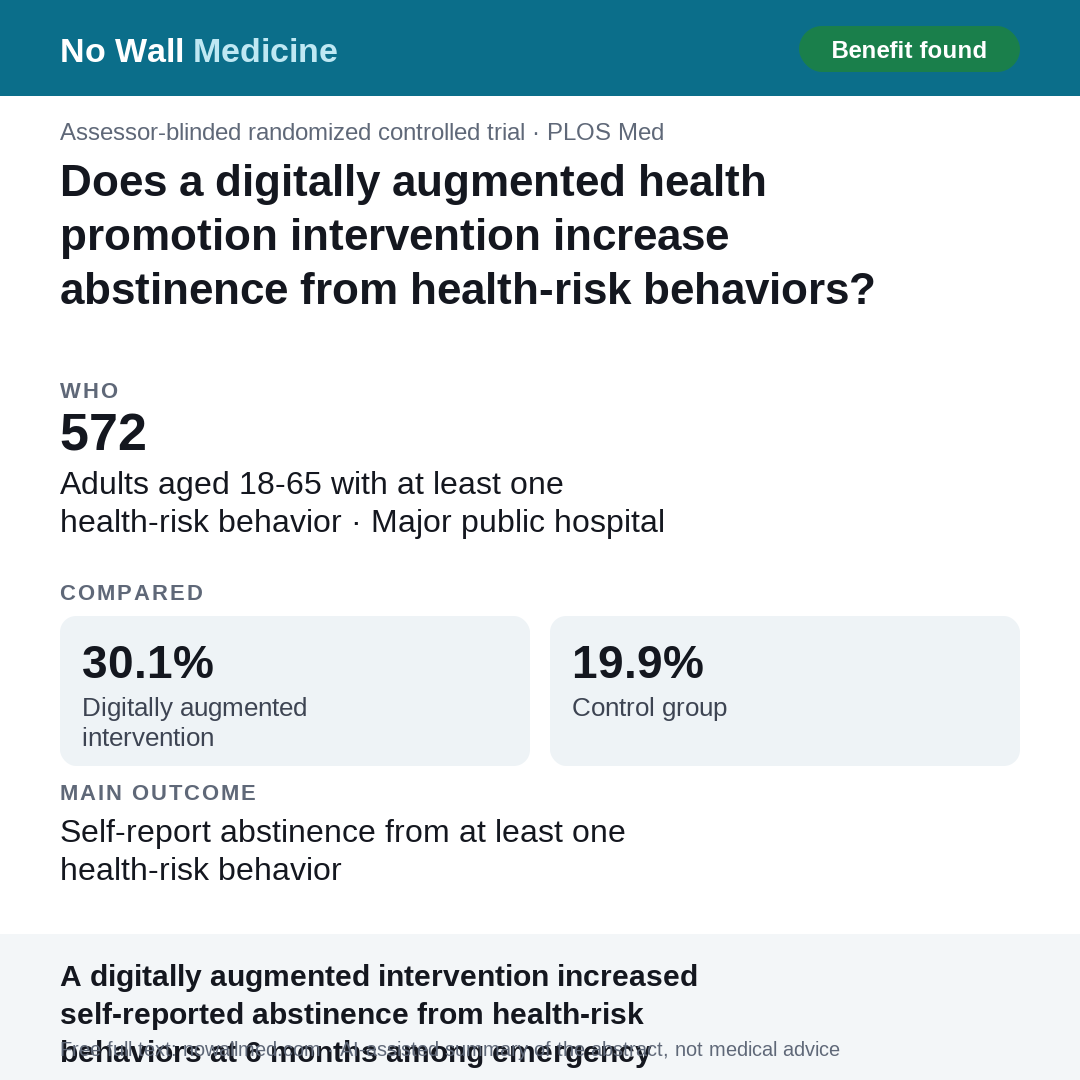
Assessor-blinded randomized controlled trialBenefit found
Does a digitally augmented health promotion intervention increase abstinence from health-risk behaviors?
Who
572
Adults aged 18-65 with at least one health-risk behavior · Major public hospital emergency department in Hong Kong
Compared
30.1%Digitally augmented intervention
19.9%Control group
Main outcome
Self-report abstinence from at least one health-risk behavior
Result: relative risk 1.51 (95% CI 1.13-2.02)
Bottom line: A digitally augmented intervention increased self-reported abstinence from health-risk behaviors at 6 months among emergency department discharge patients.
Limitation: Reliance on self-reported outcomes, single-center design, and loss to follow-up.
PLOS Med · 2026-09-08Download image
Clinical question: Does a digitally augmented health promotion intervention increase abstinence from health-risk behaviors?
Why it matters: Emergency department visits represent a unique opportunity to promote behavior change for noncommunicable diseases driven by tobacco use, alcohol consumption, unhealthy diet, and physical inactivity.
In absolute numbers
Digitally augmented intervention: 30.1% · Control group: 19.9% → a difference of 10.2 percentage points, so about 10 people would need the treatment for 1 more to benefit (number needed to treat) over the trial’s follow-up.
Worked out by us from the two group results above, not reported by the authors. Check the paper for the exact outcome and timing.
Key points
- Researchers studied 572 adults in a Hong Kong emergency department who were randomized to receive either telephone advice plus mobile messaging or telephone advice alone.
- At 6 months, 30.1% of the intervention group achieved self-reported abstinence from at least one health-risk behavior compared to 19.9% in the control group.
- The intervention also increased the likelihood of having fewer risky behaviors at 6 months and 12 months, with physical inactivity showing the greatest improvement at 6 months.
Limitation the authors note: The authors state the study relied on self-reported outcomes, used a single-center design, and experienced loss to follow-up.
Headline and key points written with AI from the paper’s abstract, with every number checked against it. Read the paper before relying on them.
Was this summary helpful?
Subject terms
Headline, design, result, key points, caveat and citation as plain text.
Cite this article
Li HCW, Xia W, Yeung J, et al. Effect of a digitally augmented general health promotion intervention on abstinence from health-risk behaviors among emergency department discharge patients: A randomized controlled trial. PLoS Med. 2026;23(9):e1004916. doi:10.1371/journal.pmed.1004916
Spotted a mistake? Suggest a correction