Home-based inspiratory muscle training is being tested to improve functional capacity in chronic COVID-19 patients
Effect of a home-based inspiratory muscular training programme on functional capacity in patients with chronic COVID-19 after a hospital discharge: protocol for a randomised control trial (InsCOVID trial)
Assessor-blinded randomized controlled trialUnclear result
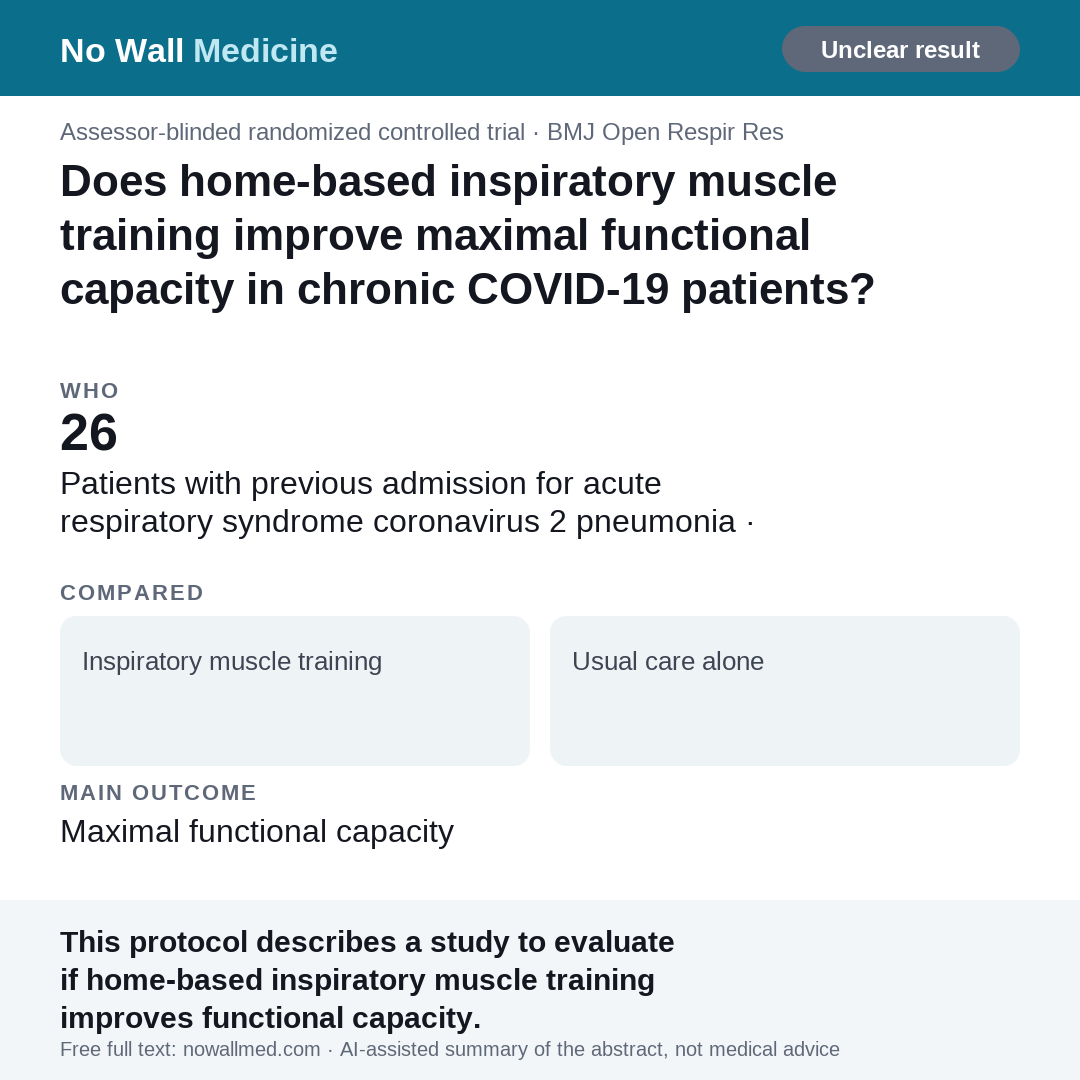
Does home-based inspiratory muscle training improve maximal functional capacity in chronic COVID-19 patients?
Who
26
Patients with previous admission for acute respiratory syndrome coronavirus 2 pneumonia · Single-centre
Compared
Inspiratory muscle training
Usual care alone
Main outcome
Maximal functional capacity
Bottom line: This protocol describes a study to evaluate if home-based inspiratory muscle training improves functional capacity.
BMJ Open Respir Res · 2022-07-05Download image
Clinical question: Does home-based inspiratory muscle training improve maximal functional capacity in chronic COVID-19 patients?
Why it matters: It is unknown if home-based inspiratory muscle training programs can improve maximal functional capacity for symptomatic patients experiencing fatigue and exercise intolerance after hospital discharge for COVID-19.
Key points
- This randomized controlled trial will enroll 26 patients with previous acute respiratory syndrome coronavirus 2 pneumonia to compare a 12-week home-based inspiratory muscle training program against usual care.
- The study aims to evaluate whether training the muscles used for breathing can change maximal functional capacity in patients more than 3 months after hospital discharge.
Headline and key points written with AI from the paper’s abstract, with every number checked against it. Read the paper before relying on them.
Was this summary helpful?
Abstract
Introduction
Exercise intolerance and fatigue are the most common symptoms in patients with chronic COVID-19 after hospital discharge. Supervised exercise training programmes improve symptoms, but scarce research has been done on home-based exercise programmes on the maximal functional capacity for discharged symptomatic COVID-19 patients. This study evaluates whether a home-based inspiratory muscle training (IMT) programme improves maximal functional capacity in chronic COVID-19 after hospital admission. Methods and analysis
This single-centre, assessor-blinded randomised controlled trial, powered for superiority, seeks to evaluate maximal functional capacity as the primary endpoint. A total of 26 eligible patients with a previous admission for acute respiratory syndrome coronavirus 2 pneumonia (>3 months after hospital discharge) will be randomised (1:1) to receive a 12-week programme of IMT versus usual care alone. A blinded assessor will measure outcomes at baseline and after the intervention (12 weeks). An analysis of variance will be used to compare continuous outcomes among the two-intervention groups. As of 21 March 2022, eight patients have been enrolled. Ethics and dissemination
The research ethics committee (Comité Ético de Investigación con Medicamentos de l'Hospital Clínic Universitari de València) approved the protocol following the principles of the Declaration of Helsinki and national regulations (Approval Number: 021/226). Findings will be published in peer-reviewed journals and conference publications. Trial registration number
NCT05279430.
Abstract reproduced under the article’s CC BY NC licence.
Subject terms
Cite this article
Palau P, Domínguez E, Sastre C, Martínez ML, Gonzalez C, Bondía E. Effect of a home-based inspiratory muscular training programme on functional capacity in patients with chronic COVID-19 after a hospital discharge: protocol for a randomised control trial (InsCOVID trial). BMJ Open Respir Res. 2022. doi:10.1136/bmjresp-2022-001255
Spotted a mistake? Suggest a correction
Top studies every Monday
The week’s key trials and guidelines in your specialties, plus any topics you follow. By email, free.
Get the weekly digest