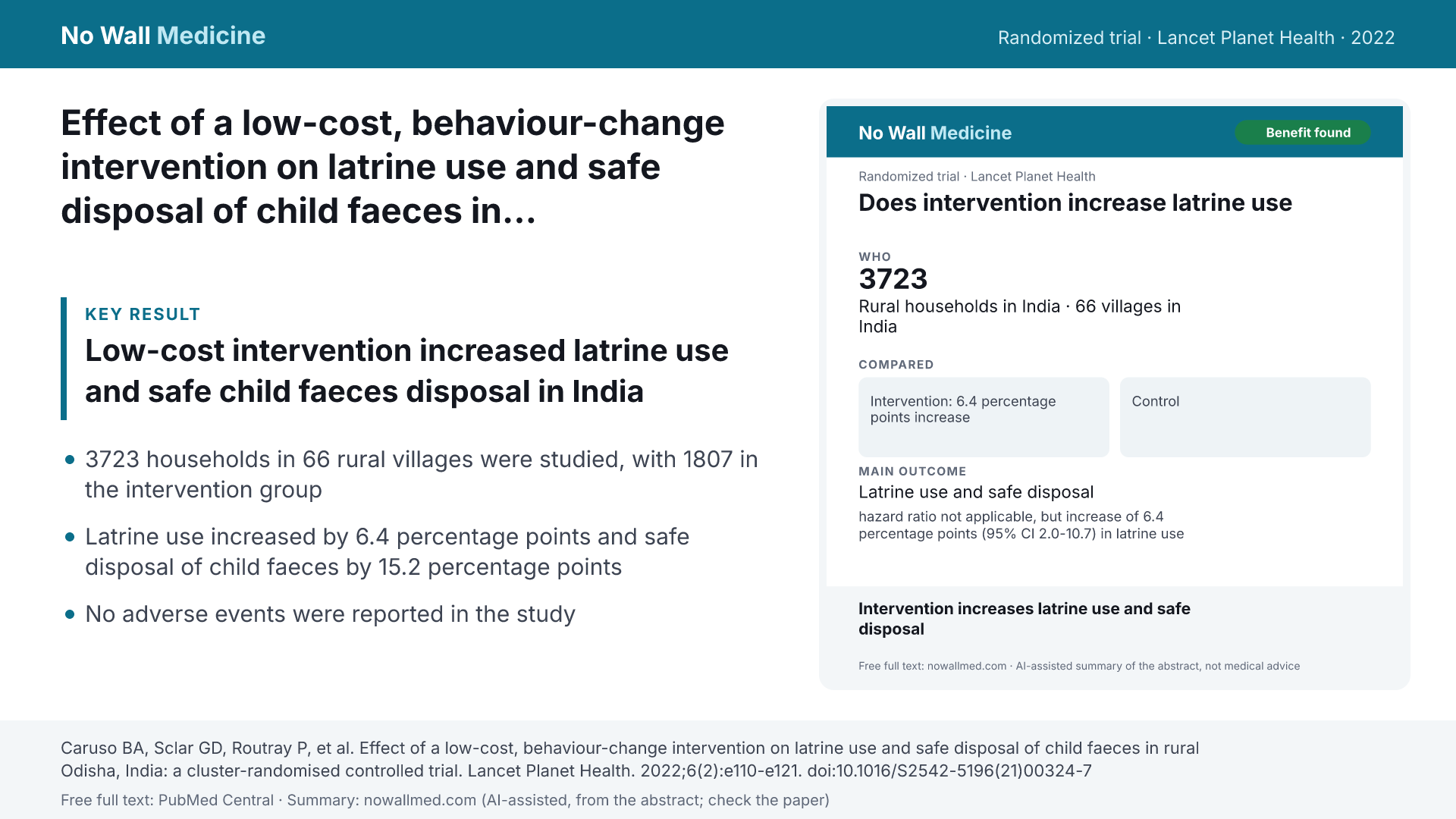
Low-cost intervention increased latrine use and safe child faeces disposal in India
Effect of a low-cost, behaviour-change intervention on latrine use and safe disposal of child faeces in rural Odisha, India: a cluster-randomised controlled trial
Randomized trialBenefit found
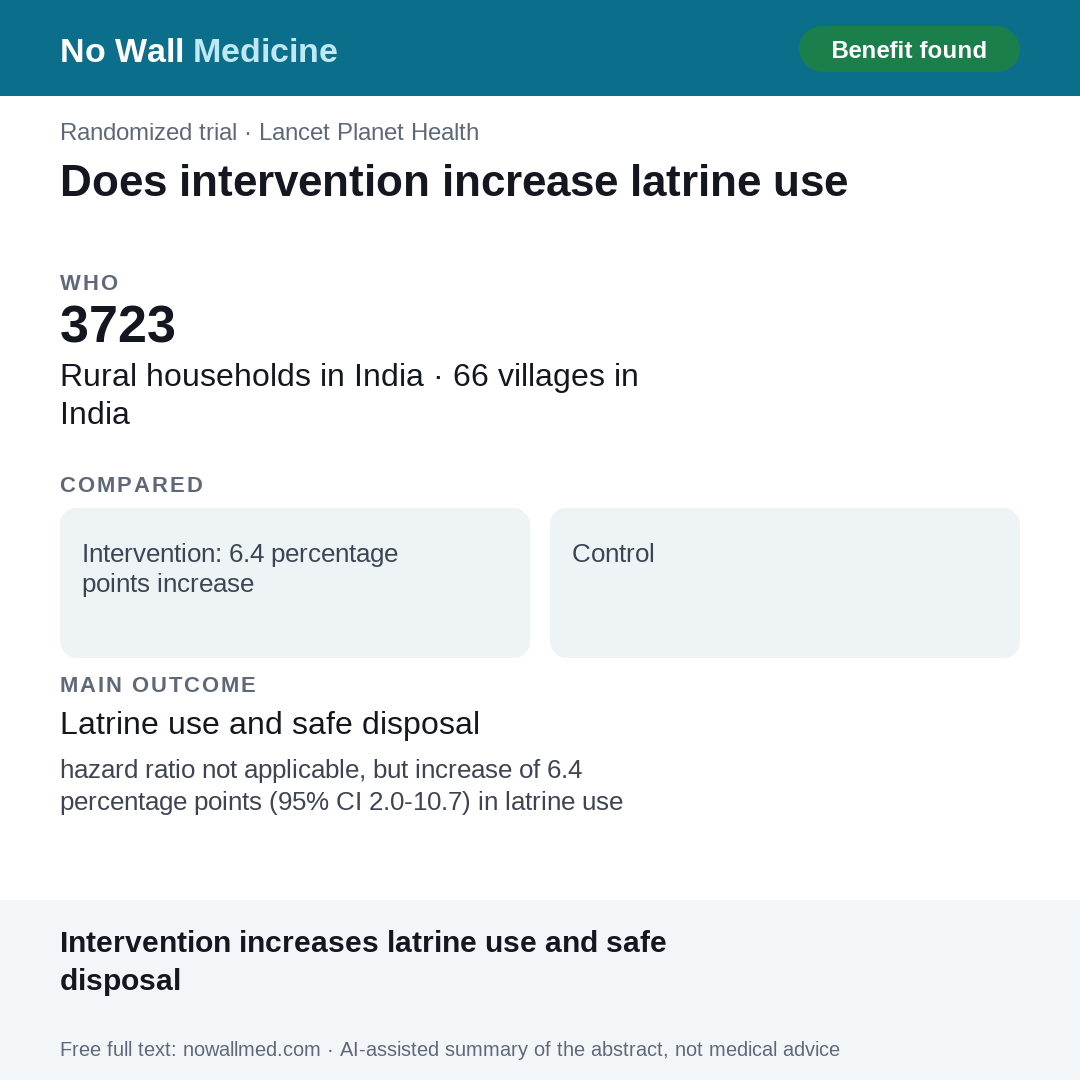
Does intervention increase latrine use
Who
3723
Rural households in India · 66 villages in India
Compared
Intervention: 6.4 percentage points increase
Control
Main outcome
Latrine use and safe disposal
Result: hazard ratio not applicable, but increase of 6.4 percentage points (95% CI 2.0-10.7) in latrine use
Bottom line: Intervention increases latrine use and safe disposal
Funded by: Bill & Melinda Gates Foundation
Lancet Planet Health · 2022-02-13Download image
Why it matters: Uptake of Government-promoted sanitation remains a challenge in India
Key points
- 3723 households in 66 rural villages were studied, with 1807 in the intervention group.
- Latrine use increased by 6.4 percentage points and safe disposal of child faeces by 15.2 percentage points.
- No adverse events were reported in the study.
Limitation the authors note: The intervention was unlikely to reduce exposure to faecal pathogens to a level necessary to achieve health gains
Headline and key points written with AI from the paper’s abstract, with every number checked against it. Read the paper before relying on them.
Was this summary helpful?
Abstract
Background
Uptake of Government-promoted sanitation remains a challenge in India. We aimed to investigate a low-cost, theory-driven, behavioural intervention designed to increase latrine use and safe disposal of child faeces in India. Methods
We did a cluster-randomised controlled trial between Jan 30, 2018, and Feb 18, 2019, in 66 rural villages in Puri, Odisha, India. Villages were eligible if not adjacent to another included village and not designated by the Government to be open-defecation free. All latrine-owning households in selected villages were eligible. We assigned 33 villages to the intervention via stratified randomisation. The intervention was required to meet a limit of US$20 per household and included a folk performance, transect walk, community meeting, recognition banners, community wall painting, mothers' meetings, household visits, and latrine repairs. Control villages received no intervention. Neither participants nor field assessors were masked to study group assignment. We estimated intervention effects on reported latrine use and safe disposal of child faeces 4 months after completion of the intervention delivery using a difference-in-differences analysis and stratified results by sex. This study is registered at ClinicalTrials.gov, NCT03274245. Findings
We enrolled 3723 households (1807 [48·5%] in the intervention group and 1916 [51·5%] in the control group). Analysis included 14 181 individuals (6921 [48·8%] in the intervention group and 7260 [51·2%] in the control group). We found an increase of 6·4 percentage points (95% CI 2·0-10·7) in latrine use and an increase of 15·2 percentage points (7·9-22·5) in safe disposal of child faeces. No adverse events were reported. Interpretation
A low-cost behavioural intervention achieved modest increases in latrine use and marked increases in safe disposal of child faeces in the short term but was unlikely to reduce exposure to faecal pathogens to a level necessary to achieve health gains. Funding
The Bill & Melinda Gates Foundation and International Initiative for Impact Evaluation.
Abstract reproduced under the article’s CC BY licence.
Subject terms
Cite this article
Caruso BA, Sclar GD, Routray P, et al. Effect of a low-cost, behaviour-change intervention on latrine use and safe disposal of child faeces in rural Odisha, India: a cluster-randomised controlled trial. Lancet Planet Health. 2022. doi:10.1016/S2542-5196(21)00324-7
Spotted a mistake? Suggest a correction