Chatbot and webinar interventions did not significantly change COVID-19 vaccine intention in Japan
Effect of a mobile app chatbot and an interactive small-group webinar on COVID-19 vaccine intention and confidence in Japan: a randomised controlled trial
Randomized controlled trialNo clear difference
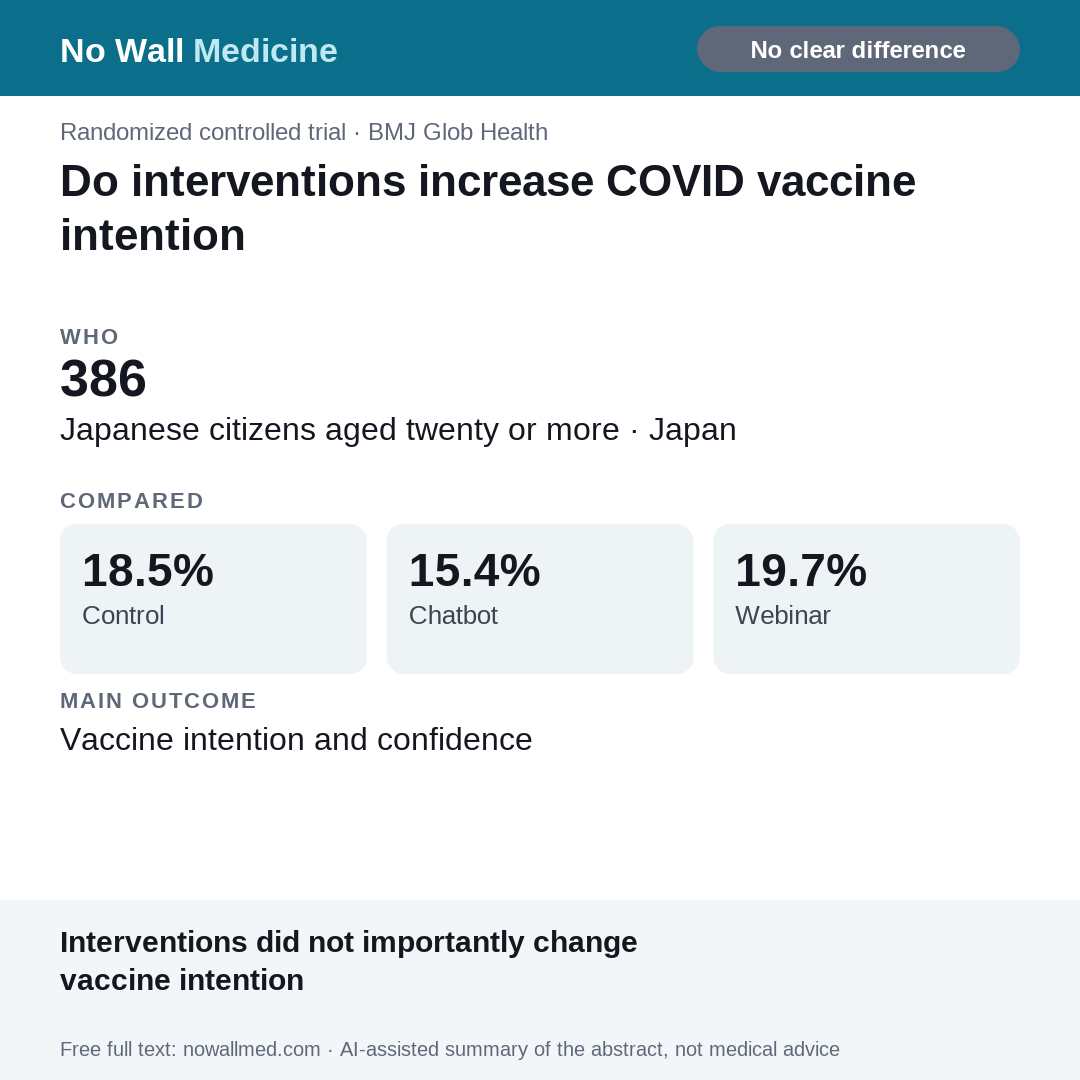
Do interventions increase COVID vaccine intention
Who
386
Japanese citizens aged twenty or more · Japan
Compared
18.5%Control (95% CI 14.5%, 22.5%)
15.4%Chatbot (95% CI 10.8%, 20.1%)
19.7%Webinar (95% CI 14.5%, 24.9%)
Main outcome
Vaccine intention and confidence
Bottom line: Interventions did not importantly change vaccine intention
BMJ Glob Health · 2023-05-30Download image
Why it matters: It was unknown if social media-based interventions like chatbots or webinars could increase COVID-19 vaccine intention and confidence among unvaccinated individuals in Japan.
Key points
- Researchers randomized 386 Japanese citizens per group to a control, a mobile app chatbot, or interactive webinars to measure vaccine intention and confidence.
- Vaccine intention increased from 0% to 18.5% in the control group, 15.4% in the chatbot group, and 19.7% in the webinar group, with no significant difference between groups.
- Interactive webinars were associated with larger improvements in vaccine confidence for importance (7.8% vs -2.5%) and effectiveness (6.4% vs -7.6%) compared to the control group.
Headline and key points written with AI from the paper’s abstract, with every number checked against it. Read the paper before relying on them.
Abstract
Introduction
We investigated the effect of social media-based interventions on COVID-19 vaccine intention (VI) and confidence in Japan. Methods
We conducted a three-arm randomised controlled trial between 5 November 2021 and 9 January 2022 during a low incidence (<1000/day) of COVID-19 in Japan in the midst of the second and the third waves. Japanese citizens aged ≥20 who had not received any COVID-19 vaccine and did not intend to be vaccinated were randomly assigned to one of the following three groups: (1) a control group, (2) a group using a mobile app chatbot providing information on COVID-19 vaccines and (3) a group using interactive webinars with health professionals. VI and predefined Vaccine Confidence Index (VCI) measuring confidence in the importance, safety and effectiveness were compared before and after the interventions under intention-to-treat principle. Logistic regression models were used to investigate the effect of each intervention on postintervention VI and changes of VCI compared with control. Results
Among 386 participants in each group, 359 (93.0%), 231 (59.8%) and 207 (53.6%) completed the postsurvey for the control, chatbot and webinar groups, respectively. The average duration between the intervention and the postsurvey was 32 days in chatbot group and 27 days in webinar group. VI increased from 0% to 18.5% (95% CI 14.5%, 22.5%) in control group, 15.4% (95% CI 10.8%, 20.1%) in chatbot group and 19.7% (95% CI 14.5%, 24.9%) in webinar group without significant difference (OR for improvement=0.8 (95% CI 0.5, 1.3), p=0.33 between chatbot and control, OR=1.1 (95% CI 0.7, 1.6), p=0.73 between webinar and control). VCI change tended to be larger in chatbot group compared with control group without significant difference (3.3% vs -2.5% in importance, OR for improvement=1.3 (95% CI 0.9, 2.0), p=0.18; 2.5% vs 1.9% in safety, OR=1.1 (95% CI 0.7, 1.9), p=0.62; -2.4% vs -7.6% in effectiveness, OR=1.4 (95% CI 0.9, 2.1), p=0.09). Improvement in VCI was larger in webinar group compared with control group for importance (7.8% vs -2.5%, OR=1.8 (95% CI 1.2, 2.8), p<0.01), effectiveness (6.4% vs -7.6%, OR=2.2 (95% CI 1.4, 3.4), p<0.01) and safety (6.0% vs 1.9%, OR=1.6 (95% CI 1.0, 2.6), p=0.08). Conclusion
This study demonstrated that neither the chatbot nor the webinar changed VI importantly compared with control. Interactive webinars could be an effective tool to change vaccine confidence. Further study is needed to identify risk factors associated with decreased vaccine confidence and investigate what intervention can increase VI and vaccine confidence for COVID-19 vaccines. Trial registration number
UMIN000045747.
Abstract reproduced under the article’s CC BY NC licence.
Topics
Cite this article
Kobayashi T, Tomoi H, Nishina Y, Harada K, Tanaka K, Sasaki S. Effect of a mobile app chatbot and an interactive small-group webinar on COVID-19 vaccine intention and confidence in Japan: a randomised controlled trial. BMJ Glob Health. 2023. doi:10.1136/bmjgh-2022-010370
Spotted a mistake? Suggest a correction
Top studies every Monday
The week’s key trials and guidelines in your specialties, plus any topics you follow. By email, free.
Get the weekly digest