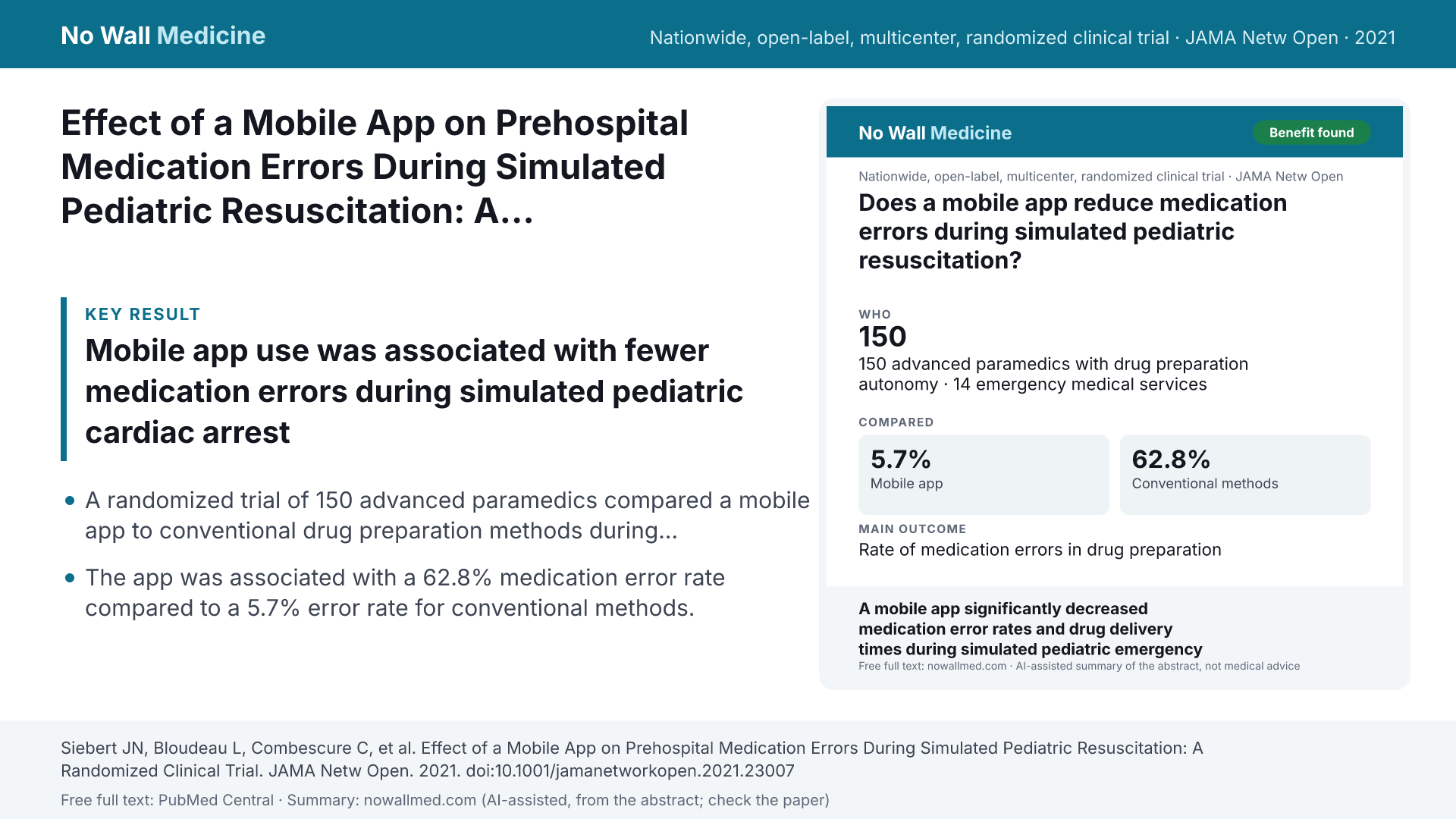
Mobile app use was associated with fewer medication errors during simulated pediatric cardiac arrest
Effect of a Mobile App on Prehospital Medication Errors During Simulated Pediatric Resuscitation: A Randomized Clinical Trial
Nationwide, open-label, multicenter, randomized clinical trialBenefit found
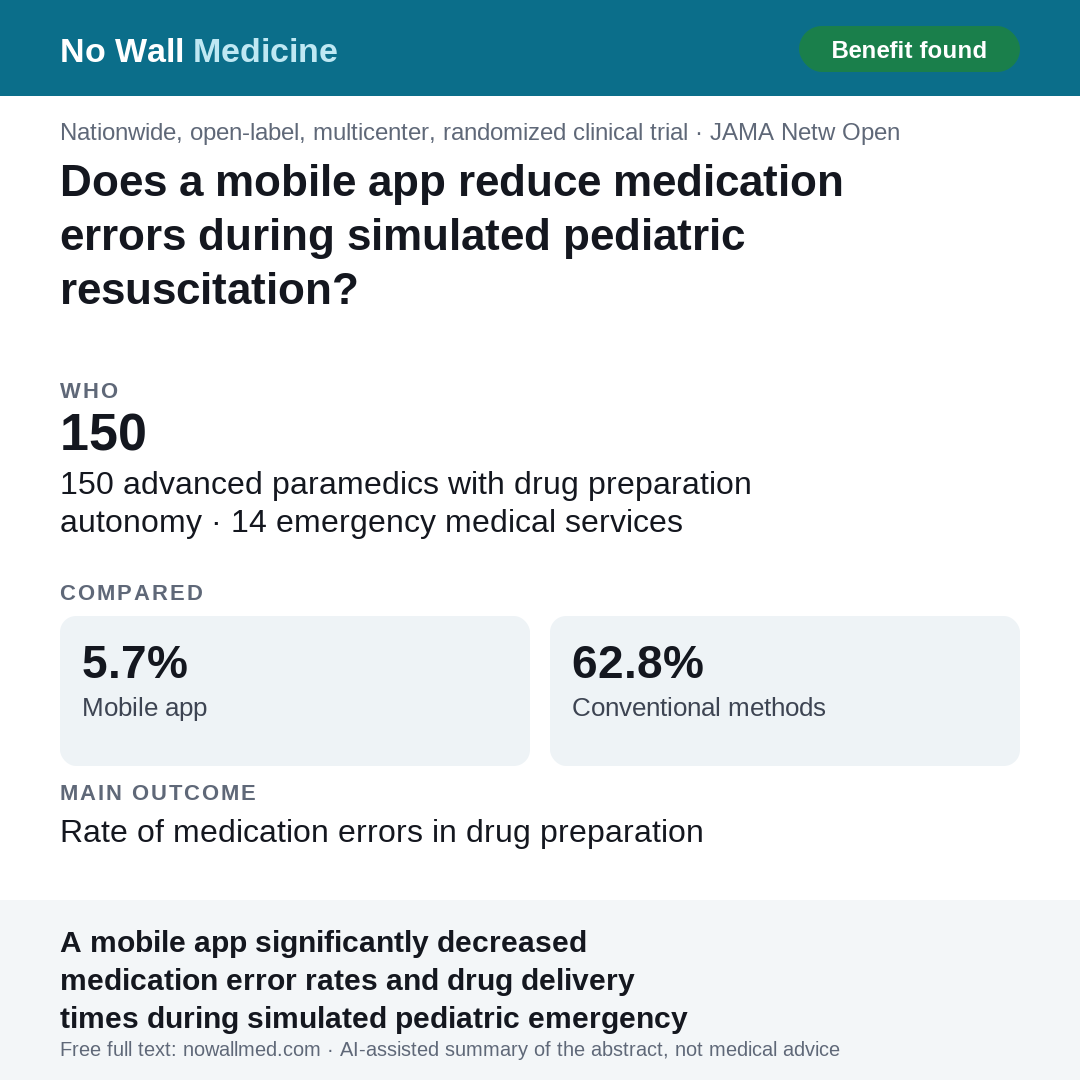
Does a mobile app reduce medication errors during simulated pediatric resuscitation?
Who
150
150 advanced paramedics with drug preparation autonomy · 14 emergency medical services centers in Switzerland
Compared
5.7%Mobile app (17/296)
62.8%Conventional methods (191/304)
Main outcome
Rate of medication errors in drug preparation
Result: proportion of medication errors decreased in absolute terms by 66.5% (95% CI, 32.6%-83.8%)
Bottom line: A mobile app significantly decreased medication error rates and drug delivery times during simulated pediatric emergency drug preparation.
JAMA Netw Open · 2021-08-02Download image
Clinical question: Does a mobile app reduce medication errors during simulated pediatric resuscitation?
Why it matters: Innovative interventions for preventing medication errors in prehospital emergency care for children are currently lacking.
In absolute numbers
Mobile app: 5.7% · Conventional methods: 62.8% → a difference of 57.1 percentage points, so about 2 people would need the treatment for 1 more to benefit (number needed to treat) over the trial’s follow-up.
Worked out by us from the two group results above, not reported by the authors. Check the paper for the exact outcome and timing.
Key points
- A randomized trial of 150 advanced paramedics compared a mobile app to conventional drug preparation methods during simulated pediatric out-of-hospital cardiac arrest scenarios.
- The app was associated with a 62.8% medication error rate compared to a 5.7% error rate for conventional methods.
- Using the app was associated with a 40 second decrease in mean time to drug preparation and a 47 second decrease in mean time to drug delivery.
Headline and key points written with AI from the paper’s abstract, with every number checked against it. Read the paper before relying on them.
Was this summary helpful?
Subject terms
Cite this article
Siebert JN, Bloudeau L, Combescure C, et al. Effect of a Mobile App on Prehospital Medication Errors During Simulated Pediatric Resuscitation: A Randomized Clinical Trial. JAMA Netw Open. 2021. doi:10.1001/jamanetworkopen.2021.23007
Spotted a mistake? Suggest a correction