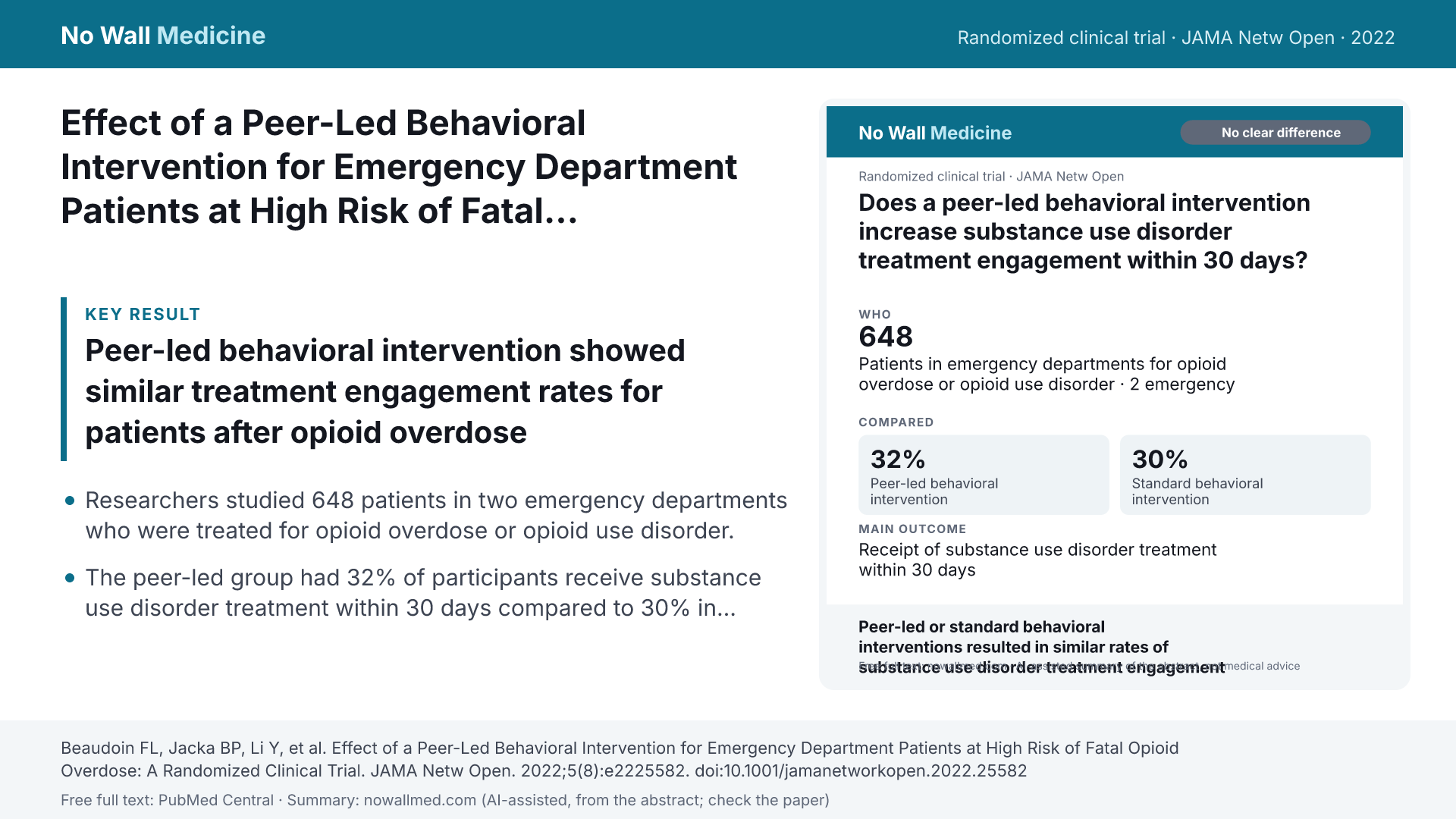
Effect of a Peer-Led Behavioral Intervention for Emergency Department Patients at High Risk of Fatal Opioid Overdose: A Randomized Clinical Trial
Key result: Peer-led behavioral intervention showed similar treatment engagement rates for patients after opioid overdose
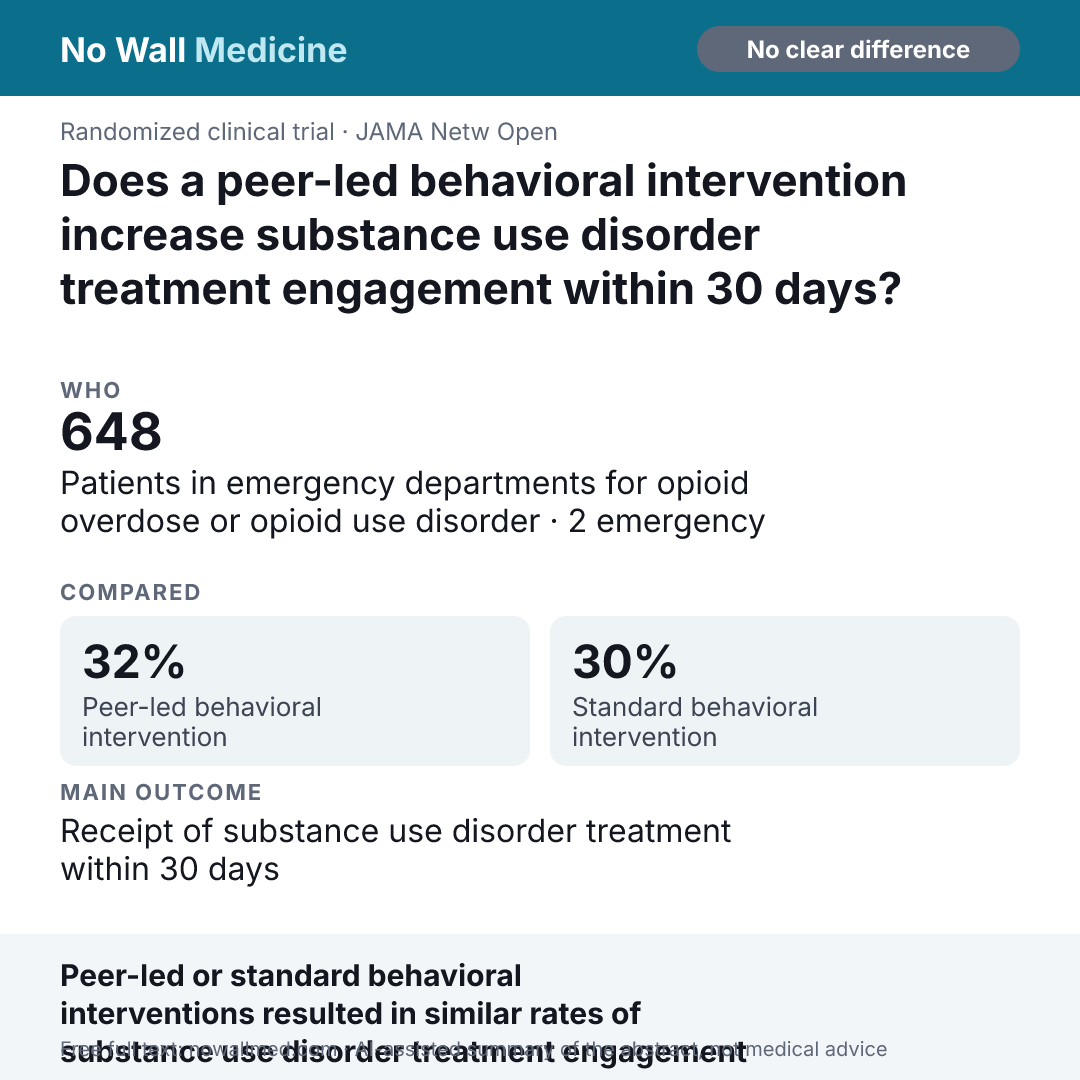
Randomized clinical trialNo clear difference
Does a peer-led behavioral intervention increase substance use disorder treatment engagement within 30 days?
Who
648
Patients in emergency departments for opioid overdose or opioid use disorder · 2 emergency departments
Compared
32%Peer-led behavioral intervention (103/323)
30%Standard behavioral intervention (98/325)
Main outcome
Receipt of substance use disorder treatment within 30 days
Bottom line: Peer-led or standard behavioral interventions resulted in similar rates of substance use disorder treatment engagement within 30 days.
Limitation: Further study is required to determine effects on longer-term engagement and other health outcomes.
JAMA Netw Open · 2022-08-01 · Save PNG
Key points
- Researchers studied 648 patients in two emergency departments who were treated for opioid overdose or opioid use disorder.
- The peer-led group had 32% of participants receive substance use disorder treatment within 30 days compared to 30% in the standard care group.
- The most common treatments accessed by all participants were outpatient medication for opioid use disorder, including buprenorphine at 18.4% and methadone at 6.8%.
Discussion prompts
- Would these patients look like yours? Who was left out?
- Is the main outcome one that matters to patients?
- Is the difference large enough to change what you do?
Cite: Beaudoin FL, Jacka BP, Li Y, et al. Effect of a Peer-Led Behavioral Intervention for Emergency Department Patients at High Risk of Fatal Opioid Overdose: A Randomized Clinical Trial. JAMA Netw Open. 2022;5(8):e2225582. doi:10.1001/jamanetworkopen.2022.25582
Free full text: PubMed Central · Summary and visual abstract: nowallmed.com/a/effect-of-a-peer-led-behavioral-intervention-for-emergency-department-1k5gdr8/ (AI-assisted from the abstract; check the paper before relying on it).