Daily WeChat reminders were associated with early improvements in HIV prevention medicine adherence
Effect of a Reminder System on Pre-exposure Prophylaxis Adherence in Men Who Have Sex With Men: Prospective Cohort Study Based on WeChat Intervention
Open-label, multicenter, prospective cohort studyBenefit found
Does a WeChat reminder system improve pre-exposure prophylaxis adherence in men who have sex with men?
Who
716
HIV-negative men who have sex with men · multicenter
Compared
no-reminder group: fluctuated between 0.75 and 0.80
reminder group: gradually increased over time from 0.76 to 0.88
Main outcome
percentage of medications taken on time
Result: odds ratio 1.65 (95% CI 1.01-2.70)
Bottom line: A WeChat reminder system may improve early-stage pre-exposure prophylaxis adherence and help users develop medicine-taking habits.
J Med Internet Res · 2022-08-11Download image
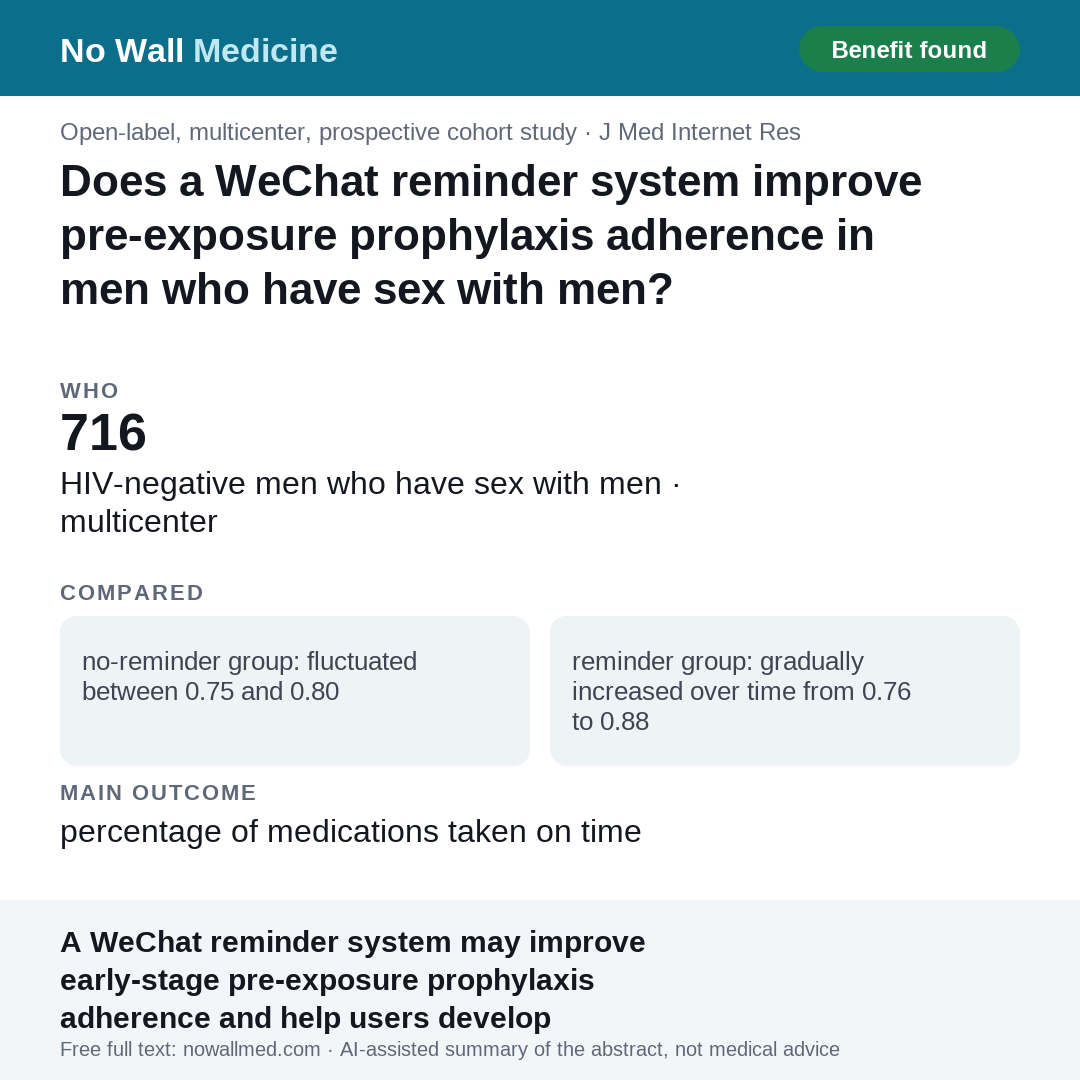
Clinical question: Does a WeChat reminder system improve pre-exposure prophylaxis adherence in men who have sex with men?
Why it matters: Forgetfulness is a primary reason for poor adherence to pre-exposure prophylaxis, which is a medication taken to prevent HIV infection.
Key points
- The study followed 716 HIV-negative men who have sex with men, comparing a group receiving daily WeChat messages to a group receiving no reminders.
- Adherence in the no-reminder group fluctuated between 0.75 and 0.80, while the reminder group increased from 0.76 to 0.88, though adherence at each time point was not statistically different between groups.
- Using the reminder system was associated with an improvement in adherence during the early stage (OR 1.65, 95% CI 1.01-2.70) and an improvement in average adherence (OR 1.82, 95% CI 1.10-3.01).
Headline and key points written with AI from the paper’s abstract, with every number checked against it. Read the paper before relying on them.
Was this summary helpful?
Subject terms
Cite this article
Lin B, Liu J, He W, Pan H, Ma Y, Zhong X. Effect of a Reminder System on Pre-exposure Prophylaxis Adherence in Men Who Have Sex With Men: Prospective Cohort Study Based on WeChat Intervention. J Med Internet Res. 2022. doi:10.2196/37936
Spotted a mistake? Suggest a correction
Top studies every Monday
The week’s key trials and guidelines in your specialties, plus any topics you follow. By email, free.
Get the weekly digest