Remote self-directed behavioral intervention led to greater weight loss than usual care in adults with obesity
Effect of a Remotely Delivered Self-directed Behavioral Intervention on Body Weight and Physical Health Status Among Adults With Obesity: The D-ELITE Randomized Clinical Trial
Randomized clinical trialMixed results
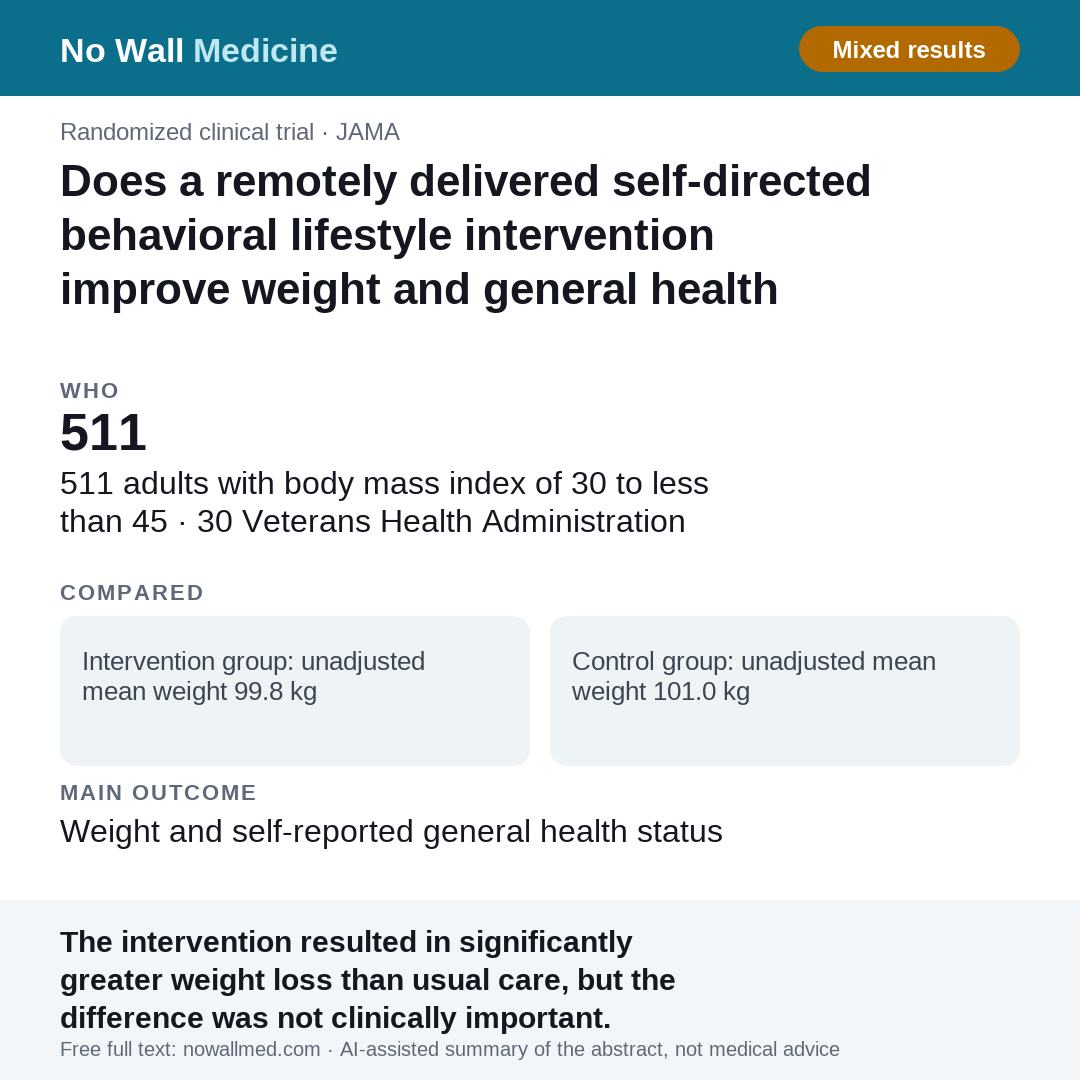
Does a remotely delivered self-directed behavioral lifestyle intervention improve weight and general health status?
Who
511
511 adults with body mass index of 30 to less than 45 · 30 Veterans Health Administration sites
Compared
Intervention group: unadjusted mean weight 99.8 kg
Control group: unadjusted mean weight 101.0 kg
Main outcome
Weight and self-reported general health status
Result: adjusted between-group mean weight difference -1.93 (97.5% CI -3.24 to -0.61)
Bottom line: The intervention resulted in significantly greater weight loss than usual care, but the difference was not clinically important.
JAMA · 2022-12-13Download image
Clinical question: Does a remotely delivered self-directed behavioral lifestyle intervention improve weight and general health status?
Why it matters: The effectiveness of remotely delivered, self-directed weight loss programs in routine clinical practice is largely unknown.
Key points
- The study randomized 511 adults with a body mass index of 30 or more to receive either a remote behavioral lifestyle intervention or usual care.
- At 12 months, the intervention group had an adjusted mean weight difference of -1.93 kg compared to the control group, though this was not a clinically important difference.
- There was no significant difference in self-reported physical health status between the groups, with an adjusted mean difference of 0.69 for the health survey score.
Headline and key points written with AI from the paper’s abstract, with every number checked against it. Read the paper before relying on them.
Topics
Cite this article
Hoerster KD, Hunter-Merrill R, Nguyen T, Rise P, Barón AE, McDowell J. Effect of a Remotely Delivered Self-directed Behavioral Intervention on Body Weight and Physical Health Status Among Adults With Obesity: The D-ELITE Randomized Clinical Trial. JAMA. 2022. doi:10.1001/jama.2022.21177
Spotted a mistake? Suggest a correction