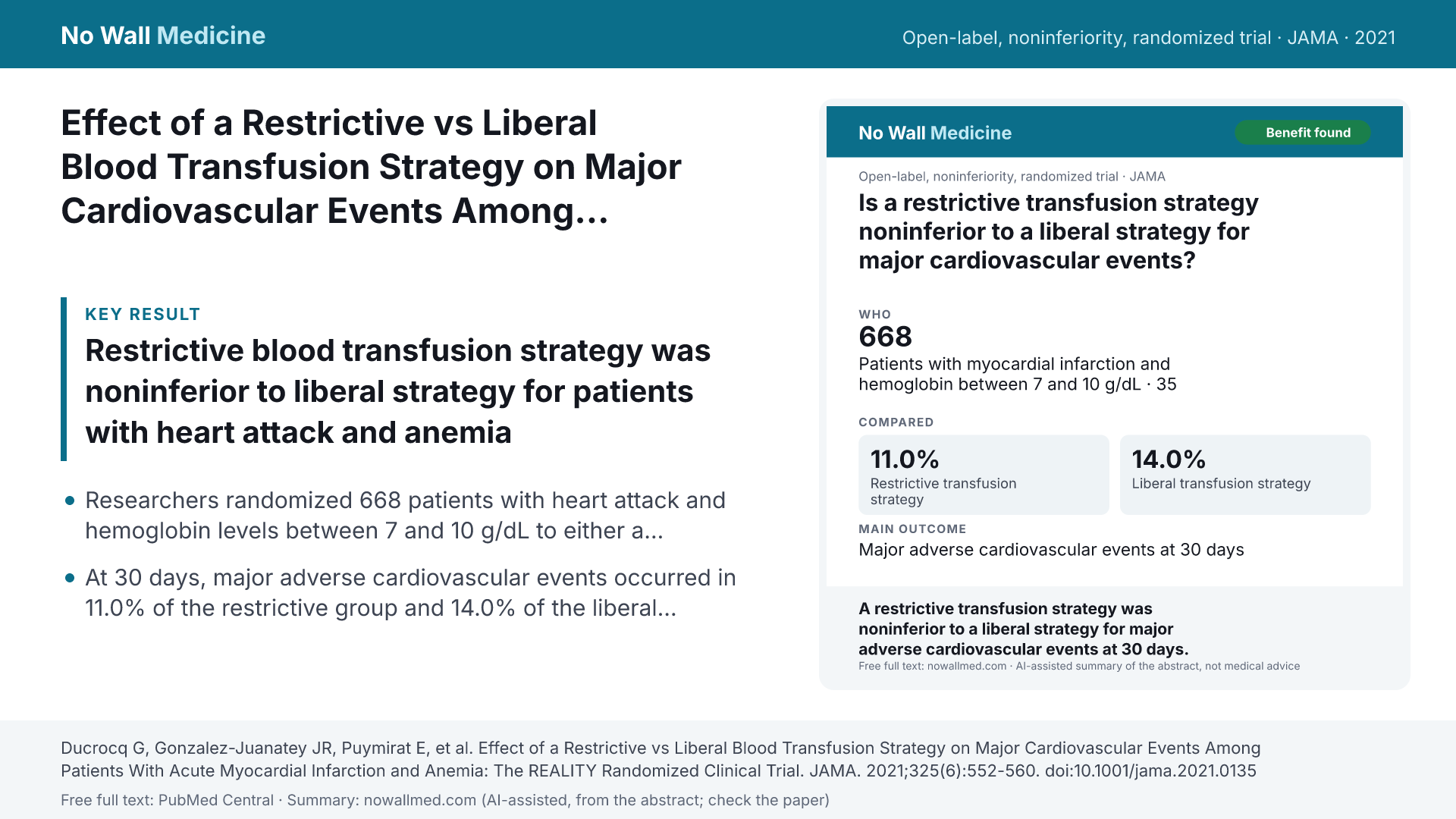
Effect of a Restrictive vs Liberal Blood Transfusion Strategy on Major Cardiovascular Events Among Patients With Acute Myocardial Infarction and Anemia: The REALITY Randomized Clinical Trial
Key result: Restrictive blood transfusion strategy was noninferior to liberal strategy for patients with heart attack and anemia
Key points
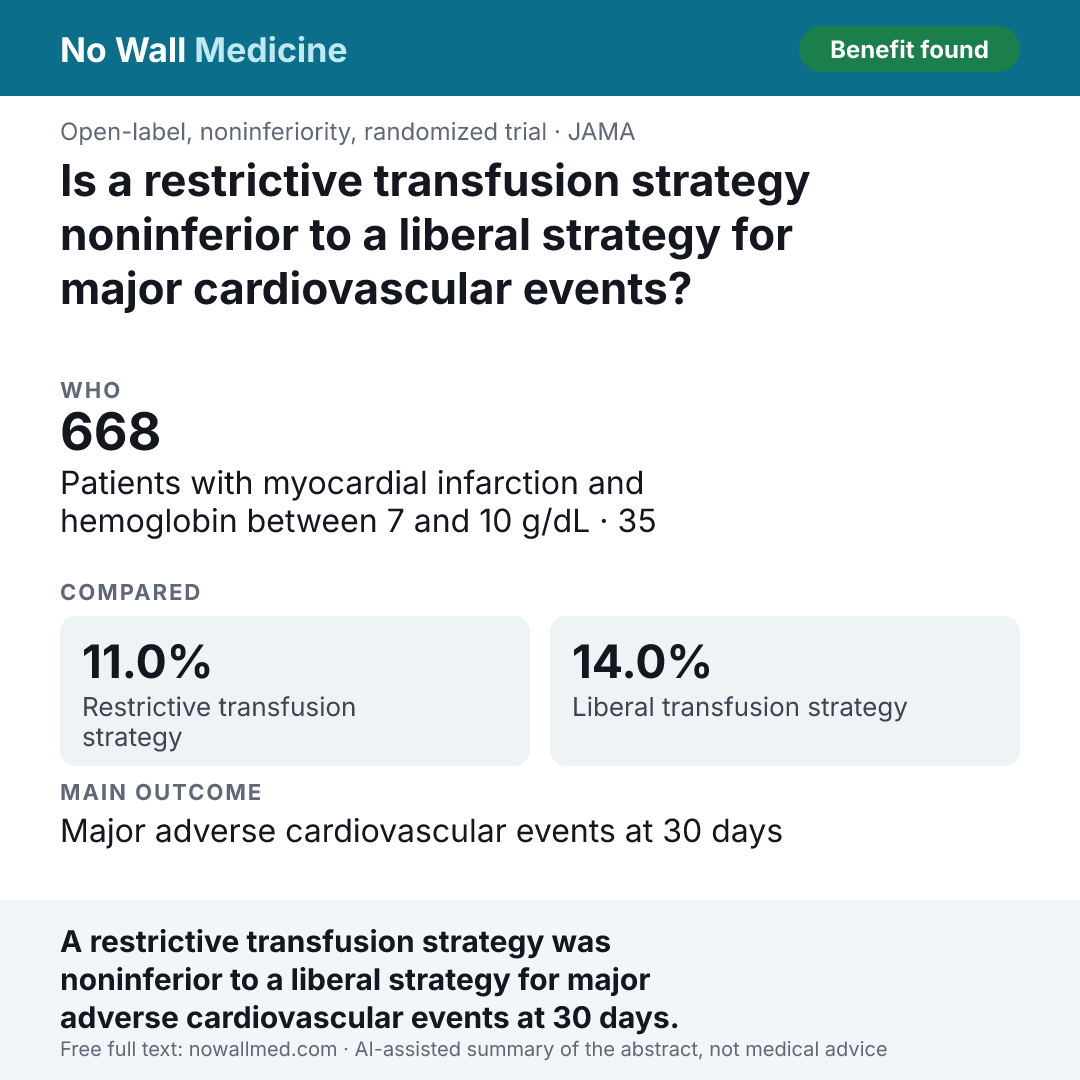
- Researchers randomized 668 patients with heart attack and hemoglobin levels between 7 and 10 g/dL to either a restrictive or liberal blood transfusion strategy.
- At 30 days, major adverse cardiovascular events occurred in 11.0% of the restrictive group and 14.0% of the liberal group, meeting the noninferiority criterion.
- The restrictive group received 342 total units of packed red blood cells, while the liberal group received 758 total units.
Why it matters: The optimal transfusion strategy for patients experiencing a heart attack while also having anemia is currently unclear.
Discussion prompts
- Would these patients look like yours? Who was left out?
- Is the main outcome one that matters to patients?
- Is the difference large enough to change what you do?
Cite: Ducrocq G, Gonzalez-Juanatey JR, Puymirat E, et al. Effect of a Restrictive vs Liberal Blood Transfusion Strategy on Major Cardiovascular Events Among Patients With Acute Myocardial Infarction and Anemia: The REALITY Randomized Clinical Trial. JAMA. 2021;325(6):552-560. doi:10.1001/jama.2021.0135
Free full text: PubMed Central · Summary and visual abstract: nowallmed.com/a/effect-of-a-restrictive-vs-liberal-blood-transfusion-strategy-on-n78duk/ (AI-assisted from the abstract; check the paper before relying on it).