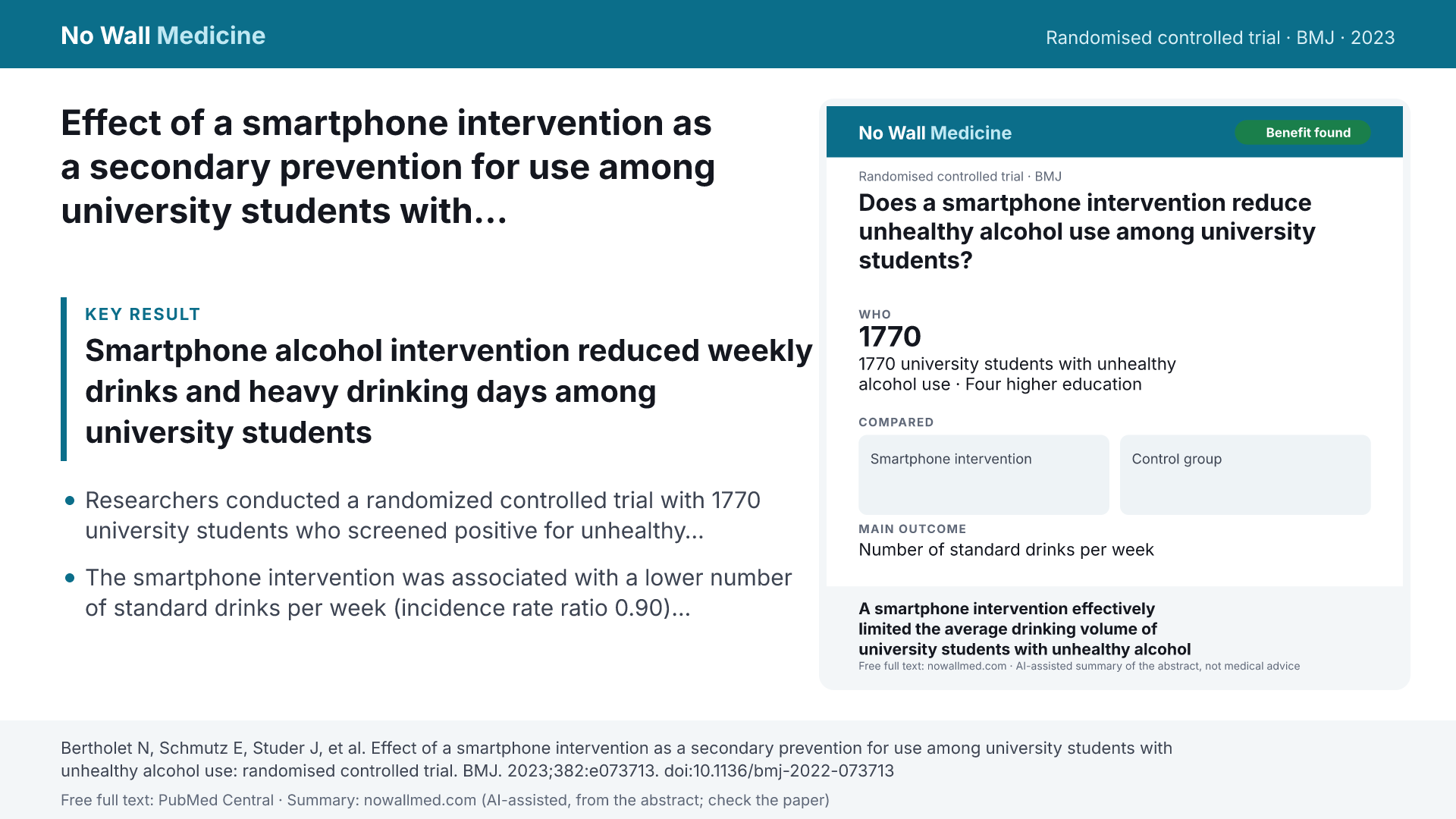
Smartphone alcohol intervention reduced weekly drinks and heavy drinking days among university students
Effect of a smartphone intervention as a secondary prevention for use among university students with unhealthy alcohol use: randomised controlled trial
Randomised controlled trialBenefit found
Does a smartphone intervention reduce unhealthy alcohol use among university students?
Who
1770
1770 university students with unhealthy alcohol use · Four higher education institutions in Switzerland
Compared
Smartphone intervention
Control group
Main outcome
Number of standard drinks per week
Result: incidence rate ratio 0.90 (95% confidence interval 0.85 to 0.96)
Bottom line: A smartphone intervention effectively limited the average drinking volume of university students with unhealthy alcohol use.
BMJ · 2023-08-16Download image
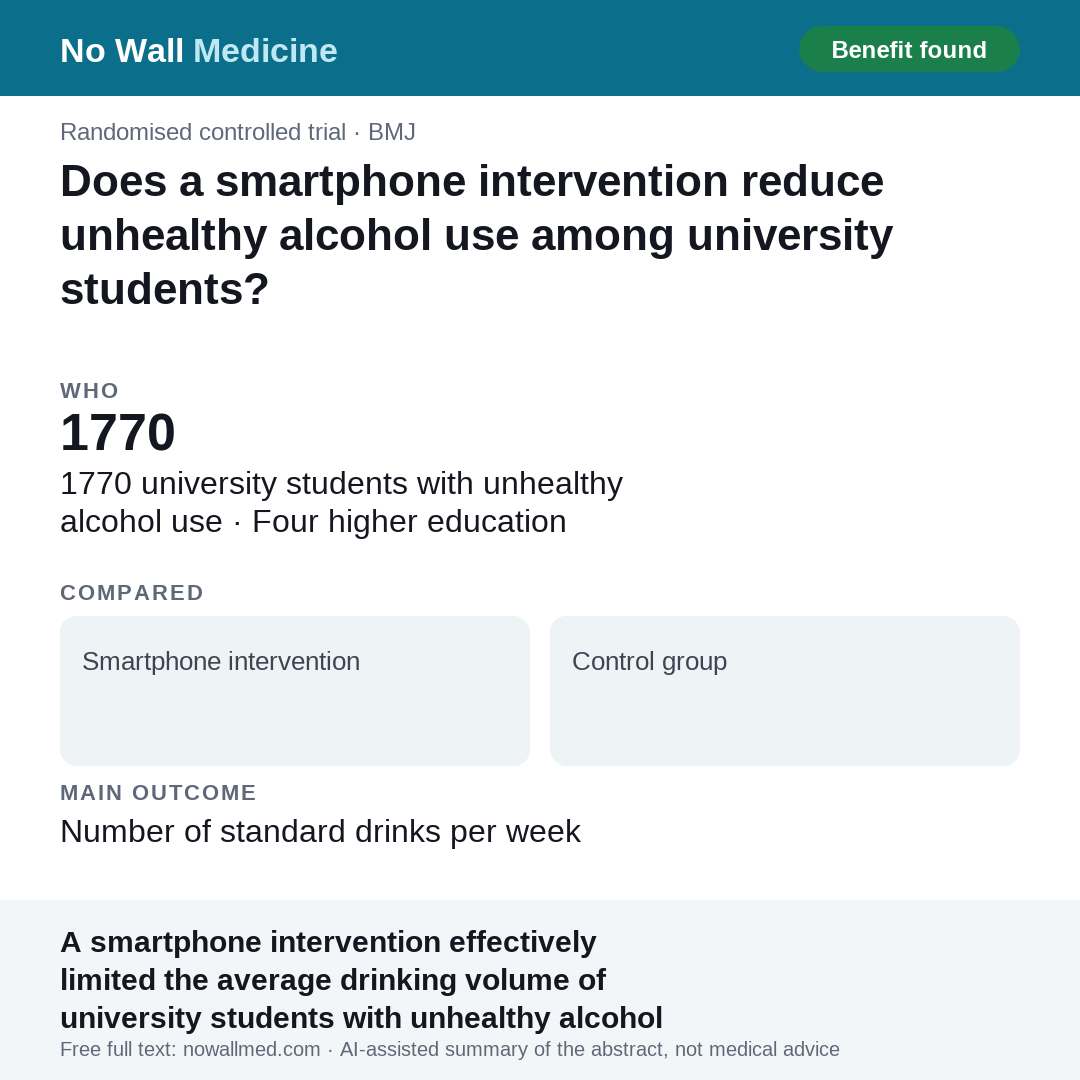
Clinical question: Does a smartphone intervention reduce unhealthy alcohol use among university students?
Why it matters: It is unclear if providing access to a brief, smartphone-based intervention can effectively limit drinking volume in university students with unhealthy alcohol use.
Key points
- Researchers conducted a randomized controlled trial with 1770 university students who screened positive for unhealthy alcohol use.
- The smartphone intervention was associated with a lower number of standard drinks per week (incidence rate ratio 0.90) and fewer heavy drinking days (0.89).
- The smartphone application did not affect academic performance or alcohol-related consequences during the follow-up period.
Headline and key points written with AI from the paper’s abstract, with every number checked against it. Read the paper before relying on them.
Was this summary helpful?
Abstract
Objective
To estimate the effects of providing access to an alcohol intervention based on a smartphone. Design
Randomised controlled trial.. Setting
Four higher education institutions in Switzerland. Participants
1770 students (≥18 years) who screened positive for unhealthy alcohol use (ie, a score on the alcohol use disorders identification test-consumption (AUDIT-C) of ≥4 for men and ≥3 for women) were randomly assigned by 1:1 allocation ratio in blocks of 10. Intervention
Providing access to a brief, smartphone based alcohol intervention. Outcome measures
The primary outcome studied was number of standard drinks per week at six months and the secondary outcome was number of heavy drinking days (past 30 days). Additional outcomes were maximum number of drinks consumed on one occasion, alcohol related consequences, and academic performance. Follow-up assessments occurred at months three, six, and 12. Data were analysed by intention to treat and by using generalised linear mixed models with random intercepts for the recruitment site and participants nested within the recruitment site, and with intervention (v control), time (three months v six months; 12 months v six months), and baseline outcome values as fixed effects. Results
Between 26 April 26 2021 and 30 May 2022, 1770 participants (intervention group (n=884); control group (n=886)) were included. Mean age was 22.4 years (standard deviation 3.07); 958 (54.1%) were women; and 1169 (66.0%) were undergraduate students, 533 (30.1%) were studying for a master's degree, 43 (2.4%) were studying for a doctorate, and 25 (1.4%) were students of other higher education programme. The baseline mean number of standard drinks per week was 8.59 (standard deviation 8.18); the baseline number of heavy drinking days was 3.53 (4.02). Of 1770 participants, follow-up rates were 1706 (96.4%) at three months, 1697 (95.9%) at six months, and 1660 (93.8%) at 12 months. Of 884 students randomly assigned to the intervention group, 738 (83.5%) downloaded the smartphone application. The intervention had a significant overall effect on the number of standard drinks per week (incidence rate ratio 0.90 (95% confidence interval 0.85 to 0.96)), heavy drinking days (0.89 (0.83 to 0.96)), and the maximum number of drinks consumed on one occasion (0.96 (0.93 to 1.00), P=0.029), indicating significantly lower drinking outcomes in the intervention group than in the control group during the follow-up period. The intervention did not affect alcohol related consequences or academic performance. Conclusions
Providing access to the smartphone application throughout the 12 month follow-up was effective at limiting the average drinking volume of university students who had self-reported unhealthy alcohol use at baseline. Trial registration
ISRCTN 10007691.
Abstract reproduced under the article’s CC BY NC licence.
Subject terms
Cite this article
Bertholet N, Schmutz E, Studer J, et al. Effect of a smartphone intervention as a secondary prevention for use among university students with unhealthy alcohol use: randomised controlled trial. BMJ. 2023. doi:10.1136/bmj-2022-073713
Spotted a mistake? Suggest a correction