WeChat-based hybrid intervention improved quality of life and illness acceptance in people living with HIV
Effect of a WeChat-Based Hybrid Intervention on the Adaptation Outcomes of People Living With HIV/AIDS: Pilot Randomized Controlled Trial
Randomized controlled trialBenefit found
Does AiCare improve adaptation outcomes for people with HIV/AIDS?
Who
92
people living with HIV/AIDS in China · HIV clinic in Hunan, China
Compared
Control group
Intervention group
Main outcome
quality of life and acceptance of illness
Result: quality of life increased by 6.35 (95% CI 2.62-10.93)
Bottom line: AiCare improves quality of life and acceptance of illness
J Med Internet Res · 2025-04-03Download image
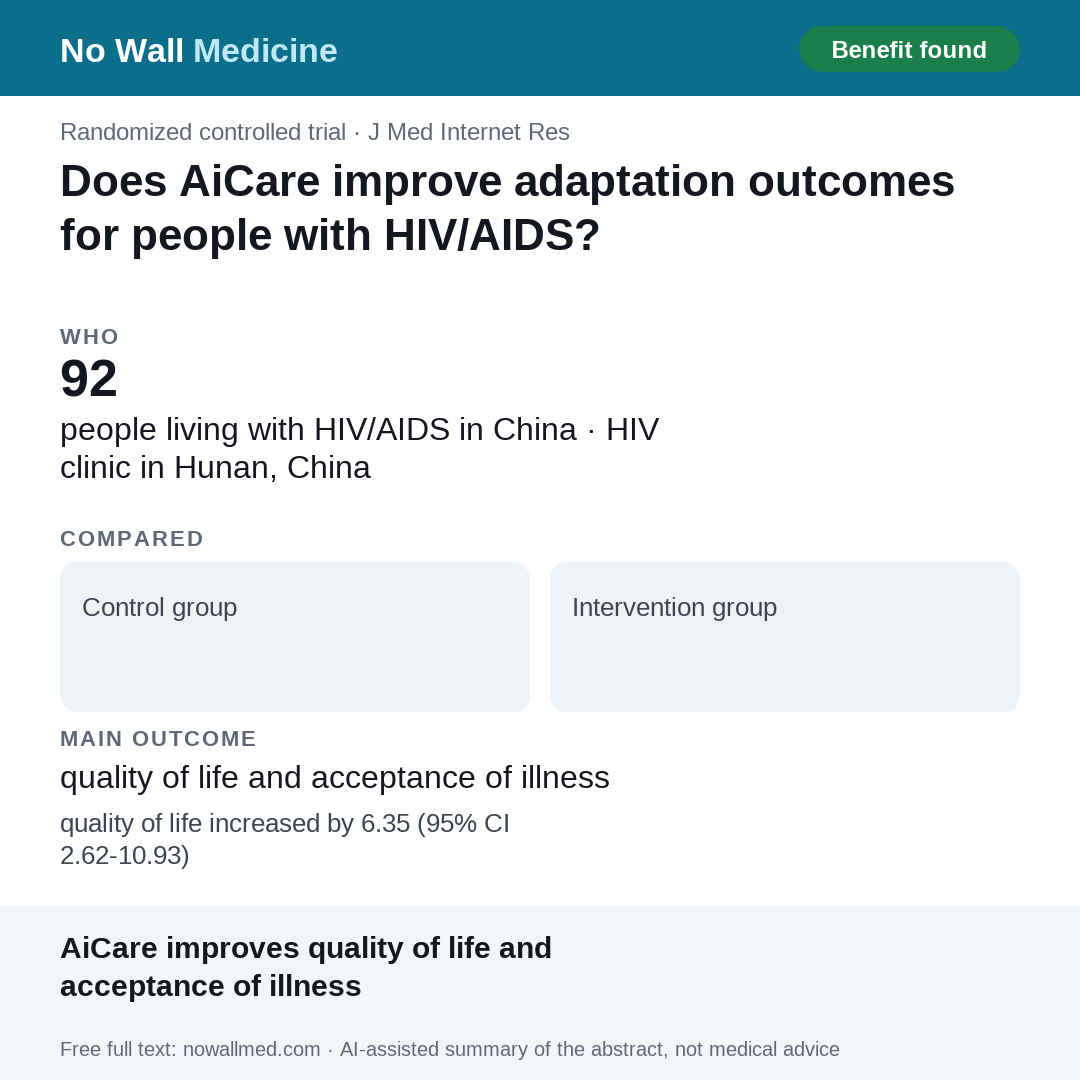
Clinical question: Does AiCare improve adaptation outcomes for people with HIV/AIDS?
Why it matters: Existing evidence often overlooks the interactions among various challenges, such as mental health and medication adherence, that people living with HIV/AIDS encounter.
Key points
- Researchers conducted a randomized controlled trial with 92 people living with HIV/AIDS in China to test the AiCare hybrid intervention.
- Immediately after the intervention, quality of life increased by 6.35, illness acceptance improved by 4.49, and anxiety decreased by 2.15 compared to standard care.
- At 3 months, improvements in illness acceptance and anxiety remained significant, but the change in quality of life was not statistically significant.
Headline and key points written with AI from the paper’s abstract, with every number checked against it. Read the paper before relying on them.
Topics
Cite this article
Wang H, Qin Z, Li Y, Duan Y, Lu Q, Xiao X. Effect of a WeChat-Based Hybrid Intervention on the Adaptation Outcomes of People Living With HIV/AIDS: Pilot Randomized Controlled Trial. J Med Internet Res. 2025. doi:10.2196/65268
Spotted a mistake? Suggest a correction