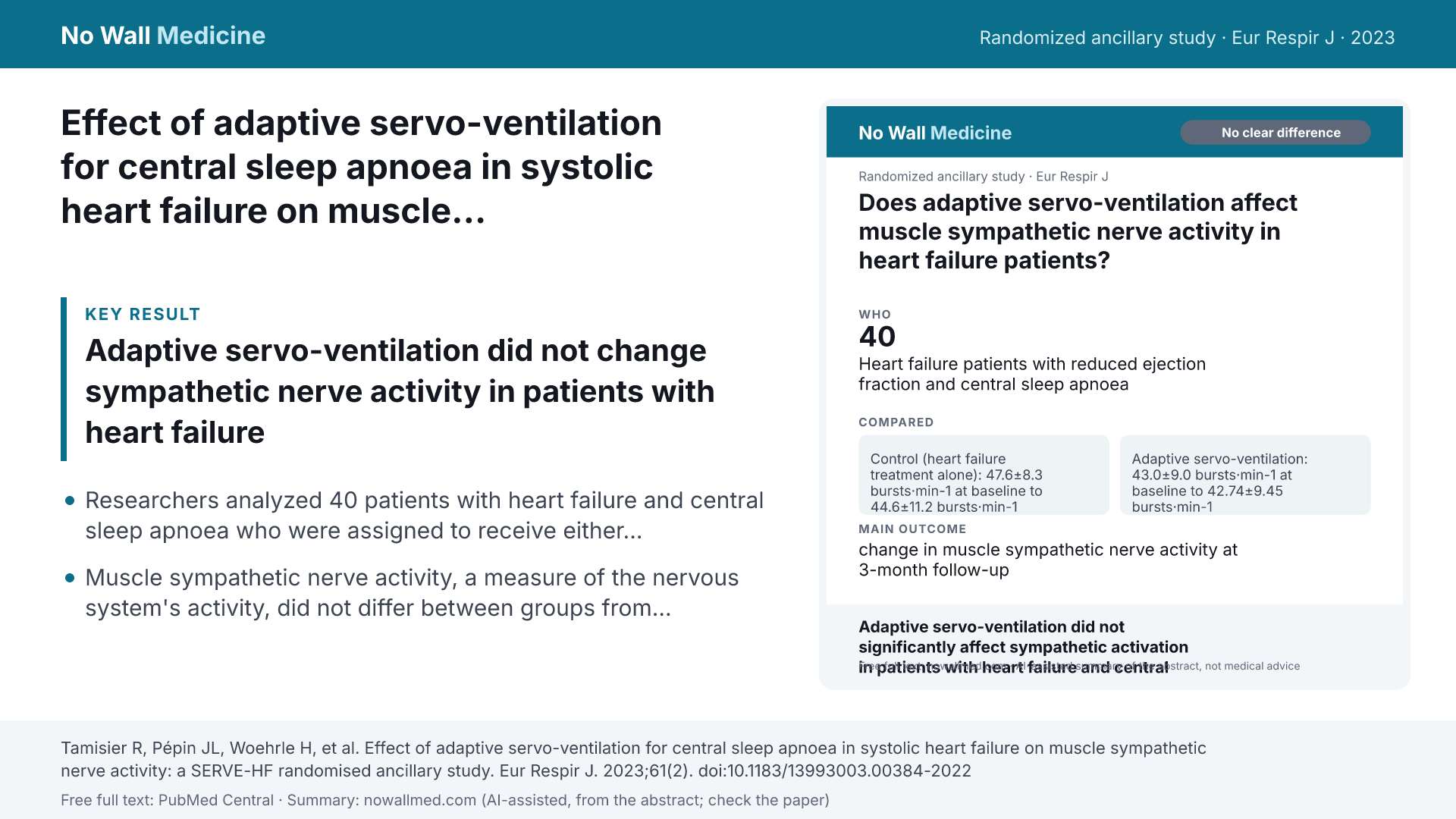
Adaptive servo-ventilation did not change sympathetic nerve activity in patients with heart failure
Effect of adaptive servo-ventilation for central sleep apnoea in systolic heart failure on muscle sympathetic nerve activity: a SERVE-HF randomised ancillary study
Randomized ancillary studyNo clear difference
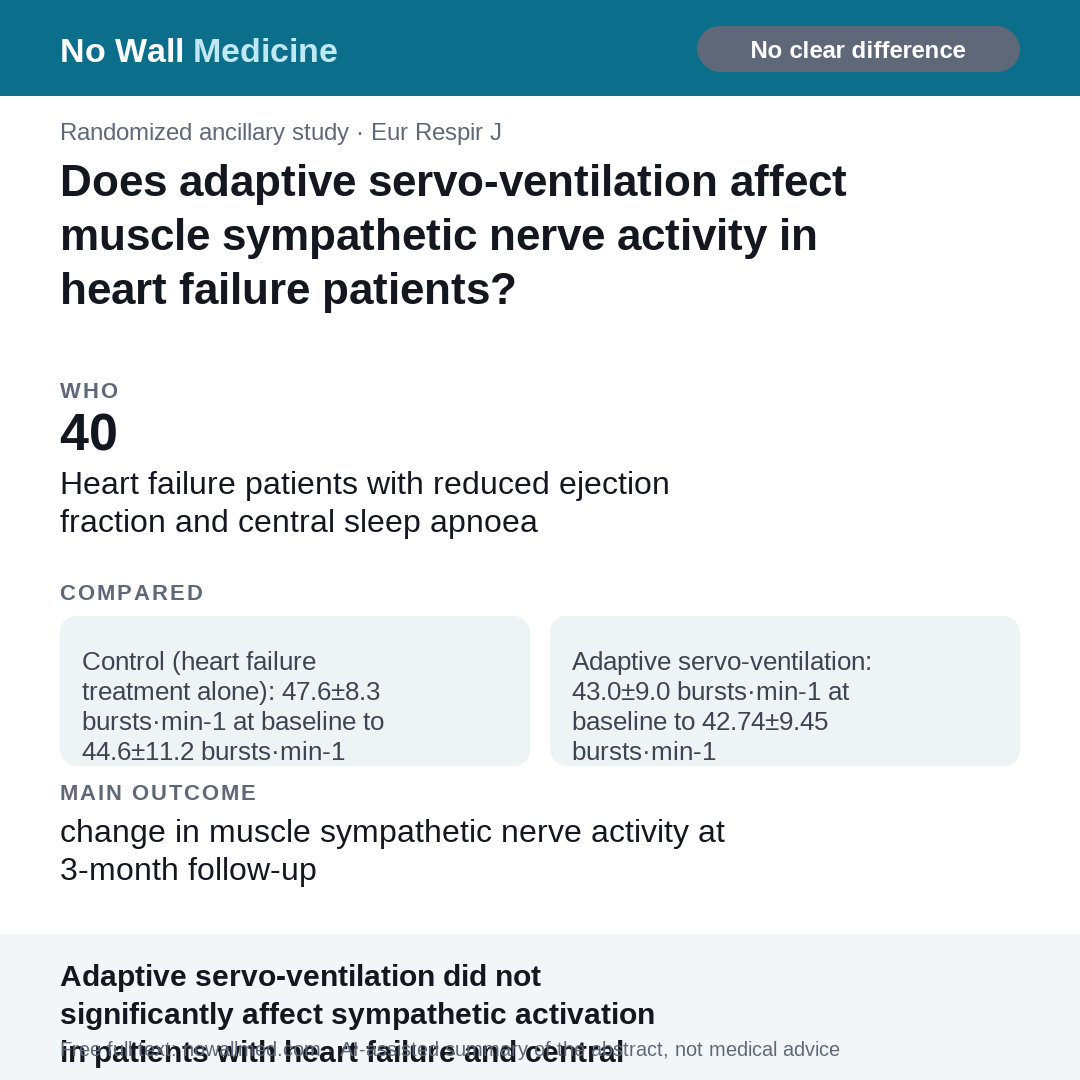
Does adaptive servo-ventilation affect muscle sympathetic nerve activity in heart failure patients?
Who
40
Heart failure patients with reduced ejection fraction and central sleep apnoea
Compared
Control (heart failure treatment alone): 47.6±8.3 bursts·min-1 at baseline to 44.6±11.2 bursts·min-1
Adaptive servo-ventilation: 43.0±9.0 bursts·min-1 at baseline to 42.74±9.45 bursts·min-1
Main outcome
change in muscle sympathetic nerve activity at 3-month follow-up
Bottom line: Adaptive servo-ventilation did not significantly affect sympathetic activation in patients with heart failure and central sleep apnoea.
Eur Respir J · 2023-02-09Download image
Clinical question: Does adaptive servo-ventilation affect muscle sympathetic nerve activity in heart failure patients?
Key points
- Researchers analyzed 40 patients with heart failure and central sleep apnoea who were assigned to receive either standard treatment or standard treatment plus adaptive servo-ventilation.
- Muscle sympathetic nerve activity, a measure of the nervous system's activity, did not differ between groups from baseline to the 3-month follow-up.
- A reduction in sympathetic nerve activity was associated with increased cardiovascular mortality in the adaptive servo-ventilation group, while it appeared protective in the control group.
Headline and key points written with AI from the paper’s abstract, with every number checked against it. Read the paper before relying on them.
Was this summary helpful?
Subject terms
Cite this article
Tamisier R, Pépin JL, Woehrle H, et al. Effect of adaptive servo-ventilation for central sleep apnoea in systolic heart failure on muscle sympathetic nerve activity: a SERVE-HF randomised ancillary study. Eur Respir J. 2023. doi:10.1183/13993003.00384-2022
Spotted a mistake? Suggest a correction