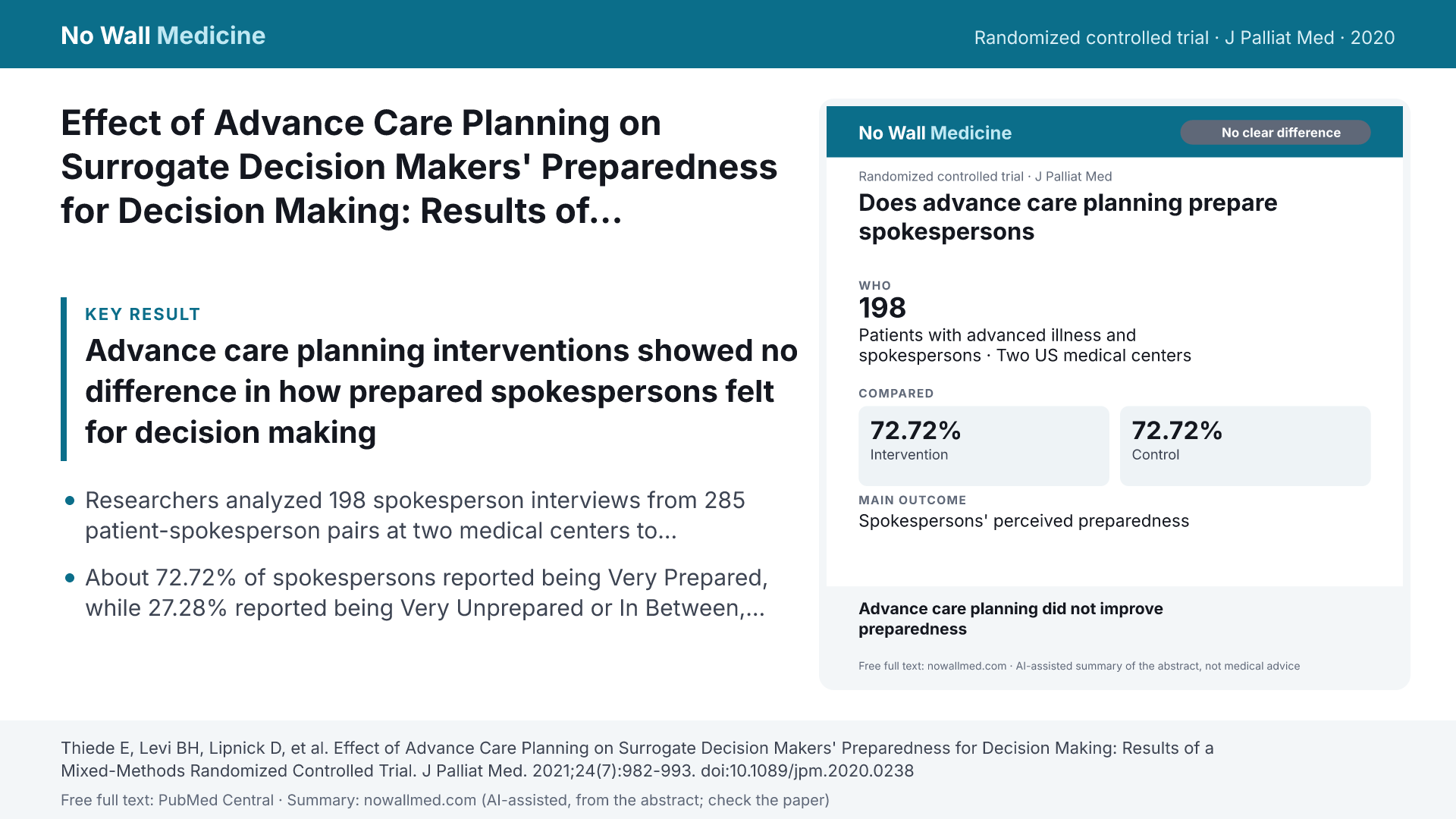
Advance care planning interventions showed no difference in how prepared spokespersons felt for decision making
Effect of Advance Care Planning on Surrogate Decision Makers' Preparedness for Decision Making: Results of a Mixed-Methods Randomized Controlled Trial
Randomized controlled trialNo clear difference
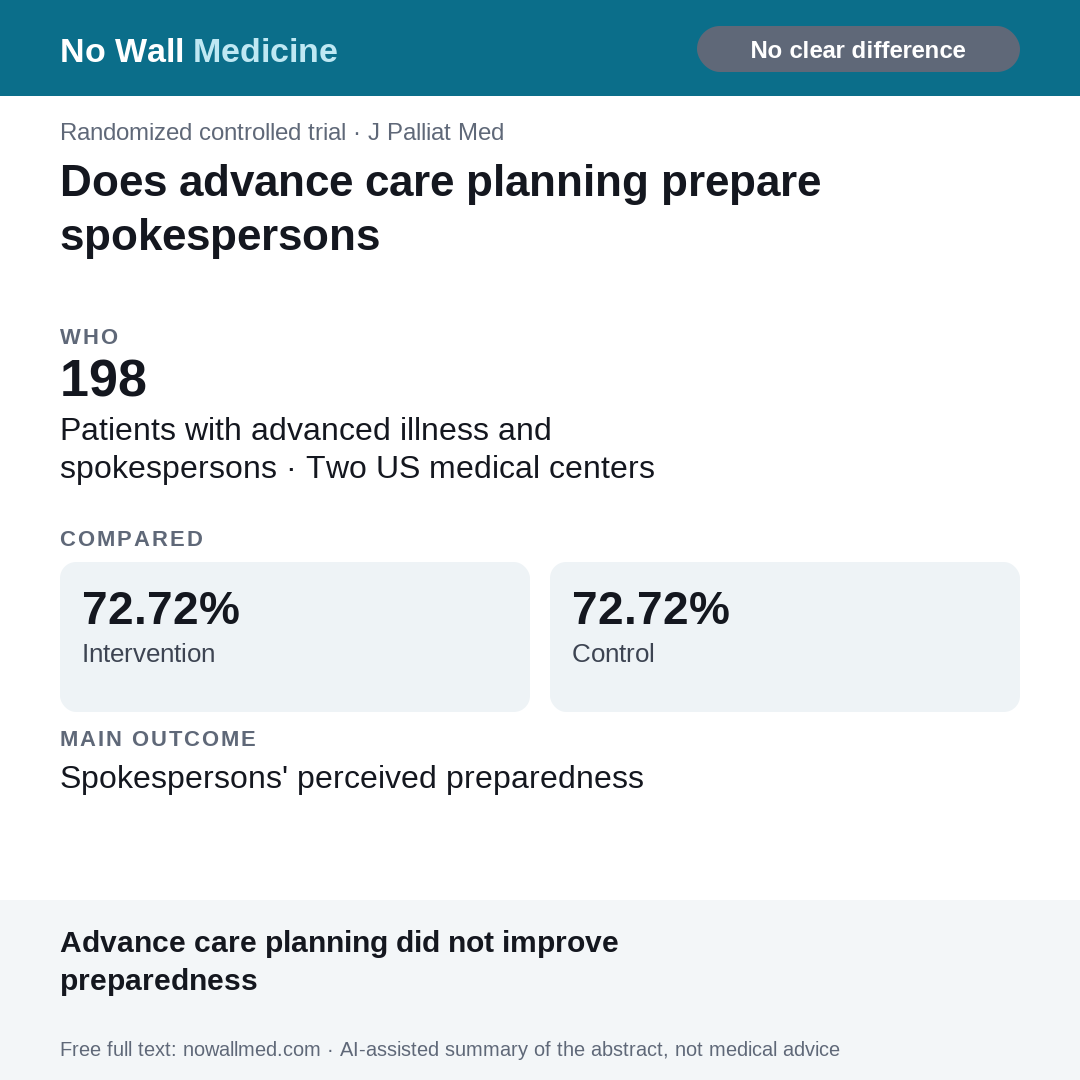
Does advance care planning prepare spokespersons
Who
198
Patients with advanced illness and spokespersons · Two US medical centers
Compared
72.72%Intervention (144/198)
72.72%Control (144/198)
Main outcome
Spokespersons' perceived preparedness
Bottom line: Advance care planning did not improve preparedness
J Palliat Med · 2020-12-29Download image
Why it matters: It is unknown what factors influence the extent to which spokespersons feel prepared to make end-of-life decisions for patients with advanced illness.
Key points
- Researchers analyzed 198 spokesperson interviews from 285 patient-spokesperson pairs at two medical centers to assess preparedness for end-of-life decisions.
- About 72.72% of spokespersons reported being Very Prepared, while 27.28% reported being Very Unprepared or In Between, with no differences found across study arms.
- The occurrence of conversations after the intervention was not linked to perceived preparedness, though spokespersons using a decision aid reported more conversations.
Headline and key points written with AI from the paper’s abstract, with every number checked against it. Read the paper before relying on them.
Was this summary helpful?
Subject terms
Cite this article
Thiede E, Levi BH, Lipnick D, Johnson R, Seo La I, Lehman EB. Effect of Advance Care Planning on Surrogate Decision Makers' Preparedness for Decision Making: Results of a Mixed-Methods Randomized Controlled Trial. J Palliat Med. 2020. doi:10.1089/jpm.2020.0238
Spotted a mistake? Suggest a correction