Mobile app guidance showed no difference in team performance during simulated cardiac arrest scenarios
Effect of an app-guided advanced cardiac life support algorithm on teamwork, non-technical skills, and workload in simulated in-hospital cardiac arrest: a randomized controlled feasibility trial
Randomized, simulation-based controlled feasibility trialNo clear difference
Does an app-guided advanced cardiac life support algorithm improve teamwork, skills, and workload?
Who
80
40 interprofessional teams of healthcare professionals · Simulated in-hospital cardiac arrest scenarios
Compared
CPR Leader app group: mean NASA-TLX score 49.2 ± 13.6
Control group: mean NASA-TLX score 54.1 ± 14.6
Main outcome
Team performance, non-technical skills, and subjective workload
Bottom line: The resuscitation support application did not improve performance or workload compared to standard practice in experienced professionals.
Limitation: Findings may not generalize to novice providers, mixed-experience teams, or real-world clinical practice.
Scand J Trauma Resusc Emerg Med · 2026-08-12Download image
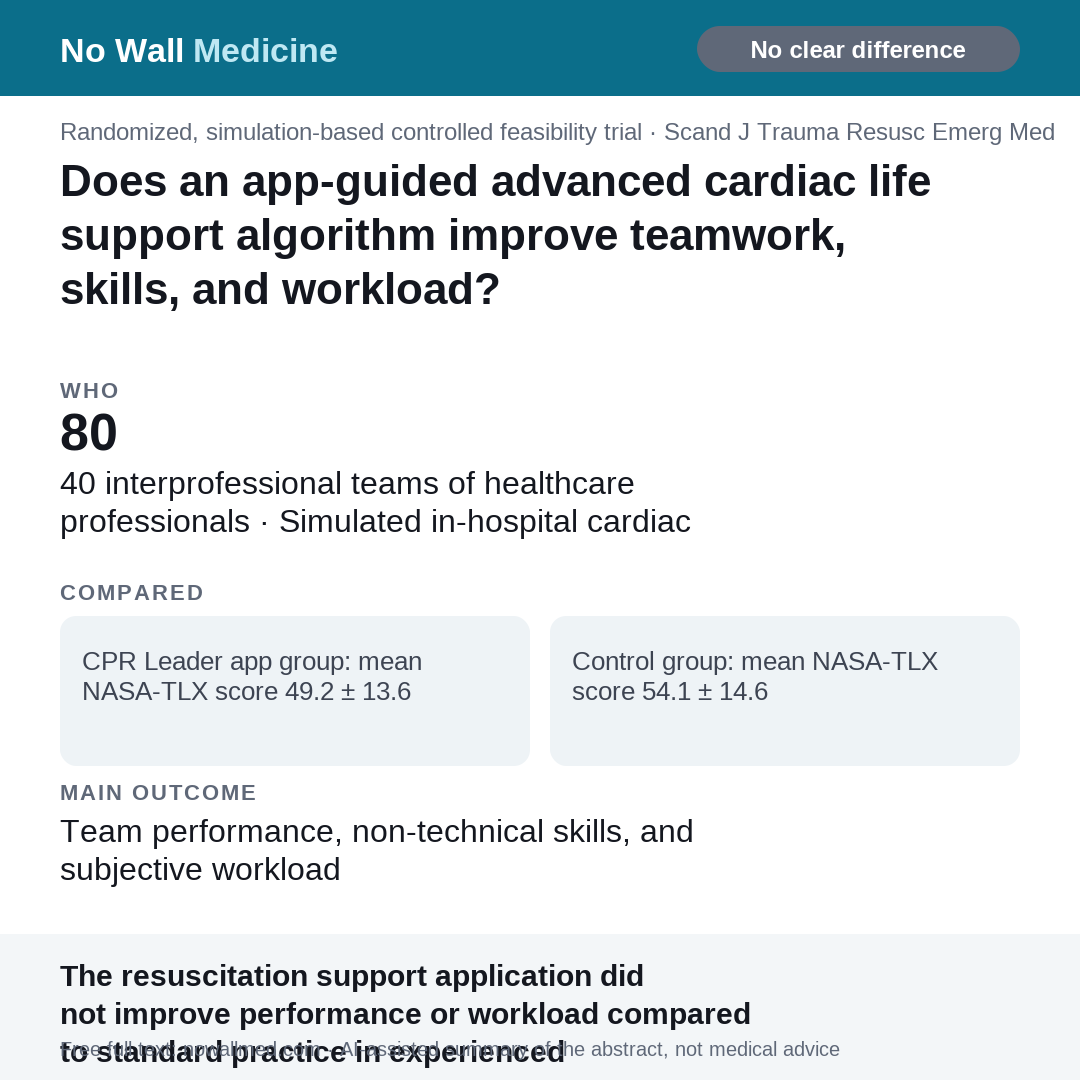
Clinical question: Does an app-guided advanced cardiac life support algorithm improve teamwork, skills, and workload?
Why it matters: The impact of digital decision-support tools on cognitive workload, team performance, and advanced life support performance remains uncertain.
Key points
- Researchers conducted a randomized feasibility trial with 40 interprofessional teams, totaling 80 participants, comparing advanced life support performance with and without the CPR Leader app.
- The app was not associated with differences in team performance, non-technical skills, or subjective workload, with NASA-TLX scores being 49.2 ± 13.6 for the app group and 54.1 ± 14.6 for the control group.
- Resuscitation metrics such as time to rhythm analysis, defibrillation, and medication administration were similar between the two groups.
Limitation the authors note: The study involved predominantly experienced healthcare professionals and results should not be generalized to novice providers, mixed-experience teams, prehospital settings, or training environments.
Headline and key points written with AI from the paper’s abstract, with every number checked against it. Read the paper before relying on them.
Topics
Cite this article
Kamphausen A, Pilz M, Baumgärtel M, Kubitz JC, Engelen C. Effect of an app-guided advanced cardiac life support algorithm on teamwork, non-technical skills, and workload in simulated in-hospital cardiac arrest: a randomized controlled feasibility trial. Scand J Trauma Resusc Emerg Med. 2026. doi:10.1186/s13049-026-01673-7
Spotted a mistake? Suggest a correction