Emergency department process improvements were associated with fewer suicide-related behaviors in a randomized trial
Effect of an Emergency Department Process Improvement Package on Suicide Prevention: The ED-SAFE 2 Cluster Randomized Clinical Trial
Stepped-wedge cluster randomized clinical trialBenefit found
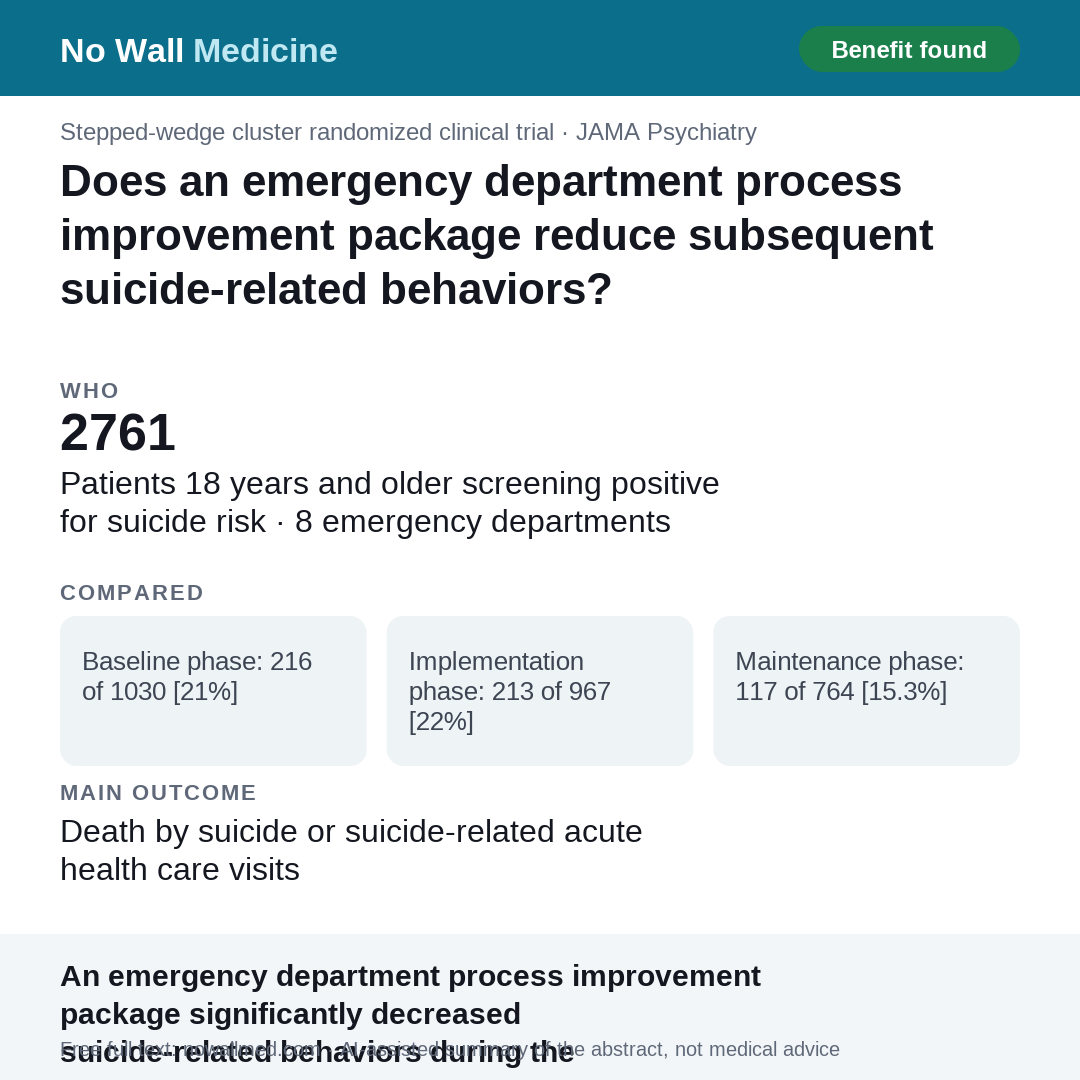
Does an emergency department process improvement package reduce subsequent suicide-related behaviors?
Who
2761
Patients 18 years and older screening positive for suicide risk · 8 emergency departments across the United States
Compared
Baseline phase: 216 of 1030 [21%]
Implementation phase: 213 of 967 [22%]
Maintenance phase: 117 of 764 [15.3%]
Main outcome
Death by suicide or suicide-related acute health care visits
Result: adjusted odds ratio 0.57 (95% CI, 0.43-0.74) compared with baseline
Bottom line: An emergency department process improvement package significantly decreased suicide-related behaviors during the maintenance phase of the study.
JAMA Psychiatry · 2023-05-17Download image
Clinical question: Does an emergency department process improvement package reduce subsequent suicide-related behaviors?
Why it matters: Emergency department interventions for suicide prevention remain underdeveloped and understudied despite suicide being a leading cause of death.
Key points
- Researchers studied 2761 patient encounters across 8 emergency departments using a stepped-wedge cluster randomized clinical trial design.
- During the maintenance phase, the rate of suicide-related composite outcomes was 15.3% compared to 21% at baseline and 22% during implementation.
- The maintenance phase showed a 43% reduction in the risk of suicide-related composite outcomes compared to baseline and a 39% reduction compared to implementation.
Headline and key points written with AI from the paper’s abstract, with every number checked against it. Read the paper before relying on them.
Was this summary helpful?
Subject terms
Cite this article
Boudreaux ED, Larkin C, Vallejo Sefair A, Ma Y, Li YF, Ibrahim AF. Effect of an Emergency Department Process Improvement Package on Suicide Prevention: The ED-SAFE 2 Cluster Randomized Clinical Trial. JAMA Psychiatry. 2023. doi:10.1001/jamapsychiatry.2023.1304
Spotted a mistake? Suggest a correction
Top studies every Monday
The week’s key trials and guidelines in your specialties, plus any topics you follow. By email, free.
Get the weekly digest